

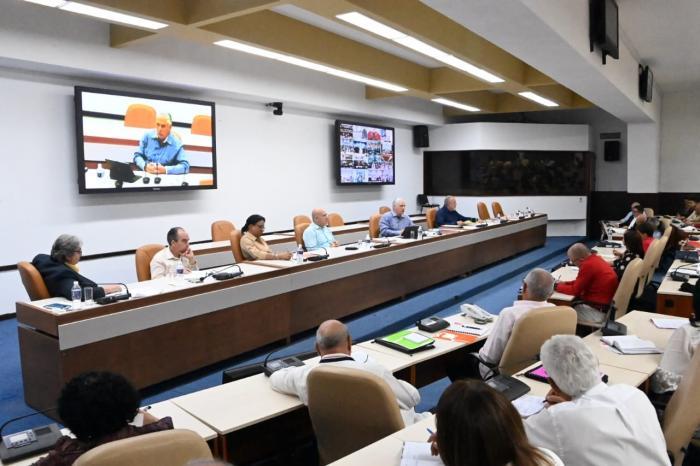
"Let's make the communication that this time needs", was heard towards the final words of the balance report of the Institute of Information and Social Communication (ICS), held yesterday afternoon, at the Palace of the Revolution, in the presence of Miguel Díaz-Canel Bermúdez, First Secretary of the Central Committee of the Communist Party of Cuba and President of the Republic; members of the Political Bureau Manuel Marrero Cruz, Prime Minister, and Roberto Morales Ojeda, Secretary of Organization of the Central Committee; and other leaders.
Just that was the essence of the words addressed by President Díaz-Canel, by way of conclusion, to that group of cadres and workers who make up the human force of the young institute that, in 2023, faced a double challenge: the entry into operation of the new agency of the Central State Administration, as well as sustaining the vitality of radio and television from its public service assignment.
The Cuban President addressed core issues related to social communication, in every sense of the word, before an audience that followed each of his remarks and on more than one occasion applauded his words. Having finished listening to the paths through which the ICS has been advancing -which counts, among the most significant of the period, with the approval of the Social Communication Law and the development of its regulatory provisions, as well as the maintenance of the activity of a hundred radio stations and 42 channels- Díaz-Canel commented that, in the country, we are facing a different moment of Social Communication, because there are structures, work teams, communication strategies, and although some are more coherent than others, the projects have at least one approach from the communication point of view.
Based on the participants' own interventions, the Head of State referred to the need to also talk about political communication, and considered, as was defended in the debate, of great importance to educate, for communication, the managers and the population. "I think it is a cross-cutting issue. And we have to educate everyone, because everyone is participating in communication. Social networks today make everyone a user, but also a communicator. Bearing in mind also that we have to distinguish them, social networks are a platform of cultural colonization in which we have to be with our contents, but it is not to be colonized, but to counteract that colonization", he explained. Achieving compliance with the Communication Law and functioning as ICS, and not as the Cuban Institute of Radio and Television -the institution that preceded the current institute- is vital, he said.
Referring to an intervention by filmmaker Magda González Grau, the President praised the suggestive and mobilizing power of stories well told and defended with quality, and alluded to the addict character in the soap opera Viceversa. "The role that the young man is playing is one of the best messages, in these times, regarding the harm of addictions", he acknowledged, and with respect to the dramatization, he distinguished that it does not hide our reality, transmits values, and highlights figures of our society that at other times have not been in these spaces.
Once again, President Díaz-Canel urged to close the way to sloppiness, banality and vulgarity in our media, and to defend what is Cuban in our productions, without denying what is universal. He stressed the importance of improving the quality of audiovisual production, "which is today the communicational code with which we can reach the people the most".
With respect to community communication, a topic that was addressed in several speeches, the president proposed to go deeper. "We must have a different vision regarding community communication, which is not only community communication from the media, but community communication as a social process, he reasoned."
THE UNITED STATES AND ITS OBSESSIONS WITH A CUBA THEY WILL NOT HAVE
In his speech, the First Secretary of the Party did not fail to denounce the propagandistic and inciting articulation of the enemies of the Revolution, in their eagerness to generate a social explosion and the destabilization of the country, exacerbated by the claim, last Sunday, of a group of citizens in Santiago de Cuba and Bayamo.
"To describe today what we are subjected to as a nation, I would say that there are two elements that are being combined from the logic of the United States Government: on the one hand, economic asphyxiation, and on the other hand, media intoxication. Economic asphyxiation, with the tightening of the blockade and the inclusion of Cuba on the list of countries that supposedly support terrorism", of which, he said, "we have not yet been able, no matter how much we have explained, to really explain to the Cuban population what it means to be included on that list, which is the most restrictive of all. And with all that combination, then to propitiate the social outburst", he said, and understood what happened this Sunday as an example of what media intoxication is.
Díaz-Canel declared that, immediately, a very large articulation of inciters appeared, of politicians who were made to play a big role, because they denounced facts that had not occurred. The U.S. embassy offered an interfering, hypocritical, arrogant message, and well-known terrorists began to give formulas on how to act aggressively in Cuba. Fake news and images with artificial intelligence, lies, false videos, constructions, the transmission of supposed direct transmissions from the places where the events were supposed to be happening, which maintained as a line that things were happening, when in those places there was total normality.
In view of what really happened -explained the President-, the leaders talked to the people, and things were clarified and they returned to their places, some stayed longer. "What there was was dialogue with those who were there, and that is legitimate. We also understand that, with the harshness that is being experienced in the current times, people have to have dissatisfactions, but they also have to know what is being done, because here there is no one standing idle, here every day most of the time is being devoted to see how we find solutions," he said. Díaz-Canel mentioned that we have problems of economic efficiency, of national production, but that we are very far from that being the fundamental cause of what is happening to us.
"They were desperate for there to be a social outburst in Cuba yesterday, and they did not succeed. They did not succeed because we worked with unity, we worked as we do politics, taking into account history, taking into account the Law, which is fair, and taking into account the truth, and explaining the truth to the people, and facing with the truth the doubts that the population might have," said the Cuban President.
Díaz-Canel understood what happened as "another moment of preparation and learning to further articulate the revolutionary forces and to continue facing all that set-up of economic asphyxiation and media intoxication". On this occasion, "the purposes, the perversity, the contempt of the government of the United States for the people of Cuba, and the contempt for the Cuban Revolution, and the contempt because we want to be free, sovereign, independent, and to have our self-determination", he affirmed.
The President ratified what he expressed in response to the event in his X account, in which he certified all the willingness of the Cuban Government, of the Party, of our institutions, to dialogue with our population, to explain, to summon, to unite, to work, to continue searching, with our own efforts and with our own talent, for solutions to the difficult situation we are living.
In a brief speech, Prime Minister Manuel Marrero Cruz referred to the war economy scenario we are living as a nation, and highlighted, given the current context, the importance of the work of communicators. The country's leadership also counts on this team of communicators to move forward, he said before an audience that, judging by the critical look of their assessments, the strength of their projections and sustained commitment, will give the battle for Cuba, as it should.


