

The naturalness with which they raise their voice in order to silence hers, the frequency with which others decide what she should do without consulting her, or the subtle way in which some believe she is incapable of grasping certain ideas still surprises her. But what astonishes her most of all is that no one seems to perceive a single hint of violence in any of these actions.
Its is a known fact that in Cuban society acts of extreme violence such as physical abuse and female homicide are unusual and strongly condemned from a legal and social point of view. Despite this, governmental institutions, mass organizations and professionals continue to work to generate awareness around an issue with strong cultural roots which extend across the entire planet.
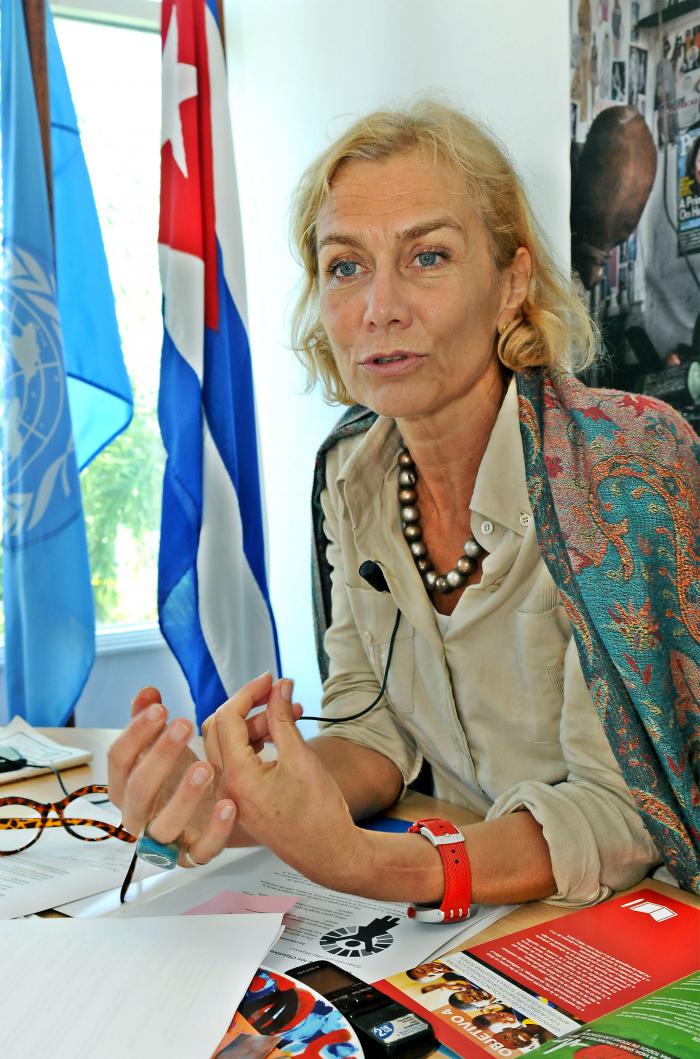
”Violence against women is a universal problem,” notes Myrta Kaulard, United Nations resident coordinator in Cuba, “It’s not just a matter for developing countries. The figures are astounding and it’s important to mention them, because they highlight the importance of the problem.”
Citing statistics during a conversation with Granma International, the UN representative revealed that one in every two women in the world is a victim of violence, whether it be physical, physiological or another form. Another equally worrying figure is that 70% of women suffer physical or sexual abuse at the hands of a partner. Female homicides are often committed by a partner.
”This is the other facet of violence against women: it can be a very personal problem, which victims don’t want to talk about.”
WOMEN & GIRLS IN A SUSTAINABLE WORLD
On September 25, 2015, the United Nations approved its Sustainable Development Goals (SDG) for the next 15 years, a program which includes 17 objectives and 169 goals. The document puts special emphasis on women and girls, as outlined in point five: Achieve gender equality and empowerment of all women and girls.
“Each one of the 17 objectives makes strong reference to women and gender equality, rights, access to opportunities and benefits,” notes Myrta Kaulard. “This is because women and girls are recognized as a fundamental element to achieving the SDGs; to ensuring our wellbeing and that of future generations, and that all people, no matter their gender or sexual orientation, might have equal access and opportunities,” she commented.
Reaching this goal over the coming years is a considerable challenge, both for governmental and international institutions responsible for ensuring that objectives are fulfilled, which is why specific aims explicitly defining the actions that must be undertaken have been presented.
“The first is to put an end to all forms of discrimination against women and girls around the world. The other is to eliminate all forms of violence against women and girls. This is directly linked to the Únete (UNiTE) campaign and commitment to eradicate violence in both public and private spaces. This is the development framework universally adopted by all countries,” states the resident coordinator.
A SUCCESSFUL CAMPAIGN TO DATE
In 1999, November 25 was designated United Nations International Day for the Elimination of Violence against Women. Less than a decade later (2008), UN Secretary-General Ban Ki-moon, launched the global UNiTE campaign to put an end to violence against women and girls.
This initiative is based on three central pillars - end impunity, not one more, and universal responsibility - and has achieved significant results in just over five years.
”Its achievements include growing social recognition of the problem of violence against women and girls. Over 60 countries have announced specific measures to prevent and tackle the issue,” states Myrta Kaulard.
More than 30 countries in Latin America and the Caribbean are working on the three campaign pillars, highlights the UN representative. A number of important countries in the region have also passed laws relating to violence against women, or have modified their legislative frameworks in order to provide a legal response to the phenomenon.
However, the struggle against this scourge isn’t limited to November. In 2012 the camping’s Global Youth Network proposed making the 25th of every month Orange Day, as a way of calling to attention to the problem and stressing the need to for a commitment to action in order to solve it, on a regular basis.
CUBA, A DIFFERENT REALITY
One of Myrta Kaulard’s personal anecdotes shows how different the Cuban context is, “I have worked in countries where women have reported what has happened to them, but later the husband finds out and becomes even more violent. Or she doesn’t know where to go to get protection.”
Since the very first years of the triumph of the Revolution, the Cuban government has made important efforts to promote female empowerment and recognize women as social subjects, which has resulted in the creation of a broad system of laws ranging from the constitution to family and labor codes.
“Its important to create commitments which recognize and act to protect victims of violence, which are effective, and know how to communicate, which address the issue with care, intelligence, but at the same time carry out concrete actions. Staying silent is not the solution,” stresses Kaulard.
It would be unforgivable in this article, not to highlight the efforts of institutions, organizations and associations, such as the Federation of Cuban Women and editorial Mujeres; the National Center for Sex Education; National Union of Lawyers; Latin American and African Network to address Masculinity; Oscar Arnulfo Romero Reflection and Solidarity Group and All women against the stream campaign.
Various Cuban artists and sports personalities have also joined the Únete campaign to end violence against women.
Of equal importance to the work undertaken by each one of these social actors is the need to raise awareness of this issue among youth, to contribute to the development of individuals who in the future, according to Myrta Kaular, might not have to face this type of problem and could create their own solutions to the issue. This is just one of the many possible routes that can be taken to create a sustainable world free from violence against women.


