

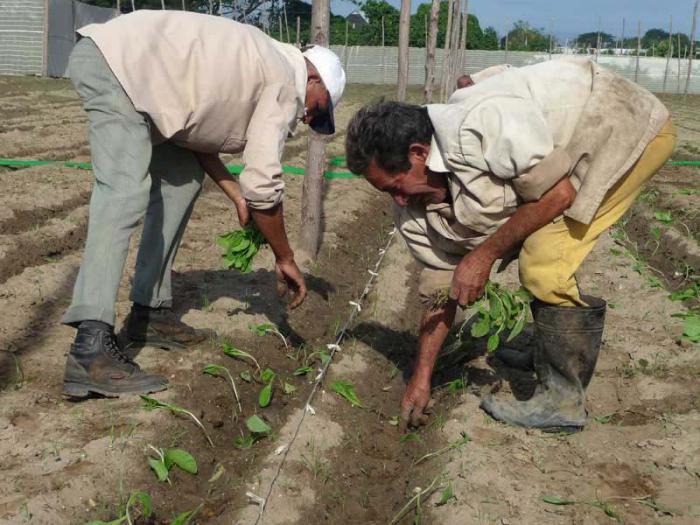
Given that the agriculture and livestock sector is one of the sore spots of the Cuban economy - due to the strain its puts on the nation’s economy and the high level of imports - promoting financial support for its various branches of production is an urgent priority. In this effort, Cuban banks have a defining role to play. Directors from the Popular Savings (BPA), Metropolitan (Banmet) and Credit and Commerce (Bandec ) banks spoke with the press on November 19 in order to give an update on what has been done thus far and future plans for providing finance to the sector.
According to Manuel Tejeda Díaz, director of Bandec’s Agriculture and Livestock Business Bank, the institution has granted loans to over 52,000 sector entities, among them state organizations, all forms of agriculture and livestock cooperatives, as well as farmers, landowners and usufruct producers.
The bulk of these credits granted by the country’s leading agricultural bank are linked to marketing, production and investment, primarily for produce such as sugar cane, grains, tobacco, milk and meat, among others, he highlighted. These loans constitute 81% of the bank’s entire credit portfolio, and benefit over 40,000 farmers. 40% of loans go to grain producers, followed by tobacco and sugar cane.
Since new prices for supplies came into effect this past June – with an important increase in the cost of fuel - the bank has taken measures to aid borrowers, and facilitate and reduce approval time for the granting of loans.
In this regard, Madelaine Martínez Echevarría, deputy director of the bank’s credit management department, noted to Granma that loan guarantees for new applicants have been made more flexible, while the institution now offers a preferential two-year introductory interest rate to usufruct producers, and special treatment for fruit farmers, among other advantages.
The effort to provide this sector with new services, such as connecting debit cards with running accounts and delivery payments, eliminating the need to withdraw cash, are convenient measures which should gradually increase, noted the Bandec directors. They also gave details on financial assistance to entities such as Azcuba, the UBPCs (Basic Unit of Cooperative Production) and state entities.
In regards to the latter, Tejeda Díaz commented on payment plans developed jointly with these entities to better fit their financial situation, and improve their circumstances in order to achieve the sector’s goal of consolidating itself as the “heart and driving force of production,” in the country, she stated. In fact “It was agreed to implement these plans from July 1, 2014 through December 2015.” In short, this type of entity has become the object of complete “financial engineering.”
Meanwhile, Martha Gómez – director of BPA’s Cooperative Bank – recalled that the institution has more than 400 clients, 66 of which are state enterprises, 35 UBPCs and 300 independent farmers, including landowners and usufruct producers. She also noted that the bank’s agricultural credit portfolio totals 1.4 billion pesos, representing 23% of all loans granted and a 2.8% increase as compared to 2014. The majority of the bank’s clients are citrus growers.
The institution with the least weight in this sector is Metropolitan Bank, given its limited radius of action, functioning exclusively in the capital which, as a province, is not one of the country’s main agricultural areas.
Cooperative Bank deputy director, Milagros Suazo, stressed the importance of producers utilizing existing channels of financing to benefit from Banmet’s credit management program, given the minimal number of agricultural clients accessing its services: only 40 small farmers with accounts, and 12 with loans, with a potential 9,000 producers in this part of country, and 4,000 usufruct farmers.


