

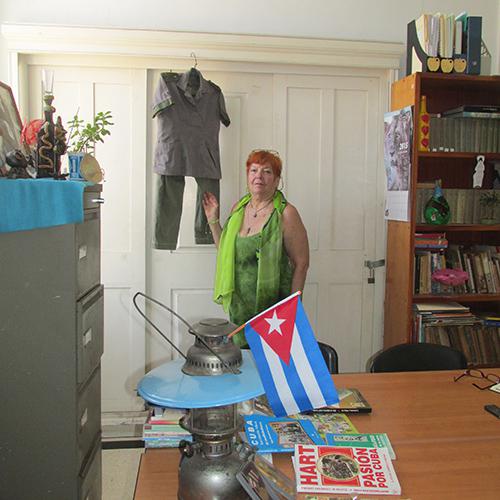
As a member of a health brigade in a coastal area close to the municipality of Santa Cruz del Norte, in today’s Mayabeque province, the victory at Playa Girón on April 19, 1961, took Gloria Salomé Nejme Franco by surprise. The following day she turned 15, and celebrated as best she could.
“Surrounded by sharp limestone rock, a cake made with sweet potato appeared. They began to sing a waltz…I had blistered feet due to my boots and the rifle slung over my shoulder, as we couldn’t leave it behind. They sang “The Blue Danube” out of tune. Afterwards I left for the literacy campaign.”
These are the memories of three important moments Gloria experienced while still just a teenager - the high spirits following the first defeat of U.S. imperialism in America, her fifteenth birthday and her debut as a literacy teacher.
When she arrived in the former province of Oriente she was thin like many girls her age, and did everything possible to hide the fact that she had mumps. Finally she could not hide the symptoms of the disease any longer.
“I arrived almost deformed and they sent me to a makeshift hospital, which was on La Vela hill. There I began to teach literacy. I taught five men to read and write. At that time, the campesina woman there had begun to have children at a young age and had to take care of the house and everything else.
“I became very fond of her. I was there almost seven months. Afterwards I was asked to teach literacy to those working to support the hospital and those from the nearby area.
I’M STAYING IN CUBA
What makes Gloria’s story unique is her social background. She was not born in the midst of economic hardship, as her father's business allowed her to live comfortably; and she was not lacking in knowledge having studied for almost a decade in a convent school. So what made her, aged just 14, embrace the nascent Revolution in Cuba?
“I can’t say I was influenced by anyone. At home there was no talk of revolution. I endured no hardships, but I was always branded as strange, because I liked playing with the daughter of the lady who worked in the house and I considered her my best friend.
“I simply left to teach literacy and fulfilled that task. Building the Revolution was something new. When the call was made for the literacy campaign, there I was. The same goes for the Committees for the Defense of the Revolution, the Federation (of Cuban Women) and the health brigades.
“I was always questioned by my whole family. Until they began to leave. When I said: ‘I’m staying in Cuba,’ they washed their hands of me.”

SPREADING LOVE
The decision to join the literacy campaign - a process that emerged in 1956 in the Sierra Maestra when classrooms were created and locals and rebels learned to read and write - marked Gloria’s life.
Today she is 70 years old and offers her own analysis, based on her experiences.
“What is literacy teaching? It’s spreading love. I see it as a step to embark on a new path. I enjoyed it. I am now aware of what it really was.
“My grandson is 17 years old, that is, three more than when I left to teach literacy, and to me, my grandson is so small. I don’t compare generations because it's no good, but I do compare ages. When I was 14 I already believed I was all grown up.
“After I returned from the literacy campaign, my mother celebrated my fifteenth birthday for real, so she said. But for me, my true fifteenth birthday was April 20, 1961, mobilized on the Cuban coast. It was unique and unrepeatable.”
FAREWELL TO THE SPOILT LITTLE GIRL
In 2014, Gloria received the Evangelio Vivo prize, awarded by the Cuban Association of Educators. The recognition was the result of her years volunteering as a teacher, a guide for Pioneers (elementary school organization), and a teacher and in management positions both at the municipal and regional level in the Cuban capital, as well as her links to organizations such as the Federation of Cuban Women and the Young Communist League.
She also has the satisfaction of having a son and grandson, although - as she herself states: “I still think I've done little. I could have done more.”
The final question: What was the result of the entire experience?
“I stopped being a spoiled city girl who feared the dark and loneliness.”


