

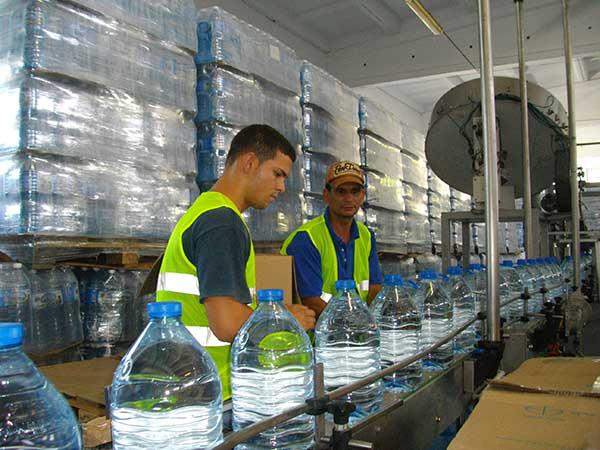
Located 11 kilometers from the municipality of Palmira, Cienfuegos province (on the southern coast of the island’s central region), in a rural area isolated from other facilities, stands the Embotelladora de Agua Mineral Ciego Montero (Ciego Montero Mineral Water Bottling Plant), belonging to the Los Portales S.A. Joint Venture.
This gigantic plant has 24-hour continuous production cycles, and is responsible for supplying 92% of the mineral water in the country. The plant also bottles water for export to certain countries in the Caribbean and Central America, in the quest to explore new markets.
Three natural sources, located within a range of no more than two kilometers, provide water to fill 12,000, 10,800 and 1,700 bottles per hour in the formats 0. 5; 1.5 and 5 liters, respectively, following a thorough technical and laboratory process including a quality control system consisting of four standards.
The plant’s Director, engineer Eduardo Álvarez Puigbert, tells Granma International that the plant is now at its most productive in its quarter-century history. The figures through August this year are indicative of this.
He outlines them as follows:
“In 2016 we are committed to manufacturing 44,913,651 bottles in the small formats (0.5 and 1.5 liters), and by the end of August we had honored 80.8% of the annual plan. This figure represents two million units more than what was achieved in 2015.”
“In the line of big 5-liter bottles the target for 2016 is 3,200,737 units (1 million more than the previous year). The total until the end of August indicates 53.5% fulfillment,” Álvarez Puigbert explains.
These results have not appeared out of nowhere. As well as the cohesion, seriousness, responsibility, and discipline with which the fully automated plant’s 62 workers assume their daily tasks, they also reflect improvements in the manufacturing process following the investment process carried out in the industry.
Engineer Osmany Enríquez Quintana, head technologist, believes that among the changes recently implemented, noteworthy is the introduction of a new French-made blowing machine (to inflate the plastic bottle preforms or molds), the most advanced of its kind in Cuba.
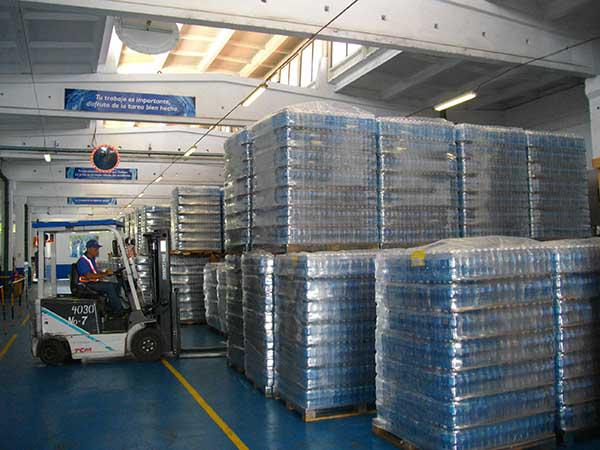
He notes that the machine has an internal ecological oven, in which the energy emitted by the infrared lamps is recovered by mirrors, ceramic tiles, and false lamps. In addition, the air used to inflate each bottle is recycled to inflate more. This means the energy recovery is far superior to that of a conventional blower.
The change in such technology – by all accounts essential – was coupled with the replacing of compressors; modifications in the bottle design; adjusting the pumping flow rates, and modernization of the water circuit. All of the utmost importance for more effective production management, as engineer Raquel Valdespino Pilot, head of production, notes.
The change in the design of the bottles was undertaken with the aim of reducing the amount of material used in the packaging. While the previous design did not allow for the possibility of reducing weight, the neck piece now weighs 3.8 grams, compared to 5g before.
The reduction in weight has meant savings of 130 tons of plastic previously required to manufacture the water bottles, Álvarez Puigbert adds.
According to the head technologist, adjusting the pumping rates contributed to substantial water savings, while it also led to a complete reversal of the water system and the annexation of an air tank, which provides the possibility of pumping the water at lower flow rates, saving a lot of liquid, a basic need when dealing with a mineral resource that must be conserved.
These adjustments have meant that 26.6% less water is now used in the production process than previously.
Similarly, the replacement of fluorescent with LED lighting in an installation of this size has also led to significant electricity savings, with the plant meeting established territorial energy savings plans without having to halt production.
Among measures to replace imports, the plant director notes the acquisition of bottle preforms in the domestic market.
Before, he explains, these were purchased in Spain, Uruguay and Mexico. Now, they are supplied by a Cuban manufacturer: the Ernesto Che Guevara Military Industrial Enterprise, located in Manicaragua.
This is the case for half-liter and 1.5 liter preforms, but has not yet been achieved in the case of 5- liter formats, although work is continuing in this direction.
Until recently, the paper labels covering the bottles were also acquired in Mexico. As engineer Abel Torres Pérez, head of Maintenance and Engineering explains, one hundred percent of labels are now supplied by Geocuba Habana.
In addition, Geocuba Villa Clara now provides rolls of polypropylene labels, Enríquez Quintana notes.
The guaranteed supply of raw materials in Cuba rather than through imports has provided enhanced security to operations in this emblem of industrial development in Cienfuegos, where the 24-hour production is divided between four shifts of six workers.
One of them, Osmel Reyes León, notes that the factory is an example of the use of technology for development and that in his 13 years at the bottling plant, he has seen this workplace grow and consolidate, with a small but very stable labor force, almost half of whom are university educated.
Concern about ensuring future generations of workers is evident through the career interest circles (for students) held in the plant; as well as the Water Festival, a local tradition, where the bottler has a permanent stand, and offers vocational training in the community of 4,800 inhabitants, from which most of its current workers come.


