

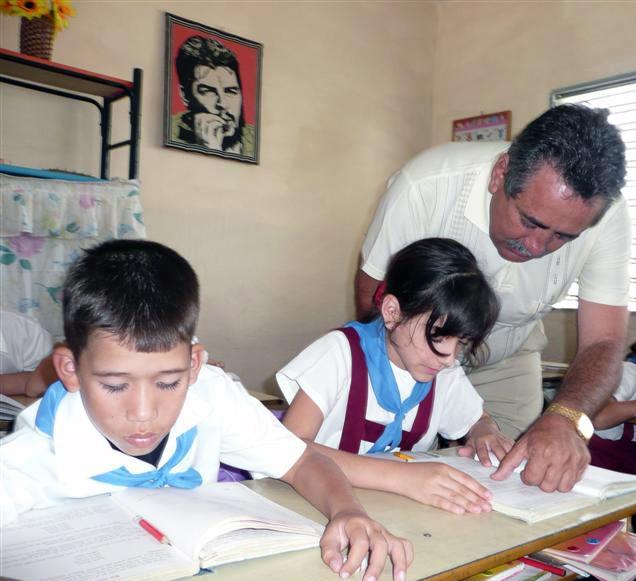
The Ministry of Education's National Primary Education Directorate and the Central Institute of Pedagogical Sciences are preparing for an important upcoming event: the Regional Comparative and Descriptive Study of Educational Quality, set to take place in 2019.
This project is conducted by the Latin American Laboratory for the Evaluation of Educational Quality, the region's principal means of monitoring and providing follow-up to the Educational Agenda 2020-2030, the comprehensive strategy charted by Ministries of Education to reach the United Nations' Sustainable Development Goals in the area of education.
In 1997 and 2006, the first regional research projects were carried out. On both occasions, Cuba placed first in examinations given at every grade level, and demonstrated important achievements with respect to equality of opportunity.
"In the 2006 study, Cuba was able to demonstrate the existence of equity in terms of gender parity, boys and girls learn equally," said Dr. Paul Torres Fernández, national coordinator working with the Laboratory for the Evaluation of Educational Quality.
"The island also proved that rural schools are as effective in terms of cognitive performance as urban ones. Moreover, evidence existed that third grade students, when variables on their economic and cultural level were cross-checked with their cognitive performance, it made no difference whether the children came from low or high rated families. In the case of Cuba, children earned very similar scores.
"In pedagogical terms, this is saying that Cuban primary schools are capable of generating equity, and counteracting difficulties and limitations that come from the home. This has an extraordinary political impact."
Prior to the 2019 evaluation, primary education in Cuba will participate in two other regional studies: one next May and another in 2018. At the same time, the national system is moving ahead with its own improvement process, which MSc Odalis García Figueroa, national primary education director, discussed with GI.

"In a step-by-step manner we are working on the revision of materials, and the re-elaboration of those for first and fourth grades. Another very important task is the experiment we are conducting in six of the country's provinces (Santiago de Cuba, Villa Clara, Artemisa, Mayabeque, La Habana and Pinar del Río). We are working jointly with the Central Institute of Pedagogical Sciences on experimentally putting into practice the materials that are being elaborated as part of the improvement process."
With regards to the improvement process, what results have been noted thus far, and when will the new projects be generalized across the system?
Dr. Paul Torres Fernández: The elaboration of the programs has not yet been completed. They are in the process of revision and analysis. Rather, over these three years of the experiment, we have been working on creating the conditions in schools to help them function more independently in the management of the academic curriculum.
The results are, in general, positive. We are projecting that during the next academic year, we can begin to pilot the new programs, new text books, new workbooks, and new methodological approaches, in the experimental schools.
This will take place not only in the educational centers in the six provinces previously mentioned. Beginning this year, it was decided to begin incorporating schools in all provinces. We are going to have a pilot period before implementing the results across the board.
The pilot of the curricular part is going to take place in all the experimental schools throughout the country, before making the decision to definitively implement it in all schools.
What changes will elementary school students notice in terms of expectations of them?
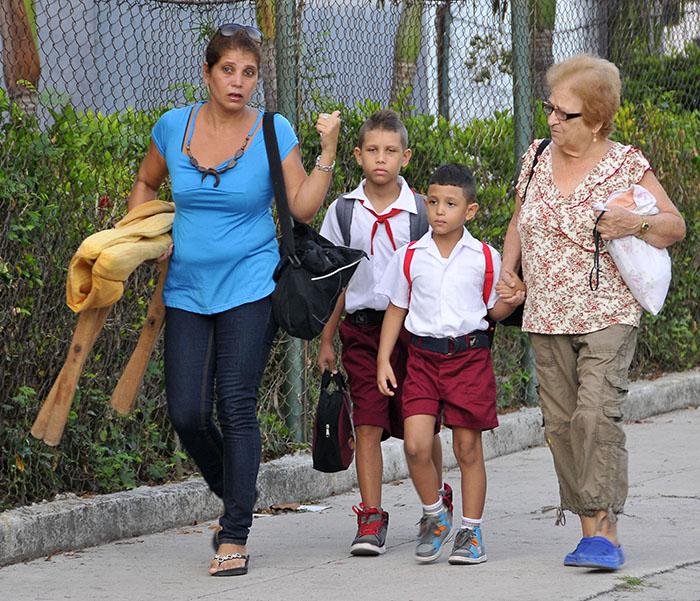
Odalis García Fiqueroa: Given the modifications we are incorporating into the conception of the curriculum, the student will be expected to be more proactive, which - given the flexibility we grant so that each school can have its curriculum and can organize its work in consonance with the place where its is located - greater possibilities exist to develop complementary and cultural activities. This will no doubt put the student in a position to play a greater role.
We are working to ensure that, within the classroom, a series of learning tasks are conceived which demand more cognitive independence on the part of students, to prepare them to undertake activities that appear in the text book and approach academic evaluations in a different manner. We insist on practical work. Thus the student has a more active, more reflective, more protagonical role, and better conditions are created to be able to succeed at the secondary level. These are our aspirations.
Doctor Paul Torres Fernández: We must condition students to trust more in their own strengths and resources; show them that they don't need to constantly call on the teacher to answer a question. We must work on this not only in the context of the improvement process.
We are seeking curricular independence for schools and in students' performance. We must continue preparing our children and work hard on their cognitive and psychological independence.
Quite some time ago, Cuba met the UN Millennium, and Sustainable Development Goals in terms of education. Considering the Comparative Regional Study and the improvement process underway within the national system, what are the main objectives on the country's educational agenda for 2020-2030?
Dr. Paul Torres Fernández: The 20-30 Agenda is not only for Cuba, it's global. We are signatories to this international covenant: the UN's new program of work looking toward sustainable development.
What is interesting in the 20-30 Agenda is that it goes beyond the aspirations of the Millennium Goals. We are talking about more advanced goals. In the Millennium Goals, addressed was the development of massive, quality education. Now the discourse goes beyond this, we have been including elements of equity since the moment when inclusion was incorporated as something to be achieved in education.
It's about proving to what extent national educational systems are capable of generating equity, beyond broad proportionality.
Cuba has this strength. We must prove it, because our schools have shown that they have the capacity to do it. What is required now is generalizing this, deepening this, consolidating, and advancing in this direction.
We have the confidence and are sure that our country, even when the bar has been raised, will once again make the jump. We know the quality, the sacrifice, the efforts, and disposition of Cuban teachers; we know the capacity for support of Cuban families, we are betting on this.


