

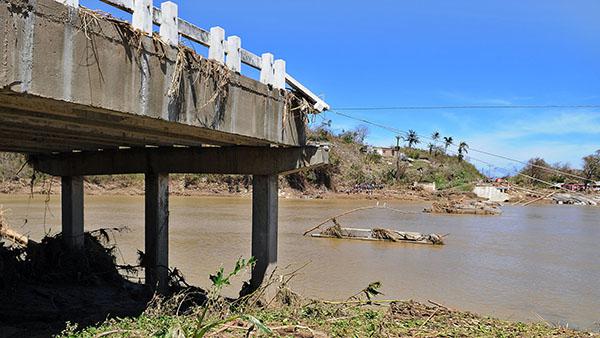
Engineer Dulcerina César Rodríguez feels her heartstrings whenever she speaks, or hears someone speaking, about the Toa River Bridge, destroyed by an unprecedented crest caused by Hurricane Matthew's heavy rains.
And for good reason.
"This was one of my main projects, that occupied me and kept me up at night for a long time, and gave me great professional experience," the Baracoa native told me, during an interview in her current home located in the Havana neighborhood of Santos Suárez.
Dulcerina graduated in 1986 from the Railroad Transportation Engineering Institute in Moscow, specializing in bridges, and completed her training internship in Santiago de Cuba's Project Enterprise No.15, where she was assigned the job of designing a concrete bridge over the Toa River, to replace the wooden bridge that barely skimmed the water.
"In June of 1987," she recalled, " we did the technical project, and in March the following year, the execution plan under the supervision of engineer Juan Sanfeliz García, a specialist in this type of construction."
This largely prefabricated work began in 1989 and was finished in December of 1990 by the Pedro Soto Alba contingent's bridge brigade, from the Construction of Architectural and Engineering Works Enterprise (Ecoai) in Moa.
"The length of the installation," she explained, "was 225 meters, with a super-structure made of nine isostatic spans, 25 meters each, with panels of pre-stressed concrete beams and slabs of reinforced concrete. It's total width, including the sidewalks, reached 11.2 meters, with a height of seven meters.
"The sub-structure, for its part, was composed of ten supports (two buttresses and eight batteries), in an arcade, with three columns of prefabricated reinforced concrete pilings, while the foundation was indirect, over pilings in eight supports, and direct on the two supports on the Moa side," she recalled, emphasizing the effort entailed in the construction, which required driving prefabricated pilings 18 meters into the ground before pouring any cement.
"Just imagine, reaching this depth in a granular soil, that is, one composed of rock, sand, and gravel. The pilings served the purpose of sustaining the cement, and together they formed the foundation.
"I recall the Toa's broad channel required us to advance little by little with the construction, filling the part of the river where we were going to drive the pilings with dirt, or set the foundation. On many occasions, we filled a patch and then a rise would destroy the fill, obliging us to start over again."
Dulcerina talked about how the placement of the bridge close to the mouth of Cuba's mightiest river meant that both the volume and strength of the water was greater, requiring extra protection for the structure.
"Toward that end, upriver from each support, a shield with pilings in the shape of an arc was placed, meant to stop the blows that occurred during rapid rises, which have been many over the 25 years of the viaduct's existence.
Despite this, the bridge collapsed.
"That’s it, any structure supported in the water can collapse at some point. Everything indicates that the enormous volume and weight of the water, plus the blows of palms, coconut and almond trees, and other enormous trees, caused the collapse of the emblematic work, although the ocean surf could have had an impact as well," said the engineer who has had considerable experience with viaducts and bridges in this and other provinces around the country.
In Guantánamo alone, the recognized expert has worked on those erected over the rivers Yumurí (between Baracoa and Maisí), Maya, Caleta and Lebeyé, as well as the Jaibo I railroad bridge, which she considers one of her most important works.
Dulcerina participated in a cooperative project in Vietnam, on the construction of a stretch of the Cau Gie-Ninh Binh highway, along with her husband, civil engineer Rolando Barreras Barrera, a hydraulic cement expert.
Previously she worked in the Santiago de Cuba Provincial Highway Department, and between 2011 and 2014, participated in the construction of the Port of Mariel.
The pain this Baracoa native feels for the loss of the city's renowned bridge is relieved a bit as I report that Cuban and Venezuelan specialists are already rebuilding the structure, with advanced technology.
Considered one of the seven wonders of civil engineering in Guantánamo, the River Toa Bridge made communication possible between Baracoa and Moa, for over 25 years.


