

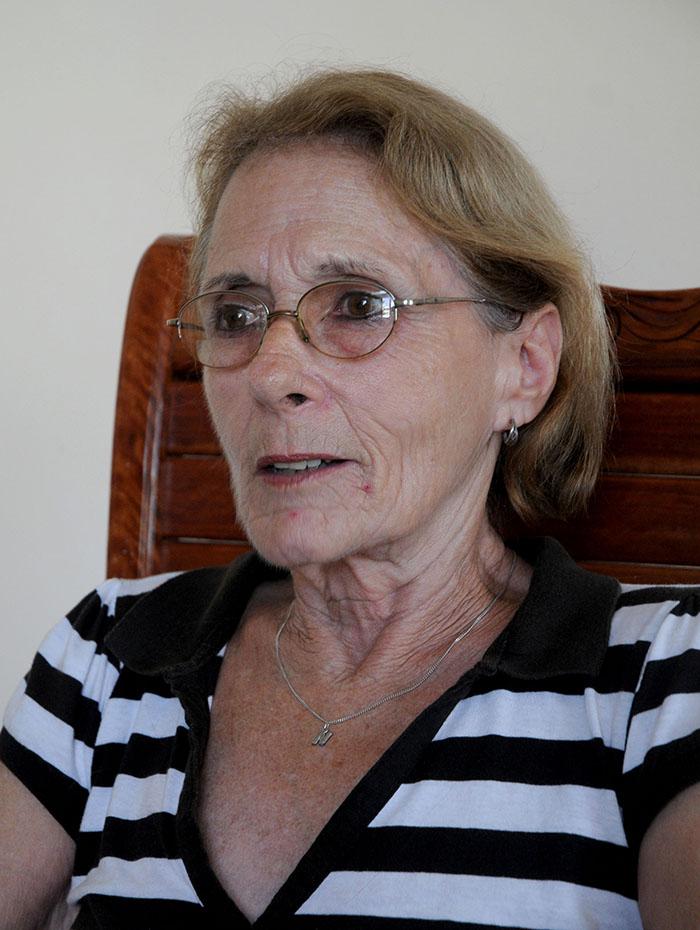
Before 1959, Nury Díaz Hernández belonged to a small bourgeoisie family. Despite the efforts of her father - who belonged to Cuba’s privileged class and opposed the Revolution - to get her out of the country, Nury and her mother remained on the island.
She still remembers what she said to him during a heated conversation. “There are millions of people in Cuba who don’t know how to read or write and it was Fidel that taught me this. Here is where I’ve got to be.”
That’s how a young girl, barely 12 years old and educated in a school run by nuns, came to teach illiterate campesinos in the center of the island.
“When Fidel convoked the Literacy Campaign, I joined up fast. I had to go and teach people to read and write. They were all new experiences. My mother supported me. People criticized her for letting me join. She was a single mother and well ahead of her time.
“I was stationed around Fomento, close to the rocky massif of the Escambray (in central Cuba’s southern region). Then the order arrived to gather together all the young girls, for security reasons due to counter-revolutionary activity in the area, and they sent me to Manaquita, in the municipality of Santa Isabel de las Lajas, to the north of the central province of Cienfuegos.
“A baby was born in the home where I was teaching people to read and write. It was something completely new for me, with different customs. Campesinos are the most courteous people I have ever met.
“Many of them had never seen a pencil. I learned more from them than they did from me. Although we lost contact later, I know that they continued to study, because I put them on the path of learning.”
THE ‘BRIGADISTICA’ THAT COULD
During the burgeoning years of the Revolution, Nury not only contended with social the stigma of being the daughter of unmarried parents; she also learned to intelligently handle reluctant students.
“There was an old man who didn’t want to learn. He called me the ‘brigadistica’ and would say, ‘How is a little girl going to tell me what to do?’
“I gradually discovered that he was very interested in lighthouses and would hide close to where I gave classes and listen in. Finally, I told him that if he wanted to see the lighthouse, he would have to come into the classroom and learn like everyone else.”
Like all literacy volunteers in 1961, Nury is proud to have participated in the campaign, although this has been her only experience as a teacher. I’m not cut out to be teacher, but I am able to educate, because I’ve done it my whole life.
THE TRAIN OF THE REVOLUTION
Even those Cubans who never experienced this moment, because they hadn’t been born yet, or were unable to participate, know just how exciting the act held in Havana’s Plaza de la Revolución on December 22, 1961, was, when the island was declared a Territory Free of Illiteracy. Nury was there.

“I marched with a group all holding pencils. It was raining and I wanted to greet the whole world. I passed in front of Fidel. His speech was fantastic. He talked about how a secondary school group was created to train us. That’s where I went.
“I went to the Sierra Maestra to pick coffee, then into the Revolutionary Armed Forces and from there to the Soviet Union. I learned to look out for myself in a professional sense. Later I worked in the Fishing Research Center.
“There I joined the micro-brigades movement and went to the Havana neighborhood of Mulgoba to set up the Amiguitos de la Ciencia Kindergarten. I met Fidel at the inauguration of the Expocuba fairgrounds and I saw him again at the Villa Panamericana, also located in the capital. This is the train of the Revolution that I boarded with the literacy campaign.
EDUCATE IN THE BEST WAY
Nury has also suffered difficult moments in her life, which she has confronted with a strength that only she can explain:
“While in the USSR, my mother died. I raised my daughter alone and now she has a PhD in nuclear physics. I educated her the best I could, that’s why I say I’ve always educated, and I have been able to transmit all this education to her without having to say: ‘Sit down, I am going to give you a class.’
“I’m proud of all of this. If I hadn’t participated in the literacy campaign, I don’t know how my life would have turned out. Perhaps I would have been unhappy.”


