

During the latest round of migration talks held in Washington December 11, the Cuban and U.S. delegations agreed on recognizing the positive impact of the Joint Statement signed January 12, 2017 and, specifically, the elimination of the “wet foot-dry foot” policy and the “Cuban Medical Professional Parole Program,” on reducing irregular emigration from Cuba to the U.S.
Likewise, the Cuban side expressed its profound concern regarding the negative consequences that unilateral, unfounded, and politically motivated decisions which were adopted by the U.S. government in September and October of 2017 have on migration relations between the two nations. In this sense, the warning was reiterated on the negative impact of the suspension of the issuing of visas at the United States Consulate in Havana which, on paralyzing the processing of applications by Cuban citizens to visit or emigrate to that country, seriously hinders family ties and exchanges of all kinds among both peoples.
On January 12, 2017, after almost a year of negotiations and encouraged by the reestablishment of diplomatic relations on July 20, 2015, based on mutual respect and the political will to strengthen these ties and establish new understandings on various issues of common interest, the governments of Cuba and the U.S. signed a new migration agreement. As predicted, this has begun to contribute to the normalization of migratory relations, which have been marked since the triumph of the Revolution by the application of the aggressive policies of successive U.S. administrations, which encouraged violence, irregular migration, and human trafficking, resulting in numerous deaths of innocent people.
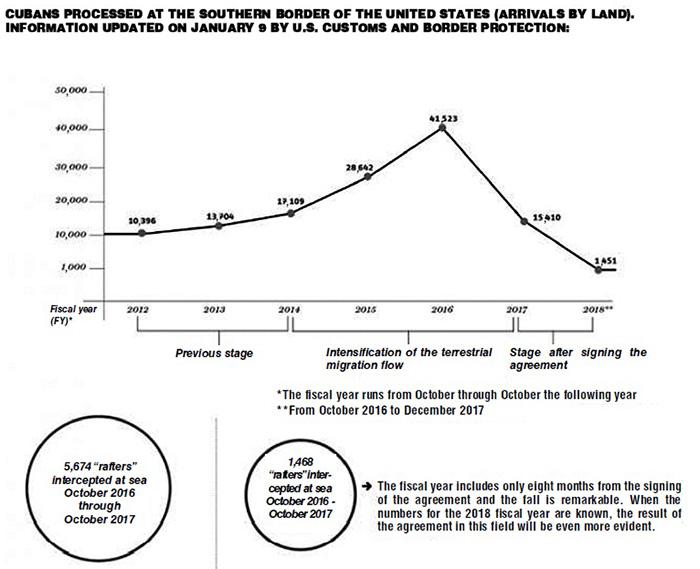
As the Declaration of the Revolutionary Government published on January 12, 2017, noted this represented “An important step forward in improving bilateral relations (...) intended to guarantee regular, safe, and ordered migration,” which has had an immediate impact evident in the decline in the irregular migration flow.
According to data from U.S. authorities, between January 12, 2017, and September of the same year, 2,057 Cubans arrived to the U.S. without visas, most to the border with Mexico. Figures from the State Department indicate that the agreement has reduced the total flow of immigration from Cuba by 64% compared to the 2016 fiscal year, while the number of irregular migrants intercepted at sea decreased by 71%.
Meanwhile, since the agreement became effective, the Cuban Border Guard has registered only 60 irregular migration incidents, with 666 participants, which represents a decrease of 94% in incidents and 92% in terms of participants, with respect to 2016. The significant reduction demonstrates the dissuasive impact of the Joint Statement. Of the total, only 24 vessels leaving Cuba were heading toward U.S. territory, with 190 participants, who were intercepted by the U.S. Coast Guard and returned to Cuba, in compliance with the agreement.
The Government of the Republic of Cuba, faithful to its international obligations and its legislation, has fully complied with this new agreement and internally assured the necessary measures to continue preventing irregular departures, deal with human trafficking and document fraud, while at the same time maintaining close coordination with its counterparts in the U.S. and neighboring countries, on which the new agreement has also had a positive impact.
In accordance with the agreement, competent authorities in the two countries, determined to discourage illegal acts linked to irregular migration, adopted effective measures to address these incidents and promoted bilateral cooperation to prevent and prosecute trafficking in persons, as well as the crimes associated with migratory movements, which endanger the national security of both nations.
Since the agreement came into effect, the return of 600 irregular migrants from the U.S. has been secured, and 1,930 from other countries, for a total of 2,530, mostly from Mexico and the Bahamas.
As established in the accord, 78 Cuban citizens declared by the U.S. as “excludable” have been received in the country, which replaced a similar figure originally included on the list of 2,746 individuals to be returned in accordance with the Joint Communiqué of December 14, 1984, while new cases are being processed.
Likewise, the return of other Cuban citizens who are in the U.S. and had been detected by U.S. authorities when they tried to enter or remain irregularly in that country, before the signing of the Joint Statement, has been analyzed and is being decided on a case by case basis.
The adoption and implementation of this agreement has been consistent with the will of the Cuban Government, in the exercise of its sovereignty, to update the current migration policy, and adjust it to the conditions of the present and foreseeable future, as shown with the application of an important group of measures since January 14, 2013, which continued with the entry into effect this January 1 of four others, which seek to further strengthen Cuba’s relations with its émigré community.
Since the beginning of this year, the requirement of “avecindamiento” (residence in Cuba for 90 days) has been eliminated, allowing children who were born outside the country to Cuban parents resident abroad, to obtain Cuban citizenship and identification documents; the “habilitación” passport authorization process for Cuban émigrés wishing to visit Cuba was eliminated; the entrance and exit from the country by Cuban citizens resident abroad on recreational boats via the Hemingway and Gaviota-Varadero International Marinas was authorized; and those who left illegally can now re-enter the country, except those who did so through the illegal U.S. Naval Base in Guantánamo.
Nearly five years after these measures to update Cuba’s migratory policy became effective, more than 2.6 million Cuban citizens have traveled to different parts of the world, of them more than 896,000 to the United States.
Notwithstanding the results of the implementation of the agreements over the past year, the current policy of the Trump administration poses a series of challenges to the implementation of the Joint Statement, which could have implications for the security of both countries, and regarding which U.S. authorities have been alerted.
The United States government has been urged to comply with its obligation to issue travel documents to no less than 20,000 Cuban citizens annually who wish to emigrate to that country, and was warned regarding the obstacles posed by the decision to designate its embassy in Colombia as a processing center for face-to-face issuing of immigrant visas, and other embassies in third countries for visa applications associated with temporary travel.
The arbitrary expulsion of a significant number of officials from the Embassy of Cuba in Washington has also had a negative impact, as it has significantly affected the functioning of the diplomatic mission, in particular the Consulate and the services it provides to Cuban residents in the United States, as well as services to U.S. citizens interested in traveling to the island, with a significant impact on family reunification and the flow of visitors between both countries.
This at a time when record numbers are traveling from the U.S. to Cuba, taking into account U.S. citizens, Cuban residents in the United States, and those of other nationalities traveling to the island from that country. This made for a total of 1,522,807 people who arrived in Cuba from the U.S. in 2017.
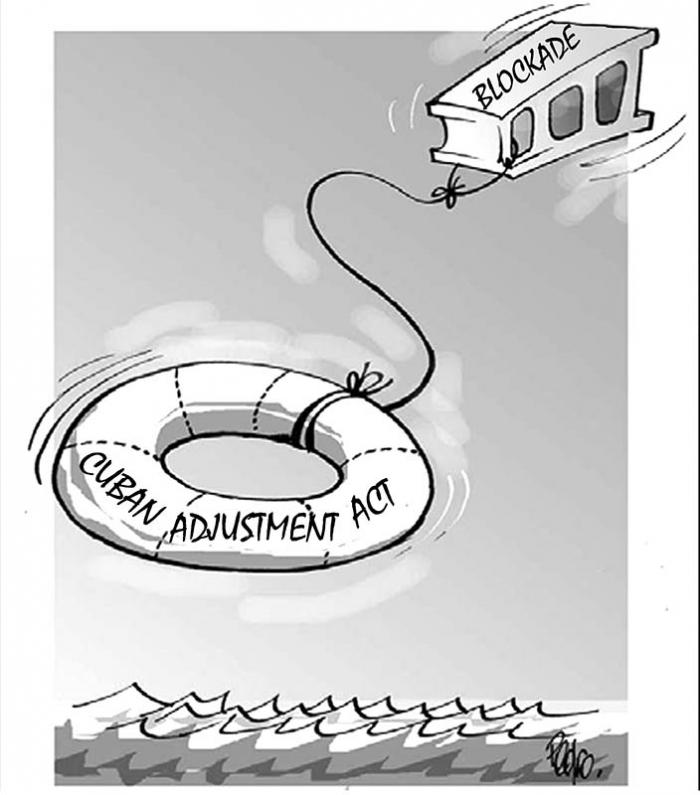
In addition to these challenges, the ongoing application of the Cuban Adjustment Act of 1966, the only one of its kind in the world, continues to encourage irregular emigration, the repeal of which will be essential to achieve normal migratory relations between the two countries.


