

Remarks by Eusebio Leal Spengler, Havana City Historian, during the unveiling of the equestrian statue of José Martí, the Apostle, in honor of the 165th anniversary of his birth, January 28, 2018
(Council of State transcript / GI translation)
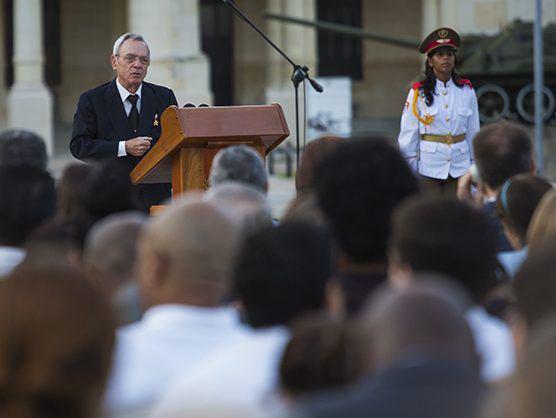
GENERAL President Raúl Castro Ruz;
Distinguished members of the Council of State and the Republic's government;
Distinguished invitees and representatives of New York City and the Bronx Museum;
Honorable members of the diplomatic corps;
Cuban men and women of the patriotic émigré community;
Cuban men and women, all;
Everything calls us to recollection this morning and to devout gratitude to our homeland’s founding fathers.
This morning, which marks the 165th anniversary of his birth, not far from here, on Paula Street, we recall José Martí in the act of supreme sacrifice for the cause he chose as his raison d'être.
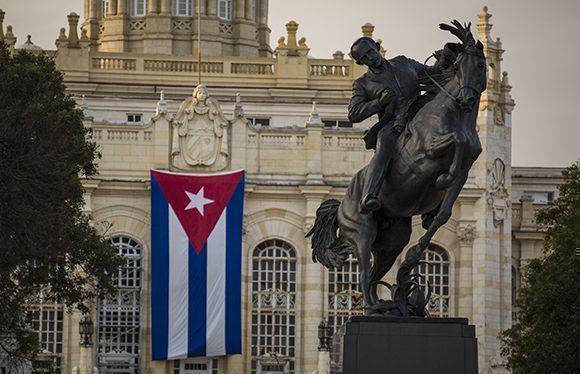
The work of the celebrated U.S. artist, Anna Hyatt Huntington, convokes us. A work of a femininity and aesthetic sense and superior technique, the sculpture marked the life of this great artist, at an exceptional moment. At 82 years of age, she took on the project, perhaps thinking that in New York's Central Park, alongside the beautiful statues of the Liberator Simón Bolívar and the Protector of the peoples of the South, José de San Martín, missing was a fundamental piece in the discourse of Our America: the figure of Martí.
Many may ask themselves, before this sculpture we unveil today, if he was a rider and a soldier, or not. In reality, beginning with the first letter he wrote his mother from Hanábana, where he was with his father, designated the guardian or custodian of those great fields near the Ciénaga de Zapata, he spoke of fattening and caring for his horse. And later, throughout his life of pilgrimages on the American continent and his final, brief stay in Cuba, he would be, no doubt, a rider.
It was a white steed they would bring him, in the name of Major General José Maceo, to use in the revolution, and the image of the animal's fright under fire from the front and the side, and that of the Teacher whose hand flies loose, as depicted in the unforgettable painting by Carlos Enríquez, his weapon that perhaps he never used. There is serenity in his face, beauty in the surroundings in which the animal tramples grasses and lilies, perhaps evoking those words I always considered the intimate premonition of his sacrifice: "My verse will grow under the grass, and I will grow as well." The scene is from May 19, 1895.
But precisely today, we do not stop to contemplate the death of one who considered it a necessary act. "It is not true," he said, "when life's work has been completed well," or when, as he also said, it occurs on a train of glory. We gather today with sadness and humility before his monument. We think about the coincidences that this beautiful dawn today supposes for all Cubans, and those around the world who revere, love, and cherish their homeland, Cuba.
The 165th anniversary of his birth on Paula Street; the 165th anniversary of when he was taken to the military church of the Angel, here close by, to be baptized in the same fountain as the priest Félix Varela. A coincidence that in this same area other founding fathers also met, and resting on this hill are some of the most important legends of Havana, the city that witnessed his birth.
It is the 150th anniversary that we commemorate this year and celebrate, of the beginning of the War of Liberation, the emancipatory war for the abolition of slavery and absolute independence.
It is also the 60th anniversary of the triumph of the Cuban Revolution that we commemorate next year. And all of this, included in the 500th anniversary of Havana, half a millennium for a city that witnessed and played a leading role in some of the most notable historical events in the history of Cuba and America.
That is why, as we place this monument here today, one that 22 years ago we tentatively attempted to bring to Cuba, we must recall, as has been done, the illustrious friend and colleague Holly Block, who lent her name and her institution, the Bronx Museum, as the platform needed to allow Cuba to raise the indispensable funds to model and forge the sculpture. Time was also needed for the development of technology that would permit us to do so without touching the original sculpture, which is not allowed by law, but to be able to make it exactly the same, with identical perfection, like the ancient technique of lost wax casting.
It was the Bronx Museum, it was Holly Block, with whom I spoke in hours of sadness, when she and I were facing sudden illnesses; she could not survive. Today, in her name, I also thank the hundred-some donors, among which are those institutions and persons who made contributions ranging from modest to large, without overlooking the generous Mexican philanthropist who has always wanted her name to remain in the shadows, and who contributed disinterestedly to make this event possible.
It is an extraordinary pleasure that we Havana residents now enjoy such a beautiful, poetically inspired a work. The Huntingtons had previously presented Havana with the gift of a sculpture complex that stands on Luis Ayestarán and 20 de Mayo Streets, the torch bearers.
Perhaps, at this moment, which is being reproduced in different places of the world, they would like to announce the dawning of this morning, when carrying the same torch, last night, thousands of Cuban youth descended University Hill to offer a beautiful tribute to the Teacher, the Apostle, as Fidel movingly called him, when in his self-defense affirms, protests, and points out, "Cuba, what would have come of you, if you had let your Apostle die!"
This was the title conferred on him by the humble workers of New York, a title similar to those held by the continents' founding fathers. Who could take the blanket of stars from the shoulders of the Liberator, Simón Bolívar, from the Protector of the peoples of the South, José de San Martín, from the great Benito Juárez, Benemeritus of the Americas? He was the Apostle, a title only shared with the Puerto Rican independence hero, who died during the very occupation and with the infinite sadness of never seeing his homeland free, Ramón Emeterio Betances, the apostle of that inconclusive freedom.
Today, as we gather in this plaza, we see in the background the beautiful monument to General Máximo Gómez, who on April 15 descended into the valley with two Liberation Army generals, approaching Martí - who had been left dejected and saddened, thinking that there was something secret to discuss, and he would not be able to interact with him, since he had no military status - but who told Martí that in addition to recognizing him as the elected delegate of the Revolutionary Party, he would make him a Major General of the Liberation Army of Cuba.
This is the Martí we see in the saddle. The man who falls from the horse is a Major General of the Liberation Army of Cuba, José Martí Pérez, also the elected delegate of the party of Cuban unity, the Revolutionary Party, constituted within and outside of Cuba, for the independence of Cuba and that of Puerto Rico. To achieve this, he was obliged to live 15 years in the United States, a long exile, during which, after arriving in January of 1880, he saw the dazzling development of New York City. The immense city being born with the splendor of its houses, its monuments, with the phenomenon of electric light and the telegraph, and with the great figures that he would evoke in his American Chronicles.
He would be, and is forever, a man of culture, at the same time a politician, a humanist, an orator, a teacher. That is why there, in the heart of New York, he never missed the exquisite lectures of Oscar Wilde; why he posed for his only portrait which he would preserve in his Front Street office - done by the Swedish painter Hermann Norman - where the only adornment was the portrait of his father and the palms of a Cuban artist, perhaps evoking an intimate desire: to die in Cuba, at the foot of a palm, fighting for its freedom.
After landing in Cuba that April 11 of 1895, after the failure of the long-prepared expedition, José Martí had briefly stopped existing, to become a different person,
Orestes, his code name. He had traveled to Santo Domingo to meet Gómez and together travel to the island of Gran Inagua, where he managed to move the heart of a sailor, who robbed their money without taking them to their beloved Cuba.
Someone else, however, of German nationality, agreed to take them aboard his fruit boat named Nordstrand. This would not have been possible if the consul from Haiti there had not given Haitian identities, to each of them: Mayor General Máximo Gómez, José Martí, Paquito Borrero, César Salas, Ángel Guerra and Marcos del Rosario, all with Haitian identity, to board the ship, apparently unarmed.
Later, that dark night, the storm, the boat in the water, and the words in the diary: Impassioned captain. Once in the boat, Gómez comments on how dangerous the moment is, when the small boat pulls away from the larger ship. The rudder is lost in the rain, and finally, the moon emerges over the high mountains of Oriente, over the promising lands of Guantánamo, and a small beach at a site known as Cajobabo will be the place where destiny takes them.
Three hundred and two kilometers they move on foot and horseback, until arriving to a place where, in an almost perfect triangle, the mighty rivers of Oriente, the
Cauto and Contramaestre come together. Oh Cauto, Cauto, how long it has been since I have seen you, said a moved General Gómez. And ready for the battle unexpectedly proposed, Martí does not accept the task of staying behind, because this was not his place.
Amidst the woods, he descends along the Santa Úrsula crossing, with the May waters cresting, and ascends to the site of his death. A young teacher from Holguín accompanies him. His name is symbolic: Ángel de la Guardia, an angel who could not protect him, could not save him from the inescapable, terrible confrontation.
And at last, on the bloodied soil, within sight of the lemonwood - the flower most loved by bees - within sight of a mamón tree and a smoke bush, he fell, unusually dressed, his heart broken. Split were the lips, from which emerged verses and words that moved even the most hardened hearts.
Author of the unity needed to return, he would not see it concluded. That is why today, as we approach this monument, we render tribute to those who made possible that your ideas prevail long after your death; to the legions who suffered and endured, seeking a road for Cuba, for this present-day Cuba, for which we struggle. Now, on this esplanade, I see in the background, before you, the Cuban people in marble lifting the shield and the homeland's symbols, and atop the monument, General Gómez, to whom you once offered to command the Liberation Army of Cuba, when you had nothing to offer him, other than the pleasure of the sacrifice and the probable ingratitude of men. It has not been so. We thank you, illustrious Dominican, for having conducted our army in arduous, difficult days. We thank you, Teacher and Apostle, for your brief, generous life. You have not died, you live in our hearts.
For Cubans of the patriotic émigré community, for the people who hear us, for the honorable U.S. people, for the kind friend, the mayor of New York City, to the memory of Holly Block, who we will honor today, and also Leanne Mella, who carried the project forward, as Cuba's representative; to our Ministry of Foreign Affairs, particularly our missions to the United Nations and to the U.S. state, who with enormous effort carried out all that was necessary, to open a pathway that meant trips in winter and summer, appeals to find, one cent at a time, the funds needed to ensure that your image would be forever preserved in bronze.
Teacher, we have done our duty! Cuba thanks you; the entire Cuban people present a floral offering before you, these gestures and these laments reaffirm that your sacrifice was not futile.
The national flag waves at the heights of the starred staff. We have not followed the customary practice, renouncing a bit the tradition of pulling away a sheet; it would be huge! We prefer that it be the flag that is raised toward the blue sky of Cuba, even before the sun has reached our eyes and has risen over lands to the east, the lands you first saw after returning to Cuba.
Blessed may you be, Teacher!
Many thanks. (Applause)


