

ARTEMISA.— The President of the Councils of State and Ministers, Miguel Díaz-Canel Bermúdez, described the Evelio Prieto Guillama Omnibus Production Enterprise, located in the municipality of Guanajay, Artemisa province, as very important to the country, as it can contribute to solving national transport problems.
The government visit headed by President Díaz-Canel to this western province October 24, commenced at the enterprise founded in 1972, the only one of its kind in Cuba.
The enterprise has two assembly lines, using equipment on a par with standard technology used globally in this type of process. Since 2015, it has produced the “Diana” bus, already used on different urban transport routes in all provinces of the country.
This must be a factory for development, Díaz-Canel emphasized. He insisted that the buses manufactured here need to be increasingly efficient, applying the various technologies that currently exist in the world. He also noted that the human potential of the island’s Institute of Design should be better used by domestic enterprises.
In this regard, Commander of the Revolution Ramiro Valdés Menéndez, a vice president of the Councils of State and Ministers, stressed the importance of using new technologies to achieve our own development, capable of responding to our problems.
“The Diana can continue to improve to make it a better bus,” Díaz-Canel stressed. The ideas materialized here will not only help to reduce imports, but will also ensure sustainable production, he noted.
During the tour of the assembly, paint, bodywork, and finishing areas, the President of the Councils of State and Ministers was able to appreciate different stages of the productive process and exchange views with workers.
PRODUCT DIVERSIFICATION
The next stop on the tour of the province was the Galaxia Dairy Products Enterprise, a basic enterprise unit located in Guanajay. Díaz-Canel inquired, among other matters, about the technical state of equipment, workers’ salaries, the types of products and their distribution, as well as the remodeling work currently being carried out in different areas.
Minister of Food Industry, Iris Quiñones Rojas, explained that the enterprise produces the all soy yogurt included as part of the subsidized family basket of basic goods for seven municipalities of the province. Also produced are ice cream, butter, and cheese. Although production levels still don’t match demand, the enterprise’s potential is gradually being developed.
Along with the significant investments made, President Díaz-Canel insisted that attention to detail must also be improved in these facilities, an aspect that doesn’t always depend on major resources.
A NECESSARY ENCOUNTER WITH HISTORY
The Cuban President also visited the Mausoleum to the Martyrs of Artemisa, to pay tribute to the revolutionary martyrs and combatants of this province.
“As part of the visit by the Council of Ministers of Cuba to Artemisa, it was necessary to visit this Memorial and pay a heartfelt tribute and homage to those who gave their lives for the Homeland, and opened the way to the triumphant Revolution,” Díaz-Canel wrote in the visitors’ book.
Special care has been taken in every detail of the site. The history that is palpable from its surroundings is also recreated with the presentation of audiovisual materials, while conferences and workshops explore the roots of the Revolution preserved here.
SUPPORTING HOUSING CONSTRUCTION
Technological improvements need to be accompanied by greater efficiency and better planning, the President of the Councils of State and Ministers noted on a tour of the Mártires de Artemisa Cement Enterprise, where he was informed of the implementation of its development program.
Increasing cement production will make it possible to better coordinate and advance the country’s housing program. Díaz-Canel insisted on the priority that all sectors conduct coherent feasibility studies and take better advantage of investments underway.
In the cement plant’s packaging area, the President learned about the production process, and enquired about working conditions, salaries, and product performance.
The case was similar on visiting the Mario Hechavarría López Fiber Cement basic enterprise unit, inaugurated in 1987, and which is also immersed in an extensive investment process to modernize its facilities.
The enterprise mainly produces roofing elements such as fiber cement tiles, which are in high demand across the country.
It is essential that we think differently about what can be done to improve the housing stock, the Cuban President stressed. The challenge is to take advantage of each of existing potentialities in the most diverse scenarios.
EDUCATION AND HEALTH
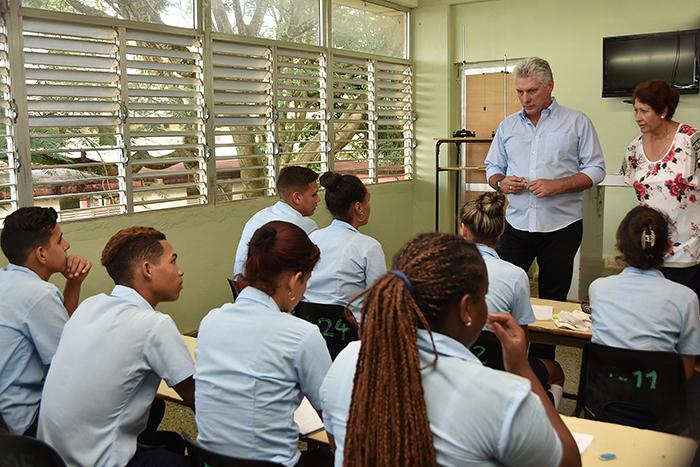
The afternoon visits began at the Manuel Ascunce Domenech pedagogical and artistic training center, where the Cuban President spoke with students about their class schedules; their computer and English knowledge; their use of the Internet and social networks; the practice of sports; the improvements that they believe the school needs; and international affairs related to Cuba.
The students assured him that they were happy with their school, although the condition of the access road could be improved. They enjoy their English classes, are studying different subjects, and identify with their educational center, students noted.
Díaz-Canel encouraged the youth to make better use of the Internet and social media, as spaces to manage knowledge, become better informed and more cultured.
Shortly after, on touring the Comandante Ciro Redondo General Teaching Hospital, the President stopped in wards and corridors, speaking with the grandmother awaiting the birth of her grandson; with a patient who comes to the institution on alternate days to receive her medical treatment; with a man waiting his turn for a consultation; with a young Mexican studying in Cuba who thanked the Revolution. The President dedicated a few minutes of his time to each of them, listening, asking about their conditions and the treatment they receive, as well whether they had any complaints about the service.
Founded in 1987, the hospital serves approximately 220,000 local residents. In addition to the various medical services offered, the training of future medical professionals is consolidated through their education and practice in the institution.
SURROUNDED ON THE BOULEVARD
What began as a tour to appreciate first hand the revival of Artemisa’s central boulevard, soon became a sea of people anxious to see and hear their President, preventing the delegation from advancing.
Díaz-Canel spoke of the reorganization of health services in the country; of the importance of keeping the boulevard active; of making sure no works were allowed to fall into disrepair; and of the satisfaction of seeing how far the province has advanced.
He recalled that this was a visit on which he was accompanied by the Council of Ministers. “This is not a control visit, it’s to help solve problems and get to know them better,” he emphasized.
I leave with the impression, he added, that many new things have been built in the area, which little by little are becoming part of the identity of this people.
I urge you, he stressed, to notify Party and government authorities when you become aware of the malfunctioning of an entity, or when the quality of services in any center declines, so that the actions that are being carried out today are truly sustainable over time.
The intense working day in Artemisa concluded in the Party Municipal Committee headquarters, where a meeting to summarize the findings of the governmental visit was held.


