

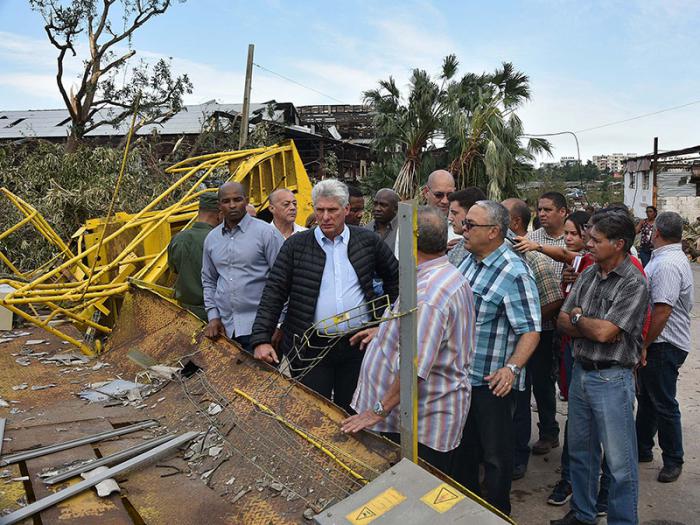
After several months of research, a multidisciplinary team of specialists from the Institute of Meteorology, Camagüey’s Provincial Meteorological Center, the Institute of Applied Sciences and Technology, and the Fernando Ortiz Foundation, contributed new information related to the emergence of the devastating tornado that struck five Havana municipalities, on the night of Sunday, January 27, this year.
Scientists were able to determine the prevailing conditions that day at different levels of the atmosphere, by analyzing and processing information from synoptic maps, satellite images, meteorological radar, surface measurements, and used numerical models to produce the findings.
Data gathered at the Casablanca automatic weather station in Havana was especially useful.
Dr. Mario Carnesoltas Calvo, coordinator of the research project, which was validated by the Institute of Meteorology’s Scientific Council, spoke with Granma, explaining that the origin of the tornado and its rapid intensification were the result of simultaneous interactions between exceptional meteorological phenomena at different levels of the atmosphere.
He mentioned, in the first place, a low pressure zone extending south from Canada, which settled over the southeastern portion of the Gulf of Mexico, favoring the development of an extra-tropical low to the north, near the Yucatan peninsula, which moved northeast and led to the formation of a cold front.
In front of this system, he continued, a line of squalls and thunderstorms developed which crossed the eastern provinces of Pinar del Río, Artemisa, La Habana and Mayabeque during the late afternoon and early evening of the 27th, producing locally severe storms, with winds gusting over 100 kilometers an hour and hail.
Within this area of prevailing atmospheric instability, as noted in analysis of the tornado’s vorticity field before its full development, several vortices – rapid, circular movements of air - at different altitudes and of varying dimensions formed.
“One of these phenomena began to intensify and became the fundamental source of energy that rapidly created a funnel cloud above the vortex. This shows that unlike, what was initially suggested, the tornado seems to have had its point of origin on land,” said Dr. Carnesoltas.
The tornado appeared in the vicinity of the Marti and Casino Deportivo neighborhoods, around 8:20pm, and from there took a northeasterly path, reaching the sea 26 minutes later, on the northern coastline east of Alamar, specifically in the neighborhood of Celimar.
As confirmed by the investigation, the powerful tornado struck the municipalities of Diez de Octubre, Regla, San Miguel del Padrón, Guanabacoa, and part of Habana del Este.
It was also corroborated that it traveled some 20 kilometers at a speed of 46 kilometers per hour, while the area impacted along this route was on average 200 meters wide, although in Luyanó and El Roble in Guanabacoa, it reached 350 meters.
In terms of intensity, it was verified that winds on the order of 300 kilometers per hour were produced, placing the tornado in the EF4 category (from 267 to 322 km/h) on the enhanced Fujita-Pearson scale.
According to Dr. Mario Carnesoltas, the occurrence of such a devastating tornado, unprecedented to date in the capital, implies the need to expand knowledge of such dangerous natural phenomena, which can occur anywhere in the Cuban archipelago.
What happened on the night of January 27 in Havana makes clear the importance of timely preparation of citizens, so everyone knows what to do in such situations, with emphasis on developing risk perception, the scientist said.
The most notable outbreak of tornadoes in Cuba took place on March 16, 1983, when a total of seven developed in Pinar del Río and the current province of Artemisa.
Among the noteworthy cases in the country is a tornado that struck Bejucal on December 26, 1940, (also an Ef4) which caused 20 deaths, more than 100 injuries, and the destruction of many homes and buildings. Two other Ef4 tornadoes hit the towns of Pedroso in Matanzas, and Cruces, Cienfuegos, within the same 24 hour period, in May of 1999.


