


This September, special education schools are opening with 1,400 new young teachers, recent graduates from the country’s pedagogical universities. This academic sub-system, in addition to progress achieved in staffing, is advancing in the preparation of students to participate in regular programs and the offering of specialized services, Ministry of Education authorities reported during an online interview with Granma.
Dr. Marlen Triana Mederos, general director of Basic Education, explained, “We say special education, referring not only to special schools or institutions, because we offer other specialized orientation services as well, including the Diagnosis and Consultation Centers, with specialists who advise teachers, families, and the population when they have any concern related to attention provided a given child.”
She commented on the young teachers in this branch of education and their training, saying, “Attention provided these teachers is important, ensuring that the educational institution is guiding them, so that they can complete their university studies, to earn a Bachelor’s degree.”
THE STUDENT BODY
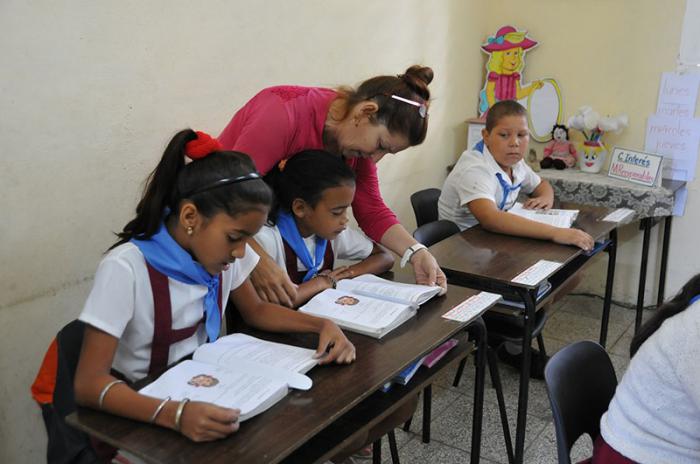
Before the triumph of the Revolution in 1959, the official enrollment in special education barely exceeded 130 students. This figure now exceeds 30,000 in special institutions that exist in all municipalities, and the associated stigma is a thing of the past. A good portion of students finish their training in general education schools.
“We also have an enrollment of more than 11,000 children in regular education schools, that is, from early childhood through adult education, and every academic year teacher coverage is improving,” she noted.
In April this year, with the inauguration of the Amistad Cuba-Vietnam School, it was possible to fulfill a dream of Fidel's, who was always sensitive to human needs and proposed the idea of establishing three such schools - one that would meet special educational needs in the western part of the country, which is the current Solidarity with Panama; another with this noble mission in the center of the island, and another for the East, with a view toward providing these services closer to students’ residences and families.
With the inauguration of schools in Villa Clara and Santiago de Cuba, it is now possible to redistribute students served in these centers, allowing for more frequent contact with families and more regular visits by students to their homes.
Regarding the improved attention that has been achieved with the opening of these schools, Dr. Mederos commented, “Everyone knows that we had only one school, which was the Solidarity with Panama in Havana. Today we have one in Santiago de Cuba and another in Villa Clara, which has made it possible to regionalize and expand these specialized services to a group of children who live in more remote settlements and in areas of difficult access.”
She continued, “Even though we have a very favorable situation in terms of teacher coverage, given that attention to our children has expanded so much - not only in special education institutions - we are facing the challenge of serving a greater number of students in regular environments.”
In her opinion, the priority is not only to train more specialized teachers, but to improve training provided teachers in regular classrooms, to better support these students in reaching their full potential.
The new Cuban Constitution, proclaimed this past April 10, reaffirms the obligatory and inclusive nature of education, supported by the eloquent language of action by the Revolution for 60 years, making clear that in Cuba, education is a right for all, without exception.
SPECIAL EDUCATION IN CUBA:
- 346 institutions
- More than 33,000 students, including children, adolescents, and youth in special schools
- More than 11,000 students served in regular classrooms
Every municipality has a Diagnosis and Consultation Center, and at least one special education school
- 1,000 specialists at Diagnosis and Consultation Centers
WHO IS SERVED BY SPECIAL EDUCATION?
Anyone with:
- an intellectual, visual, auditory, or physical-motor disability
- a communicative or learning disability.
- an autism spectrum disorder
SERVICES FOR STUDENTS WITH PHYSICAL-MOTOR DISABILITIES
The Villa Clara school for children with physical or motor limitations has an enrollment of 120 students (48 boarded) from central provinces between Cienfuegos and Camagüey. The institution opened its doors on April 20, erected and equipped at a cost of more than 6 million pesos.
Another 120 children from the country’s eastern provinces attend the Amistad Cuba-Vietnam special school in Santiago de Cuba. The investment in this institution was approximately 3.5 million pesos.
Some 170 children find more than an educational institution in Havana’s Solidarity with Panama School: a home, thanks to the love they receive from staff. Founded more than three decades ago by Fidel, every year this institution graduates more young men and women of good will.


