

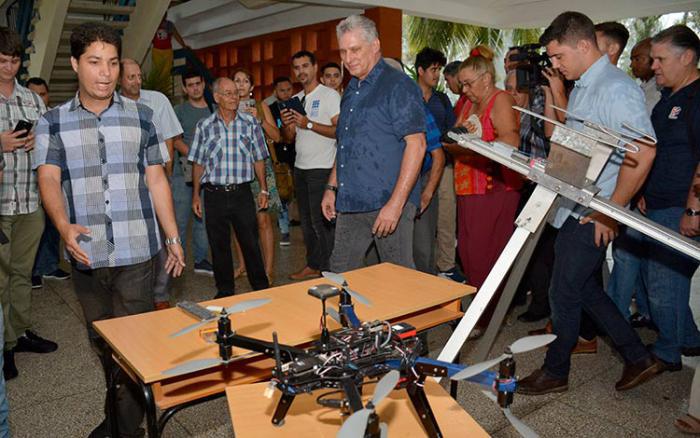
The systematization of collaboration between government and science, as an approach to address all fundamental issues in the country, is one of the lessons learned during the COVID-19 battle, according to the President of the Republic of Cuba, Miguel Díaz-Canel.
In a recent exchange with scientists and experts involved in confronting the epidemic, the President highlighted plans to hold a first meeting with the entire science and innovation system to address food production, one of our country's priorities, in the interest of achieving greater food sovereignty and reducing dependence on imports, according to a report on the Presidency of the Republic’s website.
Answers to guide the fundamental lines of national development can be found in science. Continuing to advance in strengthening of scientific, technological and innovation capacity, and in connecting of this work to our development needs and to solving national problems, is one of the country’s priorities, in which universities play a decisive role.
In their article on government work and collaboration with the scientific community in the COVID-19 battle (Gestión gubernamental y ciencia cubana en el enfrentamiento a la COVID-19), Miguel Díaz-Canel Bermúdez and Jorge Núñez Jover, dean of the University of Havana’s Science, Technology and Society department, note, "The Cuban experience includes the influential participation of the state in activities related to the production, dissemination and use of knowledge," especially emphasizing the strategy of incorporating scientific research at universities, well articulated with the national project, in order to achieve better quality of life for our people.
With excerpts from this valuable text, published in the Cuban Academy of Sciences’ magazine Anales, Granma approaches the country’s experience with government-science ties, thus culminating the series on this subject reflected in our pages.
PURPOSES OF THIS RELATIONSHIP
-Eliminate obstacles that limit the development of productive forces.
-Establish the presence of science in agricultural production poles in all territories.
-Train human resources for decision making and risk management.
-Ensure that scientific research becomes a tool that is mastered by cadres, who encourage, support and use it to solve problems.
-Link organizations with universities, as part of the strategy to use scientific research and innovation to resolve problems.
SCIENCE-STATE-GOVERNMENT
-Science has ceased to be the exclusive domain of scientists, who worked preferably in university laboratories, to become a state issue.
-The role of the state in financing research and development (R&D) activities has grown steadily.
-The long Cold War period greatly accentuated this characteristic, which, especially in the countries of the North, remains the norm to date.
-According to the Sábato Triangle (1968) there are three key players whose interactions can be an important driving force for development. These actors were identified as the state, business (at the time, the most important companies were state-owned) and universities, which at the time were mainly public.
-The emergence of neoliberalism in Latin America was accompanied by a notable weakening of state policies in science and technology.
-Economic management took precedence over politics; national objectives were displaced by corporate rationality.
THE CUBAN EXPERIENCE
-The Cuban experience includes the influential participation of the state in activities related to the production, dissemination and use of knowledge.
-The 1961 literacy campaign and all subsequent educational plans
-Foundation of the National Center for Scientific Research (CNIC), in 1965, allowed for the creation of a research facility based on the model seen in the most advanced countries.
-Incorporation of scientific research within university programs with the 1962 University Reform, especially the 1967-1972 period, when Fidel's regular presence at the University of Havana made it possible to establish a strong university scientific policy, which was well articulated with the national project at that time.
-At the first Congress of the Communist Party of Cuba (PCC), held in 1975, a thesis on scientific policy was approved, considered well ahead of its time.
-In the 1980s, the creation of the Biotechnology Scientific Pole began, which laid the foundations of the current Cuban medical-pharmaceutical industry, a key factor in the COVID-19 battle.
-Knowledge, science, technology and innovation occupy an important place in the Economic and Social Policy Guidelines of the Party and the Revolution, for the period 2016-2021; the Conceptualization of the Cuban Economic and Social Model of Socialist Development; the Foundations for the National Plan of Economic and Social Development through 2030: Vision of the Nation, Axes and Strategic Sectors; and the Constitution of the Republic.
SCIENCE, TECHNOLOGY AND INNOVATION: DRIVING FORCES OF ECONOMIC AND SOCIAL DEVELOPMENT
-The social orientation of Science, Technology and Innovation (STI), the interests they serve and the social groups they benefit, define the quality of development models and the dominant interests they reflect.
-What explains the development of Cuban biotechnology and its contribution to the health system cannot be reduced to having good institutions and excellent professionals.
-The Revolution’s historical policy directed toward strengthening Cuba’s public, free, quality health care system, and the political leadership of this sector, particularly Fidel's leadership, have been decisive.
-The dominant values of these professionals are also an expression of Cuba’s socialist, solidarity-based model.
-The best thing about Cuban science and technology policy has been the social values that have guided its efforts, in particular the interest in putting knowledge at the service of development and the satisfaction of the basic human needs of the entire population.
POLICIES AND LEGAL NORMS
-Decree No. 2/2020 (GOC-2020-156-O16): On High Technology Enterprises.
-Decree-Law No. 7: On the Science, Technology and Innovation System, signed by the President of the National Assembly People's Power, April 16, 2020.
-Resolution 286/2019 (GOC-2019-999-O86): Regulations for the Organization and Operation of the National Registry of Science, Technology and Innovation Entities.
-Resolution 287/2019 (GOC-2019-1000-86): Regulations for the System of Scientific, Technology and Innovation Programs and Projects.
-Source: Article: Gestión Gubernamental y Ciencia Cubana en el Enfrentamiento a la COVID-19 (Government Administration and Cuban Science in Confronting COVID-19).


