

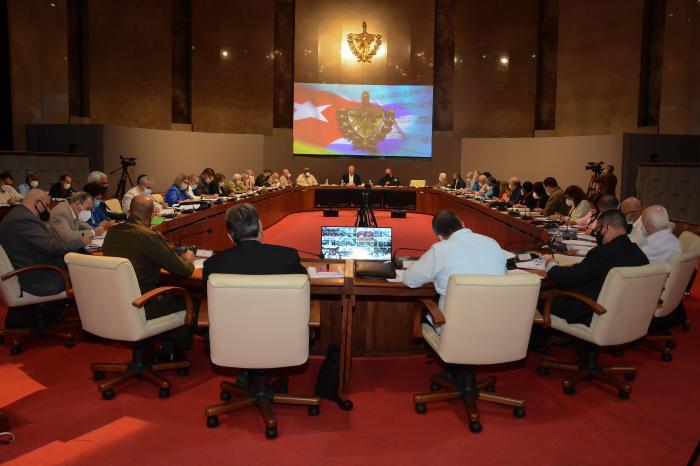
First Secretary of the Communist Party Central Committee and President of the Republic Miguel Díaz-Canel Bermúdez called on the Council of Ministers, in its first meeting of the year, to join forces to address the urgent tasks the country will undertake in the coming weeks, which will be the focus of provincial tours and accountability meetings convened by the Party and the government.
We must work more intensely on several tasks, he stated, State, in the first place, on measures to improve supply of goods available to the population and contain inflation. Likewise, he continued, we must design a comprehensive policy of attention to the non-state sector, and make progress on distance work, tele-commuting, and non-presential digital procedures, an arena in which we made progress during the COVID-19 epidemic, but have now begun to regress.
In the meeting led by Prime Minister Manuel Marrero Cruz, Díaz-Canel also reported that work will continue to be made, under the leadership of the Ministries of Economy and Planning, and Finance and Prices, on new conceptions related to the execution of municipal budgets. Among the tasks needing immediate attention, he noted, is the updating of all the Revolution’s social programs, and the rethinking of some concepts within Housing Policy, "based on the demands presented by public policies we must implement, especially those related to youth."
As one of the country’s pressing needs, the President cited the necessity of designing mechanisms of popular control to address the issues of high prices, inflation, the fight against corruption, and other problems, since it has been shown that, with popular control and participation, we can be more effective.
The President emphasized, "The reference point, what charts the path to follow, is implementation of the guidelines, the concepts, the resolutions we approved at the 8th Party Congress. This is where the analysis of our society’s problems, and proposals to solve them, are."
He explained that during the year a set of important political processes will occur, recalling that the popular consultation regarding the new Families Code is beginning, to be followed by a national referendum. This is not the Code of egalitarian marriage, he insisted, but an emancipatory Code that resolves a group of problems that exist at a social level within the country. "It is a Code of plurality, which recognizes all families, all types of families that exist in Cuba, and the problems associated with their functioning," he said.
Sticking to any one focus is to oversimplify, he said, because the document has many more important enriching, exalting, liberating aspects beyond the one most often cited, especially by those who seek to distort the breadth, the comprehensiveness, modernity, strength and contribution to our society of this new Families Code.
Díaz-Canel also addressed the role of the Communist Party (PCC) in the defense of the socialist homeland, in safeguarding the public order and citizen tranquility, and as the leading force of society and the state, which under current conditions implies the enormous responsibility of defending the essence of socialism and the concepts we reaffirmed at the Congress: unity and continuity.
He described work with younger generations as fundamental, saying they should be treated, heard, and offered participation, as the important people they are in our society, made evident in the way they grew, as human beings and revolutionaries, during their dedicated participation in critical tasks during the pandemic.
Díaz-Canel spoke of work undertaken on a program of attention to children and youth, in which a more cultured, thoughtful and integrated response is demanded from all institutions involved in the education and training of younger generations. This program, he said, will be directed toward defining public policies for this sector.
He stated that, during 2022, work in neighborhoods will be strengthened, with the participation of the population, noting that, in this participation, people can begin to see the possibility of realizing their life projects within our society, of achieving prosperity in the shortest possible time.
Regardless of the progress we made last year on physical works, improving infrastructure, resolving accumulated material problems, we must work more on the spiritual, the emotional plane, Diaz-Canel continued.
He reiterated the conviction that Cuba must prevail over the U.S. blockade, with our talent, our effort, our performance, based on what we have defined as creative resistance, which is to resist in order to move forward, grow and develop.
The strongest evidence of this creative resistance, he said, is the response we gave to COVID-19, as a blockaded country, with sanctions escalated precisely when we were facing an extremely complex situation, when we were short oxygen, when we lacked basic medications, when we lacked money for investments.
Nonetheless, on the basis of our public health system’s strengths, on the basis of the scientific and technological culture we have, as visionary works designed by Fidel, and to which Army General Raul Castro gave continuity, we did what no other underdeveloped country, and few of the developed, have done. We responded with effective protocols and five candidate vaccines, of which today three are recognized as vaccines.
When this is analyzed, carefully, with adequate time, a great deal will be noted about the significance of the role played by the Cuban people in the COVID-19 battle. We have many things to point out, to emphasize, many values to highlight, much learning and also the path we must follow to address many other issues that need improvement, the President stated.
ZERO TOLERANCE OF DRUGS
During the Council of Ministers meeting, the Cuban government’s zero tolerance of drugs was reaffirmed, with the Ministry of the Interior presenting the results of its battle with this global affliction during the year 2021, a period in which, although the national border was restricted, and closed for a time, attempts to conduct drug trafficking operations in the country continued.
According to Colonel Hector Gonzalez Hernandez, deputy chief of the National Anti-Drug Directorate, the cultivation of marijuana and drug drops off the coasts of eastern and western provinces were the principal sources of supply for criminal networks within the country. During the year, the persistence of efforts by Cuban emigrants and foreigners to organize drug trafficking operations in our country was noted.
Marrero described this as a matter of national security, to which close attention has been afforded. Nonetheless, he said, our work methods must improve, with more frank discussion of the reality, without formalities or cold statistics, getting to the causes and conditions that lead to the consumption of illicit drugs.
Marrero, also a Political Bureau member, insisted on the importance of work with adolescents and youth, especially students in middle school, a complicated age group. We must raise risk perception wihin families, and in the coastal areas where drug drops wash ashore.
Marrero directed the Ministry of Public Health to tighten control over prescription medicines; and called on the General Customs of the Republic to improve its equipment for the detection of drugs in baggage, while noting that the Ministry of Tourism needs to work on a communications policy to disseminate a clear message regarding zero tolerance of drugs in Cuba. This is an issue, he said, that requires everyone’s attention.
Within what is stipulated legally for these cases, the Prime Minister stated, sentencing must be conducted with maximum rigor. In this regard, Minister of Justice Oscar Silvera Martínez reiterated the fundamental concepts that guide law enforcement related to this harmful phenomenon: zero tolerance, direct confrontation, international cooperation and the social reintegration of those convicted of drug-related crimes.
Minister of Education Ena Elsa Velázquez Cobiella detailed work being conducted in schools, with families and students, to promote rejection of drug use. It was reported that among students and youth, the number of cases has decreased, although middle schools continue to be where drug use is most often identified, especially among eighth graders.
ALSO ON THE AGENDA
During its first meeting of the year, the Council of Ministers also approved a plan to improve local administration by People's Power bodies, to support the exercise of authority by municipalities, redefined in the 2019 Constitution of the Republic, which strengthens the autonomy of municipalities and defines the coordinating role of provincial bodies.
Vice President Salvador Valdés Mesa pointed out that the process, which is just beginning, demands a change of mentality among cadres at all levels, in terms of government work. Administrative structures have been created in municipalities that need well-trained cadres for their proper functioning, he noted.
Additionally, projects underway on the development of high-protein plants for fodder were analyzed, and progress reported, but the Council of Ministers determined that their contribution to producing animal feed with domestic resources is insufficient and not sustainable.


