

(Verbatim Versions - Presidency of the Republic)
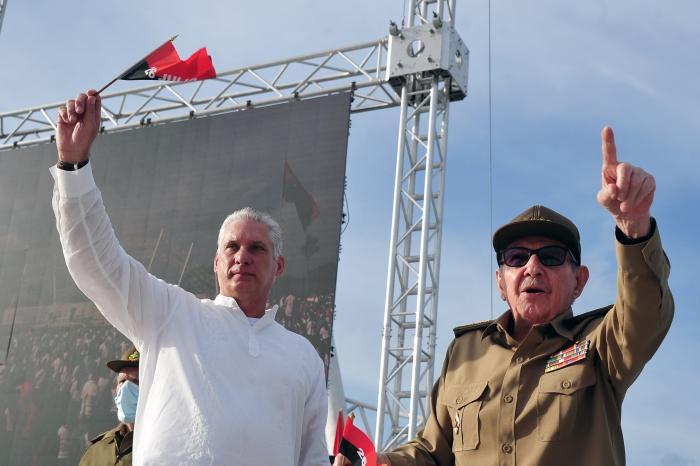
Dear Army General Raúl Castro Ruz, leader of the Cuban Revolution;
Moncadistas present;
Friends of the movement of solidarity with Cuba who are with us;
Dear, combative and revolutionary people of Cienfuegos (Applause);
Fellow countrypeople:
It is already the 26th! We return to Cienfuegos and we return to a face-to-face event after two years without such celebrations.
This possibility is the result of a feat: the control of the pandemic with our own efforts and resources under the conditions of a six-decade economic war.
And it is also an opportunity: it allows the leadership of the Party and the Government to praise and highlight the results of a territory.
The traditional beauty of the Pearl of the South, which has multiplied in the works in salute to July 26, shows us how much impact in our territories has our eternal celebrations of such a historic day. This adds another fundamental value to it.
Next year we will celebrate the 70th anniversary of the assaults that changed Cuba's history. The living protagonists come out of the books to explain to the students the reasons that led them to sacrifice their young lives on the altar of the Homeland, with no other certainty than the faith in their ideals.
Now they are here and we are greatly honored to know the testimony of their revolutionary lives, in which they shared combats and sleepless nights with Fidel, Raul, Ramiro, Almeida, Abel, Haydeé and Melba, not only during that action, but in the seven decades that followed. Their valuable memories are part of our way of understanding and loving the Revolution with the deep conviction that we are part of it.
But that experience also poses us a challenge in the formation of the new generations, who for biological reasons will no longer have the possibility of knowing closely the heroes of a fundamental chapter of national history. So fundamental, that it is not possible to explain Cuban socialism without the reasons that led Fidel and the Generation of the Centenary to storm barracks with simple rifles and an arsenal of ideas.
The imperial logic, which we have been talking about these days, bets on amnesia and social paralysis. They intend that, under the pressure of the material needs generated by their infamous 63-year blockade, the spirit of resistance of the people will give way and even intend that the last generation will forget why a socialist Revolution was made by the humble, with the humble and for the humble, 90 miles away from the American dream.
It also bets on alienation, that history is only a past of sacrifices from which the new generations must escape if they want to have a place in the "fair of vanities," in the illusion forged by the universal entertainment industry, according to which a beautiful and satisfied middle class enjoys the benefits of modernity, an exclusive territory for winners who will be served by those excluded from the system.
In this world of oblivion, History Will Absolve Me would cease to interest young people, because it is from another time and was made to cure other ills.
In case this would happen, as the Venezuelan brothers say, it would be difficult for the Cubans of the future to know that when the American companies practically owned Cuba, their great allies were the army, the police, the eviction, the machete plan, torture and death.
They would ignore that the great majorities did not own the land they worked, nor the houses where they lived. That, in general, the poor, the blacks and mulattos could only enter through the back door of businesses and mansions. That women were at a complete social disadvantage compared to men. That the most recurrent image in urban landscapes was that of street children: shoeshine boys, newspaper vendors, messengers of any business, homeless, sick and hungry. And the most common in the rural landscapes was of children with their bellies swollen with parasites.
It would not be enough all the acts that we have yet to celebrate, and I guarantee that we will, to expose the reasons why those young people, who today are the venerable grandparents or great-grandparents of the new ones, gave up their personal dreams and sold what little they had to go to an uncertain fight.
The media that oppose us will surely say tomorrow that the Cuban President charged against capitalism with "rhetoric of the past".
The truth is just the opposite. We are interested in preventing the past from returning. The future cannot be the past! Because the Cuba of the day after, the one they dream of sending us with the U.S. gunboats and on deck the infamous congressmen who vote there in favor of all the laws against their own country of origin, that Cuba, would be the return to the day after the assault on the Moncada: a bloodbath, a revenge of hatred and the reinstatement of everything the assailants intended to change and only the Revolution transformed forever. Although in the midst of a lamentable and long blackout mixed with the sweltering summer of these days some may feel that nothing is worse than the spate of negative events we have been suffering and seek relief by cursing, deep in their souls they all understand that, inefficiencies aside, the blockade is at the root, in the trunk, in the branches and in the fruits of our economic difficulties.
And, although they will not publicly acknowledge it, even an annexationist knows that Cuban problems are not going to be solved by those who have created them and maintain them with absolute disregard for the world condemnation of that scandalous abuse that has lasted for more than half a century.
Cuba is not alone! It has never been alone! Cuba represents not only the alternative to the unjust and exclusionary order that prevails in the world. We are also the possibility the world has to prove there is room for all ideas and political systems; so democracy, as proclaimed as it is violated, is recognized in all its diversity.
Socialism cannot continue to be defamed in the name of freedom, while all the doors to trade, finance and business are closed to the countries that are trying to do so.
The economic, financial and commercial blockade, the rabid persecution that this policy of a powerful empire has turned into against a small nation is, right now, the best proof that socialism does work, because even under the fire of the blockade we have built a work of social justice that places us at the level of the most advanced countries in key indicators of human development such as infant mortality, life expectancy at birth, access to health, education, culture or sports and the levels of citizen security and protection.
In the midst of the deep and sustained shortages of so many years, under the suffocating pressures of a war economy -because that is an economy under blockade-, we have never renounced the socialist aspiration of benefiting everyone, offering them multiple possibilities of human fulfillment.
We believe above all in happiness as a result of personal and collective fulfillment, based on the real possibilities of each individual to have access to knowledge and to participate actively in the society in which he or she lives.
We have achieved something in this endeavor. It can be seen in the signs that distinguish Cuban emigrants from the tens of thousands of their peers in the rest of the world. Most of ours have studies for which their relatives did not have to pay, even specialized studies of the highest level that in other countries indebt the graduate for life.
In general, they are distinguished by the knowledge and quality of their professional training, as well as by the different treatment they receive for political reasons. Although practically nobody talks about the Cuban Adjustment Act anymore, this differentiated treatment of our nationals to feed the anti-socialist discourse declaring a non-existent persecution, is part of the central objective of the war against the Cuban Revolution: to crush the alternative, to demonize socialism, to prevent other peoples from being inspired by this experience.
There is no other explanation for the maintenance of the blockade against Cuba, so incompatible with the discourses of freedom, democracy and human rights that U.S. politicians like to dictate so much. All the rhetoric against Cuban socialism clashes and denies itself in the face of this undeniable truth.
Our conclusion is that the blockade is maintained because without it this country would be a model of human society too subversive for the world order. And those who think otherwise from the "opposite side of the street", from those who impose and maintain the blockade against all civilized and humanist logic, let them lift it totally and unconditionally now! Take away the pretext! (Applause).
If the United States take away that pretext, then the world will respect them and will judge Cuba.
My fellow countrypeople:
In the time elapsed since the last celebration of July 26, we approved a new Constitution and legal norms that place the country at the forefront in guaranteeing rights for all, as has just been verified in the most recent sessions of the National Assembly, by approving the monumental Code of Families. I call on you to support it in the September referendum.
The debates on these sensitive issues have awakened consciences and have deepened the knowledge about the diverse and plural Cuban society, which has not ceased to shake off ballast, prejudices and brakes since the triumph of the Revolution.
In the same period, the American society went back almost a century in terms of women's rights, by denying the existence of the constitutional right to abortion. It also aroused worldwide solidarity in the face of an epidemic of shootings and massacres in schools and public places.
Rarely has the contrast drawn by Martí been so clear when he described the two halves of the continent, the two Americas growing in the opposite direction: the one "that has to save itself with its indigenous people, and goes from less to more ... [and the one] that drowns its indigenous people in blood, and goes from more to less."
When we evaluate the hard circumstances, we have gone through in the last year, since the complex days of July 2021, it is fair to underlined the international solidarity among the forces that our country has counted on to support its impressive resistance.
In July of last year, by dint of great pressure, the United States achieved the pronouncement of a handful of countries, apparently concerned about what was happening in Cuba, while they ignored or closed their eyes to the harsh conditions to which millions of people were subjected under the impact of COVID-19.
It is still moving to recall the formidable expressions of support from governments, parliamentarians, political organizations, friendship groups, artists, intellectuals, religious leaders and groups, trade union and social movements, as well as individuals from all over the world who sympathize with just causes and oppose abuse. Among them are the numerous expressions of solidarity and empathy from people of Cuban origin living in many countries, including the United States.
In the face of the obvious material shortages suffered at the most critical moments of the pandemic, Cuba received solidarity support from several governments of friendly countries, as well as from groups and individuals. This aid has not been limited to important material resources to support the efforts of the Public Health System to face the pandemic, but has also included food and other sensitive supplies for the consumption of the population.
We have received valuable shipments for the direct benefit of our people from Venezuela, Bolivia, Mexico, Vietnam, Nicaragua, China, Russia, Italy, Japan, St. Vincent and the Grenadines and the Dominican Republic, among others, to mention just the most significant.
Some 170 companies and businessmen from 29 countries, and 171 associations of friendship, solidarity and of Cubans living abroad, from 43 countries, provided us with assistance.
From the United States in particular, during the last year we have received multiplr expressions of friendship and commitment from organizations such as Pastors for Peace, the Venceremos Brigade, Code Pink, Puentes de Amor, Answer Coalition, The People's Forum, Wyckoff Medical Center, Alianza Martiana, just to mention a few (Applause). Also, the support of the Juan Rius Rivera Puerto Rican brigade and the young people of the Party for Socialism and Liberation of the United States, who are with us today (Applause).
We also receive many other expressions of support from organizations in Latin America and the Caribbean, Europe, Africa, Asia and the Middle East, with a long history and tradition of support for the Cuban Revolution and opposition to U.S. aggression.
We received, simultaneously, vigorous political expressions of support and solidarity.
In the first place, I would like to highlight the beautiful words about Cuba, pronounced by the President of the United Mexican States, Andrés Manuel López Obrador, when commemorating the 238th anniversary of the birth of the Liberator Simón Bolívar.
That heartfelt message from the dear people of Mexico to the Cuban people in recognition of our dignified resistance to the criminal blockade of the United States, has been reiterated more than once in Las Mañaneras de AMLO with the thrilling force of coherence and truth.
The publication on a full page of the influential newspaper The New York Times of a powerful demand that Cuba be allowed to live, and the subsequent projection of that demand on a front of the central Union Square in New York City, were powerful expressions of solidarity at a time when we were going through the most difficult stages of the pandemic, the effects of the intensification of the imperialist hostility and the ferocious campaign of slander and discredit against Cuba.
These are just the most visible expressions of an active and invariable solidarity, which campaigns of boycott and lies against the Revolution have not been able to obscure or destroy. A historical exercise of affection among nations, which does not appear in the laws but has been inscribed with indelible ink in the DNA of Cubans.
Solidarity and internationalism have guided Cuba's foreign policy since the revolutionary triumph of 1959. Throughout the years, we have known how to share and embrace the just causes of other peoples, almost always on the basis of shared sacrifice.
From very early on, we have considered that we owe a debt of gratitude to international solidarity. Therefore, anyone who considers it possible to isolate Cuba will always be mistaken. We enjoy extensive and active relations with practically the entire international community. Every year the member states of the United Nations vote almost unanimously to end the U.S. economic blockade, and our country enjoys recognition, prestige and authority for its contribution to international cooperation and its active and constructive participation in international forums.
Fellow countrypeople:
In the recently concluded sessions of the National Assembly, it was announced measures that seek to mobilize, in the shortest possible time, supplies and financial resources that we lack today. The details of their implementation will be announced in the coming weeks. If we want to have positive results in less time, it is essential to act responsibly, seriously and with discipline.
Many friends and admirers of our process continually ask us what is the Revolution today. Not in the concept, which Fidel already gave us, but in the way in which it is verified in practice.
That answer will correspond to the social scientists, to the scholars of the revolutionary processes, who will know what we do better than we do. However, I am very clear about some terms: democracy and popular participation, humanism, will to transform, creativity, innovation, commitment, ideals and revolutionary passion (Applause).
We can add other experiences that help us to develop the leadership of the country in direct contact with the people. Under pressure, needs -which have grown and deepened throughout Cuba with the scourge of the reinforced blockade, the pandemic and the impact of all the crises the planet is suffering- awaken in some selfishness, ambitions and attitudes as harmful as corruption, which undermine even the greatest efforts of the State to cushion inequalities and address vulnerabilities.
The years of harmful egalitarianism have passed, but social justice continues to be our guide. It underpins the balance of a society such as ours; we cannot leave it in the discourse.
It is a fact that where local governments neglect the essential control and underestimate the capacity of natural leaders and neighborhood organizations, crime weakens social work.
We know it. The people denounce it. Corruption is a cancer that corrodes everything, that irritates, that demobilizes, and that goes against the socialist ideal. We will not let it invade us, we fight it and we will continue to do so relentlessly.
Comrades:
Considering the dramatic conditions in which the whole planet moves today, besieged by the multiple crises generated by climate change, wars, pandemic, corruption, organized crime and other evils, we have some advantages to face it: the accumulated experience to the point it is creative resistance -as I like to call it-, clear objectives and priorities and unity, the expensive and precious unity conquered throughout years of struggle, after many setbacks and as a prize after successive victories of Marti’s and Fidel’s ideology of the Revolution.
At the beginning of our ceremony this morning we heard Fidel's words in one of the first celebrations of July 26th in the 1960s.
I would like to reiterate them now as an expression of the links of history that explain the enigma of a victorious Revolution:
"If we had given up after the Moncada attack or if we had given up after the Granma incident or when we were left with very few men, when only seven of us had guns--if we had accepted the idea of defeat, we would have been defeated right then and there. We were not defeated, simply because we never accepted the idea of defeat.
" This should always be our attitude, and this should be the great lesson of our history (...). " The attack on [Moncada was] one of the many fortresses that had to be taken later. Many Moncadas remained to be taken. Among other things there remained the Moncada of illiteracy and our peopledid not hesitate in attacking that fortress. They attacked it and took it.There was the Moncada of ignorance, the Moncada of inexperience, the Moncada of underdevelopment, the Moncada of the lack of technicians, resources of every type, and our people have not hesitated in undertaking the attack on those fortresses either.
..." End of the quotation, which suits very well to the present times.
It is up to our generation to assault the fortresses of economic inefficiency, bureaucracy, insensitivity and hatred. On their remains we will build the prosperity that is possible. And we will do so while continue to demand Down with the blockade! (Exclamations of: Down!)
Let's build a better country ourselves! (Exclamations of: Let’s build it!)
History gives us strength, inspires us, impels us and encourages us! If they could do it, we can do it!
Eternal glory to the heroes and martyrs of July 26th! (Exclamations of: Glory!)
To Victory, Always!
Socialism or Death!
Homeland or Death!
We shall overcome!
(Exclamations of: Long live Raúl! Long live Fidel!) (Ovation).


