

The role of foreign investment has been substantially modified in the recent decisions of the Cuban State to address the problems of shortages and contribute to improve the supplies in the stores of freely convertible currency and Cuban pesos.
Alejandro Gil Fernández, Deputy Prime Minister and Minister of Economic and Planning pointed out that one of the main priorities was the increase of wholesale offers while speaking at the Foreign Investment Business Forum, organized by the Ministry of Domestic Trade (MINCIN in Spanish), which was attended by representatives of the diplomatic corps, national and foreign businessmen and officials from Central State Administration agencies.
The Minister of Economy and Planning also reflected that this strategy is critical due to the demand of resources by both the private and state business sectors, which is currently supported by imports, which represents a space for the participation of foreign capital in wholesale trade.
He added that one of the country’s strength is that the infrastructure exceeds the production levels. He admitted that the technology in many industries and factories are technologically obsolete, they are also underutilized due to the lack of raw materials.
For this reason, rather than promoting the investment on warehouses and factories, they are promoting the investment in the reactivation of the ones currently existing. Cuba has the capacity to produce and consume but lacks supplies due to the need for financing.
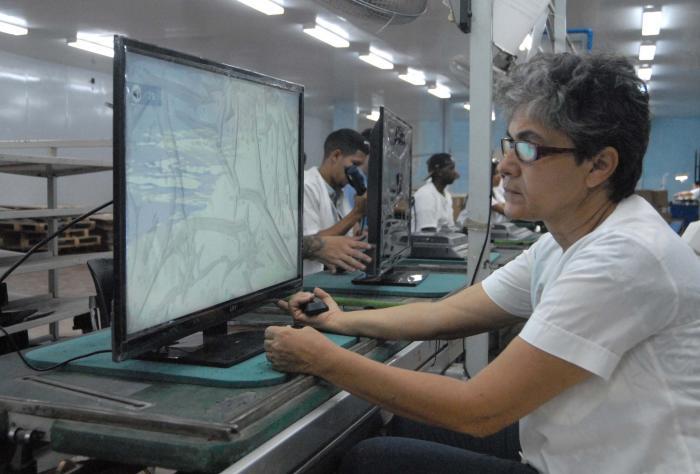
This is why we need to bring foreign investment into production, in order to supply the country’s market. For example, Cuba needs to start up the electronics industry, which products are in high demand in the market, said Gil Fernandez.
The State is looking to make the national infrastructure available to foreign investment in order to increase production. It means to increase the supply at a greater speed than what would be achieved if Cuba gradually recovers the foreign currency income lost on the Island, which is more than 3 billion in a very short period of time, he said.
The objective is that foreign investors put products in the country, and make the most of their experience, financial facilities and technology. Cuba will provide the infrastructure and state and non-state economic actors.
Regarding retail trade, which is open to the participation of foreign investment in the joint venture modality, the aspiration is not only to commercialize imported products, but also to make foreign investor interested in pre-financing the national industry, acquiring the products and commercializing them, the Deputy Prime Minister said.
MANY BUSINESS OPPORTUNITIES
During the Business Forum, which was also attended by Eduardo Rodríguez Dávila, Minister of Transportation, several Cuban entities presented business opportunities and their main characteristics under the new principles and measures approved in early August and recalled by Betsy Díaz Velázquez, Minister of Domestic Trade, at the opening of the event.
Luis Carlos Góngora Domínguez, head of Foreign Trade of the Government of Havana, presented several proposals that would contribute to improve services to the capital's population.
He highlighted the possibility of production and wholesale and retail marketing of consumer and intermediate goods in the capital, which are in high demand, associated with bakery and confectionery activities, artisanal and industrial production of candies and other confections, as well as food processing and preservation, among others.
He explained that there is market potential is clear due to the growing number of micro, small and medium-sized enterprises engaged in these activities, and the fact that these products and raw materials are widely used at home, in the family diet, which explains their demand in retail.
The products to be marketed are of general use, such as sugar, salt, flours and specific mixtures, gluten-free flours, containers and packaging, fats, oils, yeasts and colorants, among other raw materials, he added.
Regarding other business opportunities,Tomás Oviedo, from the Business Division of the Ministry of Industries (MINDUS), proposed several areas that have potential for foreign investment such as the commercialization of tires, rubber articles, and consumables and equipment related to these productions.
He pointed out that the business will be conducted in the form of a wholesale trading company that will seek to meet the highly unsatisfied demand for this type of supplies. Clients of this enterprise could include ministries such as MINCIN and the Ministry of Transportation (MITRANS), the construction sector or any other sector of the economy with automotive transportation.
He then introduced another opportunity, this time from the chemical industry, which consists of the creation of a wholesale entity that commercializes flat glass and articles made of this material and equipment for the factories using this material.
This business would seek to meet the demands of that market, to acquire new technologies for the development of this industry, but also to recover and to take advantage to the maximum of the capacities already installed.
The agricultural sector also presented a number of opportunities. María del Carmen Fages Plasencia, head of the Logistics Business Group of the Ministry of Agriculture (GELMA), proposed the development of a chain of wholesale and retail stores to offer a variety of products and inputs nationwide.
For this, she proposed to select at least five store, which location can be discussed between the parties, supported by wholesale warehouses.
The GELMA official referred to the high demand in the sector for raw materials, tools and accessories, among others. Another potential line of development would be the use of underutilized logistic capacities, for which there is a network of understocked establishments.
CONDITIONS ARE INCREASINGLY FAVORABLE FOR FOREIGN INVESTMENT.
At the meeting, Ana Teresita González Fraga, First Deputy Minister of Foreign Trade and Foreign Investment, explained the general principles for investment created in the national territory. As explained a few days ago, the measures expand the scope, they are not restrictive, but they are made to attain an ultimate goal and therefore should be watched over and complied with.
On the other hand, she also mentioned several conditions and guarantees with which they operate, such as the Single Window, created to accompany investors and facilitate the whole process.
She emphasized that Cuba has an updated Portfolio of business opportunities, which was redesigned with a more interactive visual environment and can be visited from anywhere in the world, with an integrated search system that contains about 678 projects in the prioritized sectors of the national economy.
The favorable environment for foreign investment has increased in recent times, and the evidence is in the agreement that some investments are approved at ministerial level. There is also the facilitation of business for agri-food production and there is a broader vision towards the professional services sector and the financial system, González Fraga continued.
There is also the possibility of setting up businesses online when the foreign partner cannot travel to the country, she said.
Moreover, a differentiated financial scheme for the new foreign investment modalities has been evaluated; that is to say, the businesses will operate in foreign currency, so they will make all their collections and payments with full liquidity support in foreign currency and will register their accounting in foreign currency. They will also operate in real accounts in foreign currency, from which they will freely order payments abroad.
This authorization will be maintained until there are conditions in the economy to ensure total convertibility of the national currency. At that time these businesses will start operating in CUP, without affecting their operation.
She emphasized the proposal to make the requirements for submitting proposals more flexible, in order to reduce the amount of documentation that is currently required for their approval.
She also ratified that, in spite of the difficulties the country is going through, Cuba's attractiveness for foreign capital and the numerous business opportunities in most sectors of the economy are recognized.
This opens the door to a new way to accelerate the recovery of trade, which is equal to improving the supply of goods and services to the population throughout the island.


