

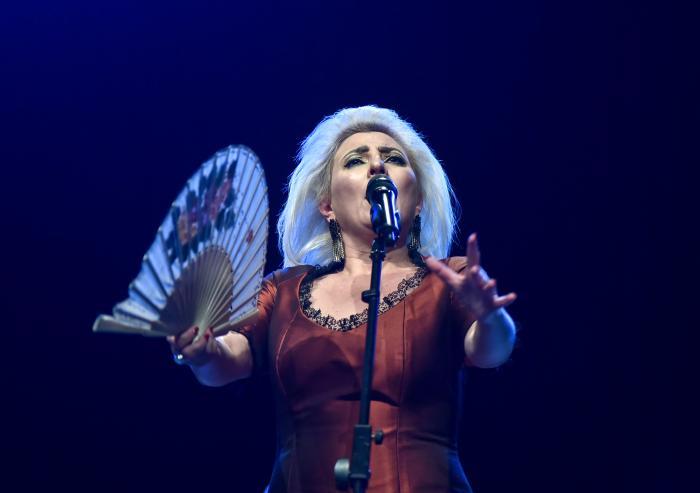
The name given to the concert is absolutely frank, and the singer displays her admiration by her fellow countrywoman in a two-and-half hour concert. Pilar's thrilling voice and timely chat makes possible the "return" of the Jurado, a singular woman who assumed carefree positions from the art.
Pilar has not only lost something with the departure of the extraordinary singer who immortalized songs learned and sung by the entire Spanish-speaking community of the world, but rather much, very much, of that temperamental woman has remained in her. Beyond brilliantly defending the repertoire of "the greatest" since 2020, when the concert premiered in Spain, the knowledgeable anecdote, the remembrance in its right measure and the sincerity that she poured in her performances, attest to this.
The audience gathered in the Covarrubias Hall of the National Theater of Havana (she also performed at the Church of the Virgin of Regla, the Sauto Theater and the Amphitheater of Havana's Historic Center) could witness all of this.
Accompanied at first by the musicians of the jazz band of maestro Joaquín Betancourt, directed on this occasion by Jaime Reyes, the singer opened her tribute with Como las alas al viento (like wings in the wind, Agustín Abellán Malla, Chango), to continue with Amor marinero, (sailing love, Bazán and García Tejero), a song that is among the first of Rocío Jurado, who "arrived at a different moment in the world of the copla," and that was one of the most censored on Spanish TV "for the gestures that those hands, that body and that woman made to interpret it".
Songs such as Vibro and Si amanece, well known by the Cuban public, had already raised the temperature of the auditorium when the full performance of Señora, a song by Manuel Alejandro, brought the theater to its feet in a sustained applause and not a few wiped away tears.
With emotions running high, the audience listened to a confession from Pilar, her answer to what she usually says when asked what she loves so much about Cuba. "Well, its people. When you taste the applause of this island, no one else convinces you," she said, and without introduction, as it was unnecessary, came Como yo te amo (As I love you). Already in the chorus, an "alteration" of the lyrics was noticed: I love you, Cuba, and again it was applauded.
To sing Algo se me fue contigo, written by Manuel Alejandro for Rocío Jurado, after the death of the artist's mother - "a song that I don't know how she could interpret"-, Pilar invited the maestro Alejandro Falcón on the piano, who also accompanied her in ¡Ay, pena penita pena! by Lola Flores, another great singer, who considered that, having seen much art, there was no one like Rocío's.
Falcón, together with the flamenco group that came to the Island with Pilar, put music to Como una ola, which was applauded for a long time. Then came La bien pagá, played by Miguel de Molina; a classic like the copla Ojos verdes, composed by Manuel Quiroga, with lyrics by Rafael de León and Salvador Valverde; Qué no daría yo, written for the Jurado by José Luis Perales, and the ballad Se nos rompió el amor, now with a flamenco arrangement and brought to life by dancer Andrés Malpica.
By thanking the Cuban institutions, she closed the concert with the songs Virgen de Regla and Me ha dicho la luna, the latter with the theater on its feet, after living a night in which Rocío and Pilar blended in one, blessed by music, transcendence and eternal harmony.
Translated by ESTI


