


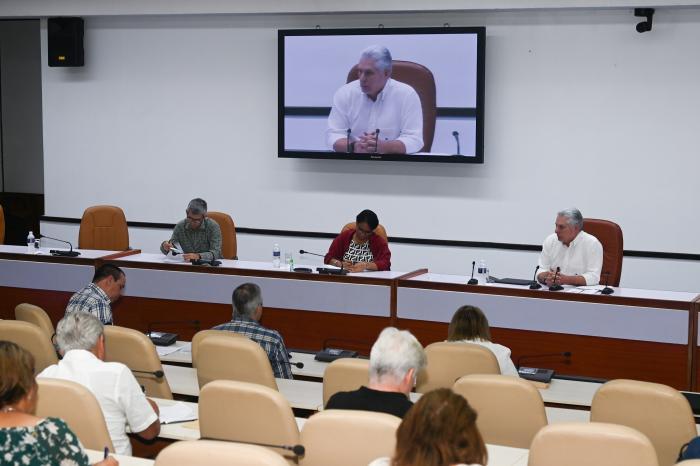
Demographic dynamics and, within it, population aging are issues of the present and the future, emphasized the First Secretary of the Central Committee of the Party and President of the Republic, Miguel Díaz-Canel Bermúdez, in this week's exchange with experts and scientists on health issues.
At the meeting, science and innovation actions were presented to guarantee healthy aging and on medical technologies to be made available to health institutions, in order to increase the quality of care for the elderly.
Díaz-Canel indicated to follow-up this matter regularly to the Program on demographic dynamics, a reality -he said- that is transversal to all social processes and, at the same time, one of the most challenging and relevant issues we face today.
The meeting, which was moderated by the Minister of Public Health, Dr. José Angel Portal Miranda, was also led by Deputy Prime Ministers Inés María Chapman Waugh and Jorge Luis Perdomo Di-Lella.
Engineer Arlem Lesmes Fernández Sigler, general director of the company Combiomed Tecnología Médica Digital, attached to BioCubaFarma, presented the geriatrics and gerentology evaluation kit that the institution will make available to the national health system (sns) to care for the elderly.
The technological package was based on the 150 kits provided in the Turquino-Manatí Plan to serve these distant communities. The kit now presented by Combiomed responds to the demand matrix to serve the elderly population at the first level of care.
The kit will be destined, in its first stage, to:
Thirty psycho-pedagogical medical centers - social institutions of the SNS in charge of comprehensive care for people with severe and profound intellectual disabilities).
One hundred and fifty-eight nursing homes (social institution of the SNS for long-term cohabitation for older adults who, for medical and/or social reasons, cannot maintain an autonomous life and cannot be cared for in their situation of dependence by other forms of non-institutional care.
The 450 multidisciplinary gerontological care teams that exist in the country's polyclinics for the care of older adults with health conditions and/or social determinants (frail elderly) under specialized multidisciplinary and outpatient care.
And 11,548 family doctor's offices, which cover 100% of the population, with preventive actions for healthy aging throughout the life course.
The Combiomed Kit for geriatrics and gerontology evaluation includes a stethoscope, an automatic sphygmomanometer (Hipermax BF), a sumaSensor glucometer (for blood glucose monitoring); a system for the comprehensive clinical management of cognitive deficits in the elderly (NeuroGer), a pulse oximeter (Oxy FT), a device for the prevention and treatment of ulcers (Stimul W), a digital clinical thermometer, a hammer for measuring neurological reflexes, and a flashlight for medical use.
The equipment, which focuses on the ten leading causes of death in our country, will have guaranteed technological sustainability. As a medical technique, it will also be introduced in the updating of the policy of care for the elderly, and as part of the digital transformation, the transmission of data and its incorporation into the digital medical book of each person is foreseen.
Dr. Mitchell Valdés-Sosa, general director of the Center for Neurosciences of Cuba (Cneuro), recalled that this innovation of Combiomed is the result of a meeting of the First Secretary of the Central Committee of the Party with members of the Academy of Sciences of Cuba, a year ago, when the situation of demographic dynamics was addressed, and indicated to give a technological response to the care of the elderly.
Doctor of Sciences Antonio Aja Díaz, director of the Center for Demographic Studies of the University of Havana, addressed the process of population aging from various aspects of social sciences, and invited to continue investing in the quality of life of the population that is not yet aged, as a way to reaffirm the purpose of aging in a healthy way.
Dr. Liliam Rodríguez Rivera, director of the Center for Research on Longevity, Aging and Health (CITED in Spanish), was in charge of the initial presentation of the topic, with the paper Science and innovation in terms of healthy aging in Cuba.
She pointed out that, while in 2021 the aging population was 21.6%, in 2022 it is already 21.9%, according to data from the National Office of Statistics and Information (ONEI in Spanish), and it is estimated that by 2050 this will amount to 33.2% of the total population.
Dr. Rodríguez Rivera stressed that the United Nations designated the period 2020-2030 as the Decade of Healthy Aging, for which four areas of action were established. Cuba is working in all of them with the purpose of changing the way we think, feel and act towards age and aging.
Another field is to ensure that communities foster the capabilities of the elderly. For this purpose, cities and communities friendly to the elderly are promoted, a program to which the municipalities of Plaza de la Revolución (the most aged in the country, where 29.3% of its population is composed of elderly people), Alamar and Habana Vieja have joined.
The meeting also included the presentation of the update of the COVID-19 forecasting models by Dr. Raul Guinovart Diaz, dean of the Faculty of Mathematics and Computer Science of the University of Havana.
In his conclusions, the researcher emphasized that:
During the week of February 13-17 there was a decrease in the number of cases compared to the previous week. The accumulated incidence in the country is at less than 1.5 cases per 100,000 inhabitants in the last 15 days, with a tendency to decrease. Sancti Spíritus and Holguín are the regions where the number of cases remained above two.
All provinces will maintain the trend towards control of confirmed cases in the following weeks, although the slight increase in the number of confirmed cases will continue.
It is verified that the vaccines and the vaccination strategy followed have had very remarkable results, which allow maintaining Cuba in a normal situation, with no deaths due to the disease.
The alert remains, as there may be an increase in the number of cases due to the arrival of visitors and the possible entry of new variants.
Translated by ESTI


