

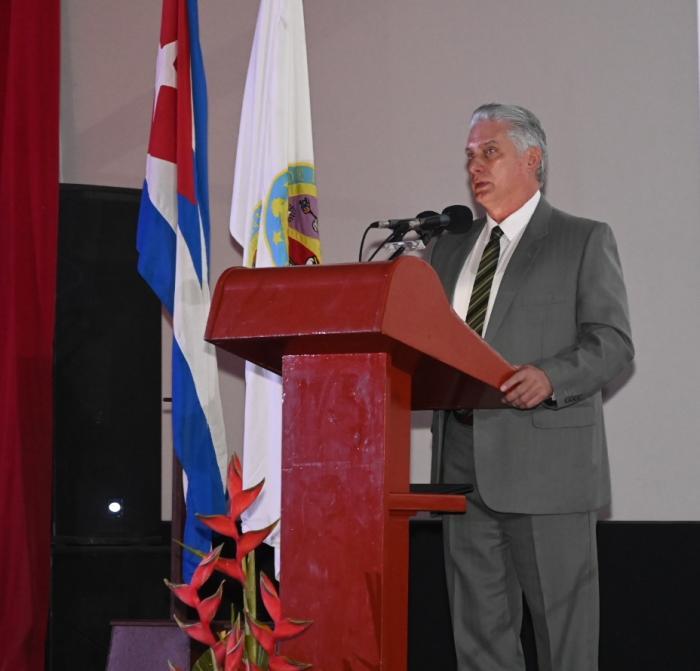
The University, hand in hand with economic actors of society in the search for solutions and the design of projects oriented to the development of the country, as part of the Government Management System strategy based on Science and Innovation, was one of the main topics tackled by Miguel Díaz-Canel Bermúdez, First Secretary of the Central Committee of the Party and President of the Republic, in this capital.
In a keynote lecture given as part of the inauguration of the Saber-UH 2023 International Scientific Convention, in the capital's Yara cinema, the engineer and Doctor of Science said that in recent years, based on the fulfillment of the country's economic and social policy, a group of legislative and regulatory exercises have been developed boosting the development of scientific research and innovation in the nation.
He went on to say that it is all about how to integrate and strengthen scientific research and innovation, considering all the challenges the country faces.
He highlighted the factors that support science and innovation as mainstays of government management, as well as the Cuban tradition, which is reflected in the thinking of men such as Felix Varela, José de la Luz y Caballero, José Martí, Carlos J. Finlay, Álvaro Reynoso, Tomas Romay and Fidel Castro Ruz.
He explained the functions of the Government Management System based on S&T, saying that this mechanism sets priorities and allocates resources, improves expertise, designs policies, encourages interaction and removes barriers, disseminates S&T to all areas and sectors of society, motivates and encourages all actors involved in the development of the country, reinforces institutions, promotes innovative values and approaches, provides scientific advice on policies, and works to establish a strong link between science and government.
The Head of State said that there are examples of capacity building in science, technology and innovation well articulated with society, as has happened with the biotechnology and pharmaceutical industry in our country, but that, unfortunately, these good results are not effectively achieved in all sectors of the Island.
In spite of this, he stressed that, in the last three surveys on innovation, conducted by the Ministry of Science, Technology and Environment (CITMA), it has been shown that there is limited progress in innovation, insufficient interconnection between all the actors that contribute to this area, which is expressed in the weak relations between the knowledge sector and the sector of goods and services, and also the territories.
In his speech, the Cuban leader raised the question of why a Government Management System based on Science and Innovation, and said that the first thing he did was to recognize this as one of the pillars of his administration, as the path towards the transformation of the society we want, with integrated and interconnected institutions in the search for solutions.
"For science and innovation to become pillars of government management, there must be the political will and all the governance to manage them at the country level, a productive-innovative system, addressing the contents of science, sustainability in a financial regulatory framework that supports these processes, the development of human potential and, of course, the role played by the knowledge sector and, in particular, universities," he said.
Among the advances and results achieved as a result of the implementation of the System, the President of the Republic mentioned the implementation of government policies at territorial level and the mobilization of expert knowledge at those levels, and the strengthening of links between the knowledge sector, the goods and services production sector and the Public Administration.
He said that this is in addition to the creation of scientific-technological parks, university-society interface companies and foundations, among other instruments to dynamize innovation, as well as the operation of the National Innovation Council.
He added that Cuba has to achieve intersectoriality, while continuing to work in the valuable field of social sciences, to achieve better results in government management.
He also stressed the need to promote and increase the strategy for doctoral training, since it is vital to have highly qualified personnel to carry out the nation's development programs.
Miriam Nicado García, Vice-Chancellor of the University of Havana, said that the convention brought together more than 2,000 delegates from 33 countries, and is one of the main actions of the program for the 295th anniversary of the founding of that university, on January 5, 1728.
She said that Saber-UH 2023 is made up of 34 events - including symposiums, workshops, congresses and seminars - which, until next Friday, June 2, will discuss various topics such as environmental management for sustainable development, geography, environment and territorial planning, languages and cultures, law in the 21st century, population, public administration and local development, as well as the XXVII Edition of the Havana Model United Nations (HAVMUN 2023).
The inaugural ceremony was attended by Ministers Walter Baluja García, of Higher Education; Marta Elena Feitó Cabrera, of Labor and Social Security; Mayra Arevich Marín, of Communications; Alpidio Alonso Grau, of Culture, and Antonio Rodríguez Rodríguez, president of the National Institute of Hydraulic Resources.
Also present were rectors of other universities in our country, deans of faculties, academic personalities, students and a representation of the diplomatic corps accredited in Cuba.


