

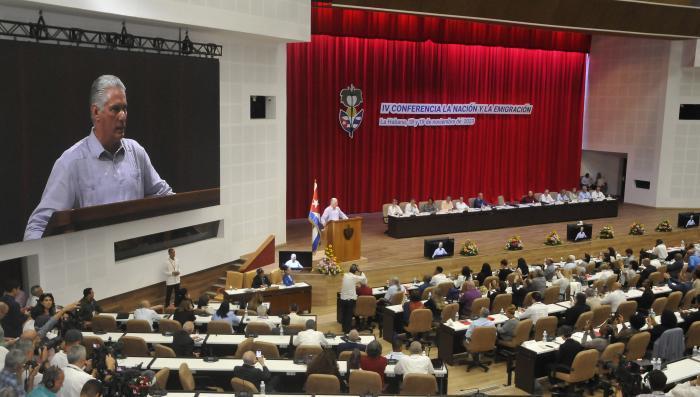
(Shorthand versions - Presidency of the Republic)
Dear compatriots:
"Truly, the feeling for the homeland is strong." We can repeat here today Fidel's words at the end of the meeting with the members of the Antonio Maceo Brigade, 46 years ago.
If those of us who live here feel proud to sing the national anthem, to listen to its chords on Alexander Abreu's trumpet, or to see the clapping from the windows of an airplane when returning from a trip, it is not difficult to imagine the emotion of those who, like you, feel the same way living far away from Cuba.
It is this feeling that has animated all the dialogues from then until now. It is the feeling that has allowed us to grow between meetings and disagreements, successes and failures, always preserving what unites us above all that could separate us.
And it is what has always moved us in these days of exchanges and deliberations, which, however topical in their content, activate our memory and increase our gratitude to those who paved the way to dialogue with patience, faith, patriotism, respect and understanding when it seemed impossible.
Recently, just last week, we watched the documentary 55 Brothers again at home with our family. Five of those boys are here today. The passage of time has not changed their feelings. We must thank them for paving the way, for not getting tired, for making the refrain they all sing at the end of the documentary come true: "The homeland has grown, said the commander..." (Applause).
This beautiful group of young compatriots was the forefront of other emigrants to the United States who accepted the invitation of the Cuban authorities to work together in the design of a new model of relations between the nation and its children living abroad, based on full respect for the sovereignty and independence of Cuba.
These patriotic gestures came with many challenges and dangers. Those present had to overcome the threats and violence of those who were opposed to the dialogue, who had and still have the support of the United States government, whose policy toward Cuba has changed little or not at all for so many years.
It was also necessary to overcome doubts and prejudices, to know how to distinguish between the interests and concerns of Cubans living in the United States and the hostility of the U.S. government toward Cuba.
Today we find ourselves in a very different moment. The world in which we live has changed, our own country has deepened its process of transformation, the presence of Cubans living abroad is much more numerous and diverse, and they have settled or remain in very different latitudes.
Army General Raúl Castro Ruz acknowledged this when he said: "Today, the overwhelming majority of Cuban emigrants are for economic reasons [...] almost all of them preserve their love for their family and the homeland where they were born, and [...] show solidarity with their compatriots.”
Thanks to the protagonists of that first rapprochement and those who followed, the links are more frequent, more active, more open, more influential and more natural.
In any account of this long and dramatic history, it is impossible to forget Carlos Muñiz Varela and José Eulalio Negrín Santos (Applause), defenders of dialogue and relations with Cuba, who were brutally murdered by ruthless enemies of the nation and of their children's relations with it. Our greatest tribute goes to their comrades present here, who fought tirelessly for justice.
Every act of rapprochement and solidarity with the homeland will be the most heartfelt and best tribute to the martyrs and other compatriots who are not physically among us and who gave themselves completely to Marti's mission of achieving unity in pursuit of the defense of the homeland.
The efforts made, the risks taken and the blood shed are the most fertile seeds of the national tree. Nothing was in vain!
In these days, in addition to honoring the word promised when we were forced to suspend the meeting scheduled for 2020 as a result of COVID-19, we are fulfilling a historic duty: To continue on the path that began with the visit to Cuba of the 55 courageous young men and women of the Antonio Maceo Brigade in December 1977, the prelude to the so-called Dialogue between the Government of the Republic of Cuba and personalities representing the Cuban community abroad, or Dialogue of 1978, and the three subsequent Conferences of the Nation and Emigration, held in April 1994, November 1995 and May 2004.
At that memorable meeting in 1978, which Commander-in-Chief Fidel Castro Ruz promoted and encouraged, it was ratified that the Revolution wished to strengthen relations with Cubans living abroad, taking into account first and foremost the interests of that community.
Fidel said it clearly: "In one way or another, by various means, we had already become aware of the problems of the Cuban community abroad, its desire to preserve its identity, its desire to preserve its moral values, its cultural values; in short, an effort to preserve its identity.”
After all, as José Martí would say, what is the homeland but "a community of interests, a unity of traditions, a unity of goals, a sweet and consoling fusion of loves and hopes?”
As in 1978, on behalf of the Cuban Government, I reiterate our willingness to continue developing an open and broad dialogue based on mutual respect and the defense of the homeland. Today, as yesterday, with the commitment not to relent in the struggle to put an end to the genocidal blockade that has caused so much deprivation, pain and division in the Cuban family.
As direct or indirect victims of this criminal policy, all of us gathered here are aware that it is the greatest obstacle to the strengthening of the country's relations with the majority of Cubans living abroad. The blockade hinders the regular, orderly and safe flow of travelers; it affects the relations between nationals living in the United States and their relatives and friends in Cuba; it restricts the rights of our fellow citizens abroad and, above all, affects their families.
I will not dwell on data that, more than numbers, are open wounds in the body of the nation and in the center of its soul, which is the Cuban family. Behind every action of blockade, threat, intimidation; behind each of the 15 million dollars a day that have been quantified as loss in the first 14 months of an administration like Biden's; behind the number, huge but inert, there are children, young people, the elderly, mothers, grandparents; there is a country punished for the audacity of being free, independent and sovereign, 90 miles from an empire.
However, this rebellious and imperfect country not only quantifies and denounces the crime, Cuba resists and creates! Neither six decades of blockade betting on human exhaustion, nor more than 200 measures of brutal demolition of the few previous advances have been able to overcome the creative resistance of this people from which you and we were born, a formidable mixture of ethnicities, cultures, spirituality, which can only be defeated by itself the day we lose the dreams of a possible better world.

This creative resistance is what explains Cuba's successful confrontation with the pandemic, when the blockade was tightened and the United States prevented even the purchase of medical oxygen. It is the idea and the dedication that have produced five vaccine candidates, including three vaccines that have been efficiently and effectively tested, and Cuban pulmonary ventilators whose performance rivals the best in the world.
A government program based on science and innovation transforms ideas into achievements and works that make us proud, without hiding our shortcomings and aware of all that is lacking to overcome the walls of the blockade.
Our greatest strength lies in the talent, effort and invincible creativity of the Cuban people and in the work of six decades of the Revolution.
In this work we include, of course, the solidarity we give and receive from all corners of the planet, from all people of good will who accompany us in the struggle against the blockade and, to our satisfaction and joy, first and foremost from Cubans whose homeland is geographically distant but sentimentally at the center of their hearts. Feel recognized, then, in this daily victory, which we call creative resistance, over those who oppose us.
Compatriots:
Despite the aggressive policies of the U.S. government, the tightening of the blockade, the financial persecution, the slanderous, false and unacceptable designation of Cuba as a state sponsor of terrorism, and media campaigns full of lies and manipulation aimed at discrediting and undermining all the government's efforts to overcome the economic siege, numerous measures have been promoted and implemented by beleaguered Cuba over the past 45 years, and significant progress has been made in strengthening and diversifying relations with Cubans living abroad.
Our Foreign Minister recalled the words of Commander-in-Chief Fidel Castro and Army General Raul Castro, historic leaders of the Revolution,which those of us who follow them uphold with respect and admiration for their work in favor of normalizing the nation's relations with its emigrants, beyond the political junctures promoted by those who insist on defeating the Revolution by all means.
I will not repeat them. The most transcendental changes in this policy began 45 years ago with these historic dialogues; they have been strengthened in the last decade with important decisions in favor of the institutionality and rights of Cuban citizenship, a process to which we have the duty to give continuity, and we are doing so.
This is happening at a time when the U.S. government is increasing its coercive measures and threatening Cuban families with new penalties. They are not only hindering visas and regular access to a country where most Cuban emigrants live. A very influential anti-Cuban congressman in Cuban politics is demanding that those who return to Cuba on vacation lose their refugee status. This demand is the biggest lie of the campaigns that politicize all Cuban emigration.
The creators and supporters of the economic war against Cuba are trying to break our natural and growing bond with the emigrants through smear and defamation campaigns generously financed by their taxpayers' money.
Despite the constant feeding of hatred, there are currently 138 Cuban associations in 57 countries. Even in places where these organizations have not been formally created, there are many who participate in support tasks and in activities organized jointly with solidarity movements and with our diplomatic and consular missions.
I want to tell you that we are very proud and comforted by the various messages of condolences, offers of help and donations that you sent during the COVID-19 pandemic, and when we suffered the unfortunate accidents at the Saratoga Hotel, at the supertanker base in Matanzas, and the damage caused by the scourge of Hurricane Ian in the west of the country, just to mention the most recent cases.
“You can always leave your homeland, but never when it is in trouble," said Martí, and you honor that principle. You are at your country's side when it needs you. Cuba recognizes, appreciates and counts on your help.
Most Cubans maintain a stable and fluid relationship with the homeland, sharing its successes, showing solidarity with our causes, taking an interest in the country's situation and contributing to its socio-economic development. Moreover, when they do so, that mysterious deep feeling that provokes what Martí also described as the sweetest word: "Cuban" appears and becomes contagious.
This condition of being Cuban, which does not depend on ethnographic characterizations, was defined like no other by the scholar Don Fernando Ortiz: "It is not enough for the condition of being Cuban to have been born in Cuba, the nation and the life; it is also necessary to have the conscience. I think that for us Cubans the distinction between the general condition of being Cuban, and the full, felt, conscious and desired condition of being Cuban, the responsible condition of being Cuban, the condition with the three virtues: faith, hope and love, would be convenient for us Cubans.
We insist on Marti's formula of a Cuba with all and for all, making it clear that this "all" does not include those who conspire against the nation to attack and insult it, those who call for invasion and license to kill their own people, nor those who defile the Lone Star flag with the annexationist call to make us the 51st state of the American Union, and those who harass and attack the artists and athletes who represent us on international stages and events.
We will never refuse to grow in rights for all, except for those who live and work in the pay of another government with the declared purpose of destroying our project and its always unfinished work of struggle for the highest possible degree of social justice.
Our arms will be open with grateful recognition to receive and embrace those who risk their personal integrity and even their lives to defend and support the homeland in difficult times, such as the legendary Alianza Martiana, Puentes de Amor, the solidarity groups that every month, under the cold, the rain and the attacks of the haters, take to the streets in hundreds of cities around the world to demand the end of the blockade against Cuba (applause).
Looking at what has been said and discussed here, we could say that this conference has allowed us to make a comprehensive assessment of what has been achieved in the field of relations with our compatriots abroad and to identify the areas in which we still need to work together, but more importantly, it is a new starting point for higher and therefore more challenging goals.
I would dare to say, without fear of being mistaken, that all of us in this room share the recognition that today the relations between Cuba and its nationals abroad are at one of their best moments. The tree planted 45 years ago is strong, vigorous and protective like a ceiba.
One of the virtues of these meetings and the long process that began in 1978 is that it does not depend on relations, contacts or even the opinion of other governments. This is a purely Cuban exercise, among Cubans and for Cubans! (Applause.) (Cries of: "Long live the free Cuba!")
The fact that it is precisely the independence and sovereignty of the nation that is the common priority has made it possible to advance resolutely and irreversibly towards common goals, without being hindered by political, ideological or any other kind of differences.
I am impressed by the way in which almost all of you approach the homeland, with respect and understanding for the realities of the country and the legitimate rights of those who live, work, sacrifice and struggle in it, which also contributes to strengthening our relations.
I hope that all the presentations made during the Conference have allowed us, as we intended, to give you a first-hand perception of the progress made in the complex universe of relations between the nation and its emigrants, and to inform you with frankness about the reality that the country is living today. We have all learned from the debate, rich in ideas and nuances that took place both in the plenary hall and in the corridors of the Convention Center or on the stages of the accompanying activities.
The lifting of the blockade, the preservation of the undeniable social conquests, not returning to the horrors of the past of exploitation and subjugation of the homeland, were fundamental approaches with which the participants broadly agreed and which show us the sincere patriotism that survives in the Cuban community abroad.
The same goes for the inalienable defense of the right to self-determination and the prerogative to resolve, solve and overcome our own problems without foreign interference and without the constant coercion of the U.S. government. It is a right that every nation has or should have and that we Cubans value as a just conquest we will not renounce.
The exchanges that have taken place in the last 48 hours have allowed us to outline the path to be followed in order to increase the participation of Cubans living abroad in the socio-economic development of Cuba and in processes of an eminently political nature, such as the popular consultations on the new Constitution and the new Family Code, in order to continue the process of transformation and to consolidate indigenous socialism aimed at achieving greater social justice for all.
We had the opportunity to discuss in depth the possibilities offered by the development of technology and information technology to project a living image of Cuba, with lights and shadows, but always proud of our history, our capacity for resistance and the legacy of social justice achieved in this rebellious and dignified country.
Once again, culture is confirmed as the main factor that identifies us, unites us and makes us proud. By highlighting our Cuban identity, we want to stimulate relations with the new generations of Cubans living abroad by strengthening cultural and historical ties with their country or that of their parents.
I would also like to confirm that wherever they are, consular assistance and protection will reach them whenever necessary and possible. It is our policy and the duty of Cuban embassies and consulates to accompany, assist and protect Cubans living abroad whenever necessary and feasible. The facts speak for themselves. In the event of a natural disaster, a war, an accident or any other calamity, our officials have been there and have been instructed to come to the aid of Cubans who need it.
At this very moment, a genocide of Dantesque proportions is being committed against the Palestinian people. As we have said many times, Cuba will continue to support the just cause of the Palestinians and we demand an immediate cease-fire (Applause). There are also Cubans who have raised families and are working for this nation.
My fellow Cubans:
Allow me to evoke the dear Eusebio Leal, who did so much for our culture and for the homeland, when referring to those who have decided to settle abroad, he expressed:
"I do not believe that migration in itself, and even more so today, should be considered a strictly political event. It is an economic issue, a family issue, or it is an optional issue [...] Those who have left, who have founded and created, have a point of reference in their homeland, they have a grave to go to, a city to return to, a mother to kiss, a child to recover [...] And it is possible that those who leave and do not forget will extend their hand to us."
"Those who must remain in other countries - as Eusebio himself said on another occasion - have children who will carry the blood of Cuba in their hearts and multiply it, and for generations will repeat the short and sonorous name of the country where their parents and grandparents were born.
On behalf of our people, I reiterate that the commitment to strengthen relations with Cubans living in every part of the world is unalterable and irreversible! (Applause).
We invite you to participate with renewed energy in this new stage in the defense of Cuba.
All those who want to build and contribute to this collective work that is the Cuban Revolution will always be welcome (Applause).
The homeland is all of us, and it grows with you!
Long live a free, independent and sovereign Cuba! (Shouts of "Long live!").
Thank you very much.
(Applause)


