

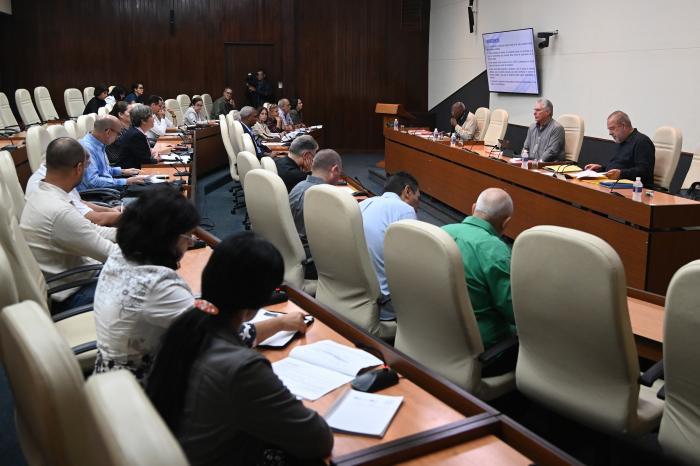
The First Secretary of the Party's Central Committee and President of the Republic, Miguel Díaz-Canel Bermúdez, yesterday highlighted the functioning of state-owned MSMEs, a form of management approved since 2021, and which in practice has remained below in number (168) when compared to private ones (9,000).
In a meeting headed by the President, and by members of the Political Bureau Manuel Marrero Cruz, Prime Minister, and Salvador Valdés Mesa, Vice President of the Republic, with ministers and representatives of several state-owned MSMEs, Díaz-Canel highlighted the flexibility of these forms of management, which adapt faster and are able to find solutions in an agile way.
The Head of State stressed the importance of solving, through the state, many of the country's current problems, for which a robust entrepreneurial system is necessary.
He praised the sense of belonging of the managers and workers of the state-owned MSMEs, and advocated that they should be efficient, earn for what they do, and that this should allow them to invest in their own benefit.
As in November, the monthly meetings with representatives of the business system to discuss issues that have a direct impact on their development, this time, as in November, dealt with the topic of state MSMEs. In the first meeting, operational problems were addressed, and in this one, proposals for solutions were presented.
The Deputy Minister of Economy and Planning, Johana Odriozola Guitart, explained that, after exchanges with several agencies and institutions related to the state-owned MSMEs, solutions were agreed upon regarding banking mechanisms for the extraction of foreign currency from their own accounts; the possibility of opening branches of the companies abroad; the power to approve activities secondary to their corporate purpose; the reduction of the amount of statistical information currently required from them; as well as the design of an internal control system which is adapted to the characteristics of these new entities.
Odriozola Guitart emphasized that "the principle we are following in the regulatory package is that state-owned MSMEs should be subject to the rules of private companies, but when the rules of the state-owned company are more beneficial, then they will be subject to those rules. This way they are not at a disadvantage with the state-owned company, and with the private one they would have similar conditions, as long as we are not talking about equity issues".
Víctor Jara, head of Servivip S.U.R.L., dedicated to integral maintenance and rehabilitation, said that the fact that they can now make their own decisions with their secondary activities will be very helpful.
As a result of the situation that exists in Havana with garbage, we made the decision to start collecting it, but we had to request it from the Ministry of Economy. If we had had that power before, maybe we would have started earlier, he commented.
Today it is very cumbersome, he added, the amount of documents we have to file for the statistical information, if we manage to have only three models, we will gain a lot of agility.
For Alejandro Palmarola, from La Quinta S.U.R.L., there is a big communication problem, "although the state-owned MSMEs emerged together with the private ones, we have to start to see the state-owned MSMEs together with the socialist state-owned company".
Today we are not understood as state-owned, he insisted, and there we have a point where in the public political discourse we have to start grouping state-owned SMEs as a form of state management, which are part of the state framework. "We are a form of state management, socialist."
Lorenzo Méndez, from the SME Tecno Espuma S.U.R.L., referred to the need to access the foreign exchange market. "We produce the isothermal boxes used to export medicines, and we need to replenish our supply of raw materials".
He considered that, with access to the foreign exchange market, "only for isothermal boxes we would save the country more than 200,000 dollars".
Vice-Minister Odriozola Guitart pointed out that the foreign exchange market is being designed, and that "in this design, the state-owned SMEs could be a good start to incorporate state entities whose demands are smaller and more flexible".


