

Ciego de Ávila is one of the first provinces in the country that will be able to generate all the electricity needed during the peak hours of the day from renewable energy sources, announced the First Secretary of the Central Committee of the Party and President of the Republic, Miguel Díaz-Canel Bermúdez.
Accompanied by the member of the Political Bureau and Secretary of Organization, Roberto Morales Ojeda, the Head of State visited on Thursday afternoon, among other places of interest, the photovoltaic solar parks installed on the outskirts of Morón, which will begin generating in the first half of May, with a power of four megawatts.
The identification of two new areas for photovoltaic solar parks of 20 megawatts continues, in the municipalities of Venezuela and Chambas, and an area for another five megawatts is being prepared in Majagua, as part of a donation from the People's Republic of China.
These investments, said the President, will give us great stability in the National Electric System, and it is important for the population to know this, because in the midst of all our difficulties, tremendous efforts are being made to sustainably improve the quality of life of our people.
The first point of the visit was the Genetic Livestock Enterprise Turiguanó, an iconic entity for its large herd of Santa Gertrudis cattle, and specialized in the production and commercialization of genetically improved animals of large and small cattle, milk, meat and its by-products.
The entity increases its social responsibility in the popular council where it is located. Special attention is given to families and people in vulnerable situations and to social institutions in the region, including the inauguration of a children's house for 12 children of workers.
Having a lot of money under water and no results, as the fishermen say, is no longer an option for the Basic Business Unit (UEB) Alevinaje Morón, which is part of the Ciego de Ávila Industrial Fishing Enterprise. There they work to turn the larvae of cyprinids and tilapia into fry, which are then planted in the province's reservoirs.
Díaz-Canel and Morales Ojeda also went there to see for themselves how they are getting out of bad times, to the point where, after several years of losses, they are already beginning to make profits.
Díaz-Canel recalled that this is an institution that Fidel created in the 1990s, with enormous potential, but which was practically abandoned, but now its management and the workers' group have decided on a different strategy.
With the same workers' collective, he said, they have begun to recover the ponds and to develop a program to provide 78 million fry this year, which, together with what they are doing in agriculture, should become an important activity for feeding the population.
And all of this, the President pointed out, is being done at the worst time, when we have the least resources. So, he reflected, we must learn the lesson and ensure that this recovery is sustainable in time and never returns to the bad times.
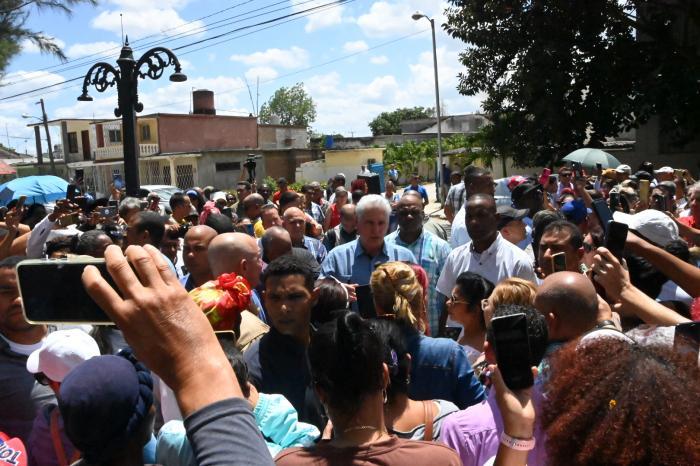
In the first tours," said the President during the exchange with the people of Morón, "we always saw what worked well and what worked badly. Now, in the last two visits, in March and April, we have seen centers that were bad and centers that are beginning to work well. Therefore, the pull that we wanted to see, so that the good would inspire the bad, is beginning to work.
"What do we have to achieve now? That those who are behind get on this "cart" and that those who are moving forward do not return to previous situations (...), and we also have to learn lessons. If there are things that are recovering in such a difficult time as this, why did we let them deteriorate? We lost time there, and we cannot allow that to happen again.
But in everything we do, he stressed, "the protagonist is the people, and together we can solve the problems, we have the talent, we have the desire in all the Cuban people to achieve it," he stressed.
TO CONTRIBUTE AMONG ALL OF US
On Thursday morning, Díaz-Canel and Morales Ojeda also visited economic and social centers in Florida, the fourth municipality of Camagüey they have visited so far in 2024.
We also take advantage of these visits, said the Head of State to the people, to exchange experiences and for everyone to move forward, and we are going to see other problems that exist here in Florida, such as water supply, roads, food.
"Here is all the land to be able to eat well, what we have to do is to produce, to contribute together, each one in what he has to do. Those who provide services to the population must provide them with sensitivity, with quality; those who have to produce must produce what we need; and we must remove obstacles and demand that things be done and done well," he explained.
GETTING BETTER AND BETTER
The Ignacio Agramonte y Loynaz Agroindustrial Sugar Enterprise is one of Florida's economic hubs. A change in management and the dedication of its employees have set it on a new course.
When José Luis Rodríguez González took over, the economic and technological deterioration was great, even last year they accumulated losses of more than 130 million pesos. In the first quarter of 2024, they already had profits of 13.8 million pesos.
The plant does not yet grind, the lack of sugar cane prevents it from doing so, but it is busy refining sugar for the standard family basket. The "workhorse" of the company, however, is its subsidiary, Derivados Sorbitol, which is also responsible for the highest percentage of Ignacio Agramonte's profits.
Last year, Derivados Sorbitol generated profits of around 12 million pesos, and in the first quarter, profits totaled 1.7 million pesos, thanks to the diversification of its offerings, including exports.
Díaz-Canel shared his experience in the sugar enterprise and told the people of Florida: "Life shows us, every time we visit the territories, that there are collectives in which there are leaders who do things differently and show you, in the midst of the complex situation, that we can move forward on our own".
However, the President added that the fundamental problem of the agroindustrial sugar enterprise remains: the deterioration of the sugar cane. They must make a great effort to recover the plantations, because even if they revitalize other areas, if they do not overcome this difficulty, they will always be limited.
The tour then continued to the Tomás Rojas Rodríguez Packing UEB, of the Camagüey Meat Company, which has a capacity to produce 18 tons of sausages and minced meat per day, and which currently, due to the limitations of raw materials, produces assortments for the standard family basket of the municipalities of Florida, Céspedes and Vertientes.
According to Díaz-Canel, this is a center with possibilities that is doing new things and is committed, with the supply of agricultural producers, to achieving a more stable productive flow over time. It is not yet what we need, but it is another step in which progress is being made, he reflected with the people.
The top leadership of the Party also exchanged at the Leopoldo Rey Sampayo Pediatric Teaching Hospital of Florida, which with a little more than 50 beds assists the children of families from the municipalities of Florida, Céspedes and Esmeralda.
Last year, the Florida Pediatric Hospital had zero maternal mortality and zero infant mortality, but in the municipality it was eight per 1,000 live births, below the province, which was 12, but above the country, which was 7.1.
Díaz-Canel inquired about the institution's services, the genetics center, and patient nutrition, and visited the wards, where he met with mothers and some children.
During his meeting with the people, the Head of State recalled that this hospital was inaugurated by General Raúl Castro Ruz and that it has been able to maintain its services with creativity, despite the limitations in supplies, medicines and other resources, mainly due to the blockade.


