

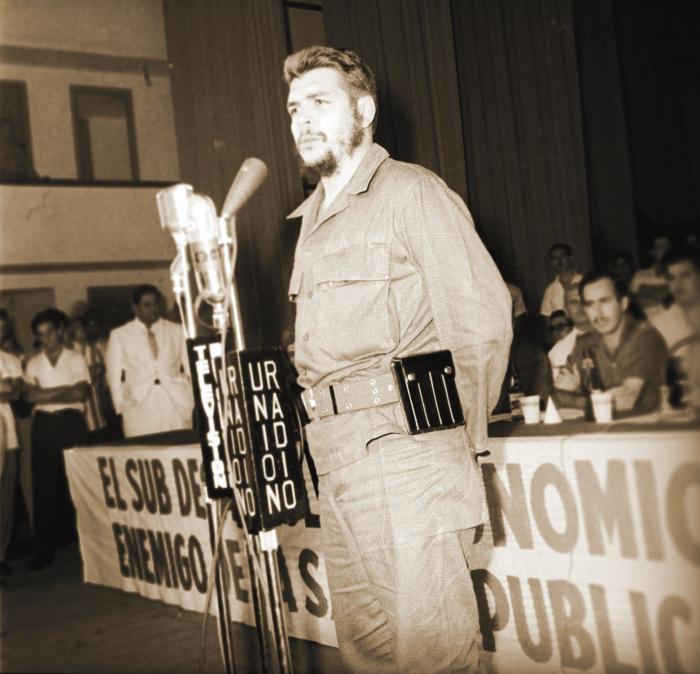
It is very difficult to write about Che. It is difficult to write about a man who in these days what he would ask us most is to do, to work, to produce, and not to go around remembering him only in reviews of his own history. Deeds, more than words -he would tell us-; example and mobilization -he would reaffirm-; he, who did not like tributes, who did not come from any other lineage than that of the worker, the common citizen, the daily fighter.
What can be written about Che that does not seem to be a mere tribute and that really serves the daily struggle of this Revolution that he also built?
There are many anecdotes and lessons of Che; each one from the point of view of the person who lived it, and in all of them there is the same essence: that the Revolution is made through man, but -as he affirms in that guide for Cuban communists which is El socialismo y El hombre en Cuba- man has to forge, day by day, his revolutionary spirit.
GUERRILLA FIGHTER, INTERNATIONALIST
On July 21, 1957, Fidel promoted Che with his well-known phrase: "Ponle Comandante", (put down commander) when he signed the letter of condolences to Frank País, for the fall of his brother Josué. He is the first, after Fidel, to carry the highest rank.
In his diary, the 29-year-old noted: "The dose of vanity that we all carry inside us made me feel the proudest man on Earth that day."
Henceforth, his figure became one of the main figures of the war and of the triumphant Revolution, with exemplary ethics and conduct for all his comrades, who did not admit the slightest slip if the welfare of the people was at stake.
Ten years later, in July 1967, he who was still a young man would make his notes in another diary, of another guerrilla, that of Bolivia?
Two different moments, two different contexts in the eyes of the same man who returned to arms, because he knew that injustices, wherever they were in this world, had to be felt as his own, and to fight for the happiness of the people? That internationalism, which is not only a duty but a revolutionary necessity, which keeps the solidarity fibers active and which, in the face of the siege of imperialism, has been what has made it possible for our peoples to break through many sieges.
That is why, when he was killed on October 9, the enemy tried to hide him with the fear of the strength of his example, but failed. Che had already transcended, by his example and his ideas, several years ago.
CUBA, FIDEL AND RAÚL
The friendship between Che and Raúl dates back to 1955, when the Cuban had to go into exile in Mexico. There they met and later they would be part of the Granma yatch expedition organized by Fidel, to be free or martyrs in 1956.
In the days of the war, their friendship grew stronger, to the point that, when Raúl was promoted to Commander and left to found the Second Front in the northern zone of the East, he left a note that ratified the identification of their thinking: "(...) Being fully identified ideologically with comrade Guevara, I delegate to him and ratify any opinions or statements he may issue in this sense and with regard to what is initially expressed in this document."
And it is precisely from Che the phrase that Raúl quotes in the National Assembly of People's Power in 1994, when he says:
"And if we are here today and the Cuban Revolution is here it is simply because Fidel entered Moncada first, because he got off the Granma first, because he was first in the Sierra, because he went to Playa Girón in a tank, because when there was a flood he went there and there was even a fight because they would not let him in. That is why our people have such immense confidence in their Commander-in-Chief, because he has, like no one else in Cuba, the quality of having all the possible moral authorities to ask for any sacrifice in the name of the Revolution."
And to all this he adds, in the farewell letter he wrote to Fidel when he left Cuba for other lands of the world, to offer the support of his modest efforts: "That if the final hour comes for me under other skies, my last thought will be for this people and especially for you."
Thus Che always took Cuba, the people he also recognizes as his own, where his children grew up, where he knew love and where he was able to make his greatest dreams of a builder come true. About him, among many ideas, Fidel said in the solemn evening after the news of October 1967: "The hours that he took away from sleep he dedicated to study; and the days of rest he dedicated to volunteer work."
That was Che, the same one that today writing about is complicated when we know that outside our homes, our work center, there is a reality that asks for more daring, more firmness, more joy and more resolution to defend the ideas that until today have allowed us to be a guiding nation for the left of the world.
There are many tasks for which the ideological vanguard must mobilize the honest men and women of this people of Fidel, Cheñ and Raúl; there are lazy souls to awaken; and also decant the opportunistic ones that make a dent in so many years of sacrifices of entire generations of Cubans. Che himself said in El socialismo y el hombre en Cuba: "Of course there are dangers present in the present circumstances. Not only dogmatism, not only that of freezing relations with the masses in the midst of the great race; there is also the danger of the weaknesses into which one can fall."
And there is Che. In that constant call to review ourselves every day, to be more revolutionary in each of the tasks, in being demanding with what is badly done thinking that our actions are going to benefit or harm the people of which we are part; the one who never tires of telling us, head on, that we should not give in even so much as that, nothing... because the sword of Damocles hangs over our heads since in 1959 we decided to free ourselves from imperialism, and while that is the fate of the rebellious island, there will be no rest. It does not matter that the enemy presents itself today with diverse and "alternative" media, naive or delicate faces. There is no rest.
CHEERS, GUEVARA!
October 1997: 30 years have passed since the assassination of Che in Bolivia, since the fall of his comrades. There are still latent memories of the discovery of his remains, of the people's parade in the Plaza de la Revolución to welcome him back, together with his comrades who have been a reinforcement detachment, as Fidel would say, in these difficult years.
Since then he has been in Santa Clara, one of the most intimate spaces of his guerrilla history; there he takes care of Cuba, from his own center. Ten years later, in 2007, just when the 50th anniversary of his promotion to Commander was being commemorated, a group of 50 young people guided by the spirit of the master journalist Guillermo Cabrera Álvarez and his Tecla Ocurrente, went to the Sierra to pay tribute to him, in union with dreams and followers of his example.
There, a tile was placed with the phrase that the young guerrilla wrote in his diary and thus, in the heart of the Sierra Maestra, there remained for the future the tribute to the man who, since his incorporation to the revolutionary struggle in Cuba, was one of its main figures. Because neither the pain, nor the difficult circumstances, nor the hardest of battles can kill the utopia and the conviction of a true revolutionary who loves; nor can they take away the victory.
We Cuban revolutionaries, in this decisive hour, will continue to forge ourselves in daily action, without renouncing one iota to the new man, and conscious that the one who opens the road is the vanguard group, the best among the good: the Party.
A bullet cannot end the infinite, Haydee Santamaría would write, torn with the news of his death. And precisely because our circumstances are more complex, it is more necessary for us. The farther away utopia seems, or the dreams of social justice that human beings deserve, the more present it is.
Che still has a lot to do. It is not about windmills, but about living and dying -if necessary- for an ideal, for other people and for the future. He showed that it is humanly possible.
That is why we will continue here, fighting inch by inch for every victory, always Fatherland or death, beloved Che.


