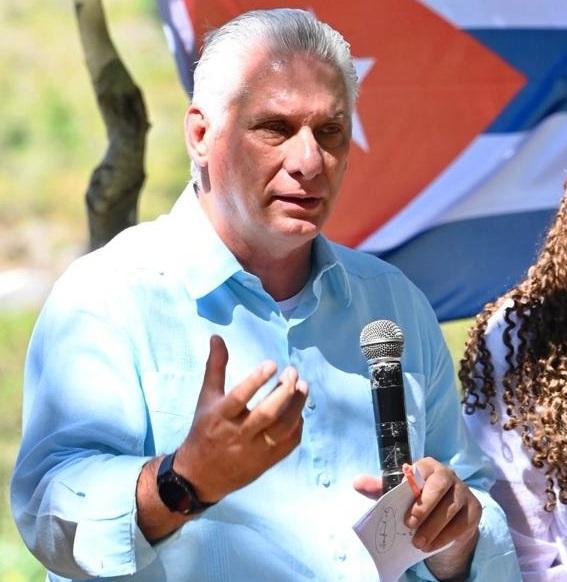
Let us study Martí. Whenever we go deeper into Martí we will be understanding Cuba better, we will be understanding Fidel. Let us study Raúl, let us study Che. Let us drink from the example set by the mambí fighters, the mambí leaders, the patriots; the young people who stood up to the dictatorships of the Republic. This was recommended yesterday by the First Secretary of the Central Committee of the Party and President of the Republic, Miguel Díaz-Canel Bermúdez, to a representation of young people from Santiago de Cuba and other parts of the country.
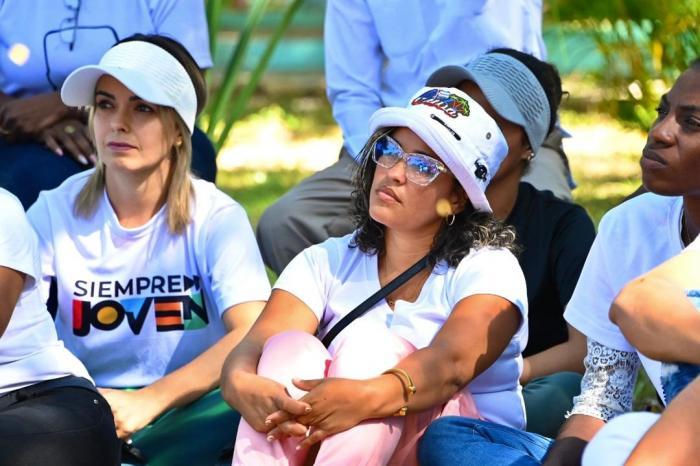
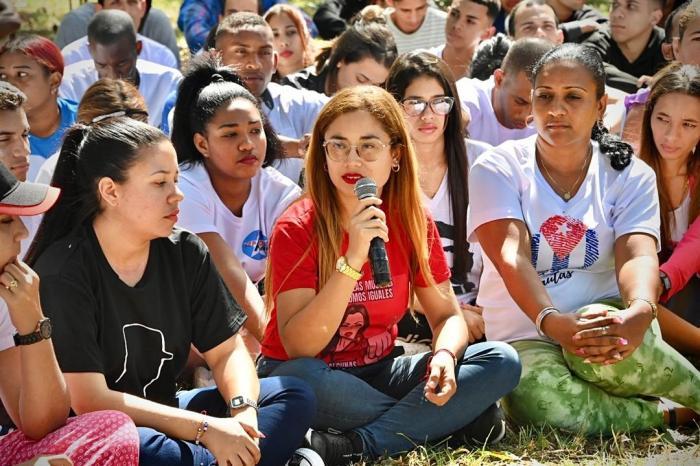
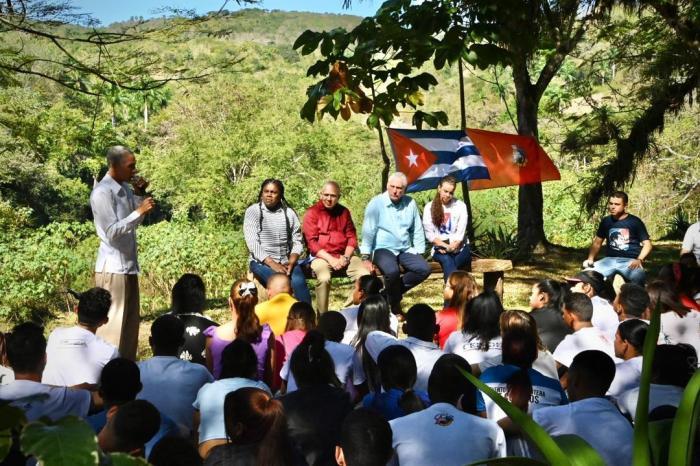
After participating, together with the people of Baire, in the commemoration of the 130th anniversary of the uprising in that place, which symbolized the beginning of the Necessary War of José Martí, on February 24, 1895, the Head of State held a meeting with about 130 militants of the Young Communist League (UJC) who staged an encampment in the campground Las Golondrinas, in the mountains of Los Negros, in the Sierra Maestra, location where mambí forces returned to the bush that day -as in 35 other places of the Homeland-, and where the troops of the Rebel Army would also fight later.
In the shade of the trees, it was an exchange to review the history and the libertarian epic of the Cuban people and talk about the current challenges, but also, said Díaz-Canel, to nourish ourselves with your ideas, to share what we have to do in the present, and to channel how you can have more and more empowerment.
Together with the member of the Political Bureau and Secretary of Organization of the Central Committee, Roberto Morales Ojeda; the first secretary of the Provincial Committee of the Party in Santiago de Cuba, Beatriz Johnson Urrutia, and the first secretary of the National Committee of the UJC, Meyvis Estévez Echevarría, the young people presented ideas, initiatives and concerns in a dialogue lasting almost two hours.
Introducing her companions, Meyvis referred that today the response of the Cuban youth, in the face of the challenges faced by the Homeland, has to be “more unity, more energy and more firmness”.
She informed about the beginning, this February 24, of the Mambí Route, an initiative that will be led by pioneers, students, scientists and other young workers, and that departed from Mangos de Roque, Mantua, Pinar del Río, culminating point of the Invasion from East to West, led by General Máximo Gómez and Lieutenant Major General Antonio Maceo, to arrive on March 15 at Mangos de Baraguá, in the municipality of Mella, in Santiago de Cuba, where that mambí heroic action began.
Along the route, the new generations, which will be systematically relieved, will carry a message of anti-imperialist reaffirmation and patriotism. And they will be presided over by a replica of the Machete of Major General Antonio Maceo, which was symbolically delivered by Díaz-Canel to the First Secretary of the UJC, at the end of the meeting in the mountains of Los Negros.
Estévez Echevarría affirmed, in her words, that the new generations of Cubans will continue to be more patriotic and anti-imperialist every day, while maintaining their support and solidarity with the Palestinian people, in the face of the aggression of which they are victims, and with other just causes in the world.
WHERE THERE IS YOUNG LEADERSHIP, THERE ARE SOLUTIONS
The meeting between Díaz-Canel and the 130 young people, representing the new generations of Santiago de Cuba and the country, began with a passionate tour of our struggles, which was led by historian Aldo Daniel Naranjo, who gave way to the interventions of about a dozen young people.
Julio, a student of Journalism at the Universidad de Oriente, praised a dialogue in which, he said, the President of the country meets with young people to listen to them and exchange with them, as “the most important people they are”, he stressed, quoting the Head of State.
In an analysis of the libertarian deeds and the present challenges, Julio sealed his words by affirming that, if “we young people did not give up before, we will not give up now, that is why there will be a Revolution for a long time”.
Karina, worker at the Pharmaceutical Laboratories of the East and member of the National Committee of the UJC, told of the efforts being made in this institution of BioCubaFarma to produce the medicines needed by the population, with emphasis on green medicine, projects in which young people play a leading role, while working on their political and ideological preparation and their professional training and promotion to leadership positions.
Lisett, a student of French Language at the University of Havana, analyzed, among other issues, the role of the new generations in social networks, in which, she said, a media war is applied to us that demands that every day we join a struggle in which the permanent vindication of Cuba against the campaigns of lies, discredit and manipulation must prevail. But, she added, everything begins with doing things right where each one of us lives our reality.
Ramón, a farmer from Placetas, Villa Clara, brought his own testimony about the effects of the blockade on the daily life of Cubans. He told how, in order to acquire goods and other things needed in freely convertible currency for agricultural production, he founded a micro and small business, and managed the production and export of a container of charcoal; but the foreign partner with whom he would make the transaction declined the business, due to pressures he began to suffer. For those who deny it, I must tell you - Ramón said - “that the blockade is there, and it is hard, hard, hard”.
Alberto, fighter of the Minint and president of the National Martí Movement in Santiago de Cuba, insisted on the rescue of history, and not the big one, the one everybody knows, he said, but the one that is in every town, in every street, as in Santiago de Cuba, where, he assured, history can be touched with the hands.
Rey Luis, radio broadcaster and vice-president of the Hermanos Saíz Association in the Heroic City, spoke about the professional training of university students, an opportunity that should be taken advantage of in the work centers, to make them fall in love with the work that is done in them, and exemplified the recruitment that is carried out in the Radio Mambí radio station, in the case of students of Journalism and Social Communication.
Richard, general secretary of the UJC Committee in the Santiago de Cuba Meat Enterprise, spoke about the transformation that is being experienced there, based on the initiatives and leadership of young people, who have contributed to respond to material limitations and increase the social responsibility of the entity.
Dayron, 24 years old, FAR graduate, now works as a cattle rancher, and has become one of the main producers of milk and various crops in the community of Songo-La Maya. He now raises more than a hundred cattle on six hectares of land that used to be covered with sicklebush: “When we are blocked, then what we have to do is produce food,” he said.
UNITY, A SYNONYM FOR PARTICIPATION
In his exchange with the young people, Díaz-Canel reflected on the inalienable principle of strengthening unity, the need for which has been demonstrated time and again throughout our history. The whole revolutionary process, of that Revolution which is unique, from 1968 to our days, taught us the strength of unity, he told them.
Unity -he stressed- has been the fundamental premise for our victory, and when we had lacked unity, we have had defeats. That is why the Ten Years' War did not end with independence; that is why the Little War was not a big war; and that is why the Necessary War, organized by Martí, ended with a U.S. intervention. That is why the Revolution of '33 failed....
But when the Revolution triumphed and Fidel brought together all the revolutionary forces, unity was achieved, and one of the concepts for that unity was the creation of the Communist Party of Cuba, and look at all the victories we have achieved, he emphasized.
The First Secretary of the Communist Party of Cuba then made a tour of the history of hostility, aggression, interference and blockade of which we have been victims.
We have been blockaded for 65 years, but now the difference lies in the tightening of the blockade, because for the first time they are beginning to apply the so-called Title III of the Helms-Burton Act, and because they have included us in a list of countries that supposedly support terrorism.
And in these circumstances, what else can we contribute to that unity, reflected Díaz-Canel, speaking to the young people, with whom he shared experiences that the Party leadership has experienced every month in its visits through the municipalities.
Unity, he said, is strengthened by participating. By participating we face the challenges; by participating we get to know each other better; by participating we become closer; by participating we propose, we criticize; by participating we implement; by participating we control; and also by participating we value the results, and when we have victories because of the contribution of all, we are generating unity.
The President emphatically praised the permanent exchange that should take place with young people, both because they are learning meetings and because they are an expression of respect towards the new generations. I, he said, will be faithful to that idea that I expressed one day, and which I do not regret, that you are the most important people we have, and as such, we have to treat you, and that is why it is important to talk to you.
I always defend the link with the youth. Raúl also defended it. Che said something as beautiful as that the fundamental clay of our work is the youth. Therefore, he added, all this that we are defending is also continuity.
Referring to the camp held to commemorate the Call of Baire, Díaz-Canel emphasized the relevance of such initiatives, which, he said, should be multiplied.
The only thing I ask of you, he explained, is that every time we commemorate a historical event, we see its meaning, its symbolism and its validity. Because -he explained- the answers to our problems are in our history.
And today's event has many symbolisms. It was the beginning of the Necessary War. It was the war that Martí saw as necessary for Cuba's independence, but also to avoid annexation to the United States, and remember the unfinished letter he wrote to Manuel Mercado on that subject.
Martí saw the Antilles as the balance of the world, because it was already clear that the United States was going to come over them, and one of the things he defended to counteract that was identity.
In several of his works, Martí asked that universities in Latin America should not follow in the footsteps of European universities or universities elsewhere. Ours had to be based on the knowledge, history and culture of the Latin American peoples, of Our America, as he said.
Later on, Díaz-Canel emphasized that this war, Martí's war, was the war necessary to avoid annexation, and it was the war necessary to achieve independence and begin to build the republic with everyone and for everyone’s good, hence some of its symbolism and validity.
And this, today, when there are people who want to divide us, who aspire to annexation with the United States, who seek to destroy the Cuban Revolution, it is also a necessary war; it is a war of continuity, which has its symbolism, its significance and its validity.
Then and now, the confrontation with the U.S. government continues, due to the aggressive policy and its intentions towards Cuba, the President summarized, referring to Martí's Necessary War, Fidel's Revolution, and all our struggles since 1868, which are one.
“And it continues to be a necessary war -he emphasized- to continue maintaining the sovereignty, independence and self-determination of our country. Therefore, this is a fact that is totally valid, because of its teachings”.
He exalted Martí's vision in founding the Cuban Revolutionary Party to organize the Necessary War, but not as a party for elections. And it is here, he remarked, where another essence lies.
He argued that we defend the Communist Party as the only party of the Cuban Revolution, as the party of the people. It is not an electoral party; it is a party to defend the Revolution, to defend the country, to defend sovereignty.
And those feelings are so strong and are multiplied with more strength in meetings like these, the president stressed, calling again on young people to look for the symbolism found throughout our history, its true connections.
The President also addressed the struggle in social networks, from which our truth must be positioned every day and for everyone, while insisting on the value of carrying out, on a permanent basis, various actions, such as this camp for the Call of Baire.
With all this -he said- we can have a tremendous spiritual, motivational and emotional growth. And he reminded us to honor every day the three fundamental purposes of the Young Communist League (although it is a youth union of people, it must have the capacity to represent the youth, he clarified): study, work and rifle. That is, to be good students, to be good workers and also to be ready to go out to fight.