

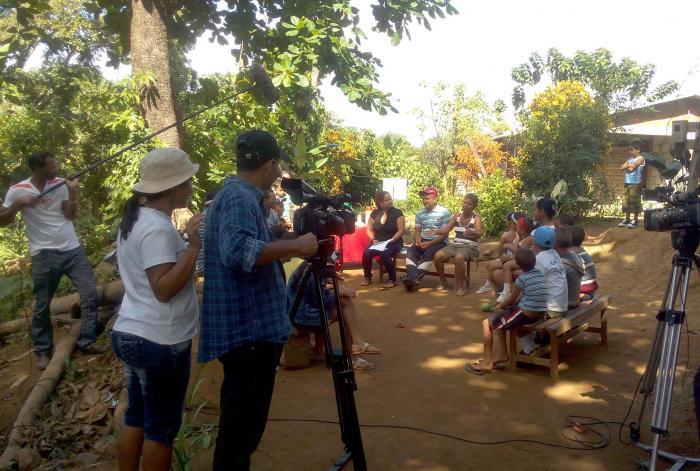
Campechuela, Granma-The First Secretary of the Central Committee of the Party and President of the Republic, Miguel Díaz-Canel Bermúdez, continued the visits of the Party's leadership to the territories of the province of Granma through the farm of the land usufructuary Rosel Lago Verdecia, in this municipality.
Campechuela, Bartolomé Masó and Buey Arriba were the last of the 13 municipalities in the territory that the President had yet to visit, as part of the Party's work system of systematically exchanging with the base in economic and social centers and with the population in the streets.
At the Lago Verdecia farm, he learned about the good yields of the peasants, despite the fact that the site is close to the sea. “Here, he says proudly, I reach 30 tons of onion per hectare”.
For six years, Lago has been tending these areas, but since his demobilization from military service, in 2012, he has been taking care of them. He started with 14 hectares, and is already working 22. He studied gastronomy, but land is his thing, it runs in his family.
Except for onions, in which he uses industrial products, he fertilizes and protects the rest of the crops with natural products, including organic matter as a by-product of the nearby sugar mill and other biopreparations, the result of peasant wisdom and agroecological extension work, such as a local insecticide based on Nin and Cardona.
Some 14 farm workers work alongside Rosel, mostly in the mornings; they earn a monthly income of some 13,000 or 14,000 pesos, backed by a productivity that allows them to reach 14 tons per hectare for cassava, one ton per hectare for beans, and 15 tons for corn, despite the salinity of the soil.
Rosel's farm is part of the Litoral productive block, shared with six other usufructuaries, Blas, Antonio, the two Rafael, Junior and José Luis, with similar productivity. Some call them the seven elites.
The Litoral is part of the municipal agro-industrial company Campechuela, founded on July 1st of last year.
In spite of the initial difficulties, due to which they accumulated losses of more than 300,000 pesos, the entity is beginning to move forward. It had profits of more than 80,000 pesos in March, and in April everything points to much higher profits, explains its director, Edel Escalona Blanco.
Díaz-Canel praised the state of the plantations of the seven of the elite, many of which border the road that circles the Gulf of Guacanayabo, from Manzanillo to Cabo Cruz, and which contribute to the local landscape a clear picture of the industriousness and work culture of the locals.
If this municipality works as it does here, said the head of state to the farmer and his companions, Campechuela will be able to be self-sufficient in food without any problems.
He inquired about the characteristics of the soils in the region and the limitations with water for irrigation, to which he put forward the scientific-technical potential of the institutions of Higher Education and scientific centers of Granma, to respond to the salinity and to increase rainfed production.
TO SUGAR, WITH EVERYTHING
Together with the first secretary of the Provincial Party Committee, Yudelkis Ortíz Barceló, and Governor Yanetsy Terry Gutiérrez, Díaz-Canel and Morales Ojeda went to the Enidio Díaz Machado sugar mill.
It is the only sugar mill in Granma that works in this harvest. It has faced many difficulties, to the point that only 5,000 tons have been produced to date.
“The harvest is in a very difficult situation, due to the unavailability of fuels and lubricants”, said the President in an exchange with the workers of the mill, and then with the inhabitants of the batey. “It has been milled very intermittently, but we have to make every effort as long as the weather allows us to do so.”
He oriented to cut all the cane foreseen to produce sugar and also to go towards molasses and alcohol, in order to increase the company's income and, with it, the salary of the workers.
He insisted on food production by the sugar company. “There is enough land here for there to be food in Campechuela, so that food does not have to be imported, but the land must be worked,” he insisted.
In conversation with dozens of residents of the Ceiba Hueca popular council, who came out to greet him, he addressed the transformation actions in the neighborhood, while reiterating the commitment, the social responsibility, that economic entities have with the communities in which they are located.
He commented on the problems in the community, such as transportation, water supply and roads, problems that must also have local answers, in addition to what must be done by the Central State Administration.
IN BARTOLOMÉ MASÓ
Food production was the focus of the Cuban President's visit to the municipality of Bartolomé Masó, where he visited the areas of the René Ramos Latour aquaculture-based business unit, attached to the Granma Fishing Company.
With 121 workers and a stable technical force, it is dedicated to the reproduction and breeding of freshwater fish, fry that it supplies to other aquaculture facilities in the province and the rest of the eastern territories. It also intends to produce 50 tons of meat of species such as catfish and tilapia this year.
The president also visited the state-owned micro-enterprise Río Yara, which produces different lines of construction materials, such as bricks and roof and floor slabs, destined for the housing program and for sale to companies, institutions and the population.
THE MOUNTAIN IS ALSO CULTURE
In the municipality of Buey Arriba, in the heart of the Sierra Maestra, Díaz-Canel arrived at the headquarters of Serrana TV, founded on January 15, 1993 under the leadership of prominent Cuban filmmaker Daniel Diez.
It is an initiative that was born to devote itself entirely to disseminate the life of the people of the mountains and turn them, not only into the protagonists of the works, but also, over time, into the filmmakers themselves, and so it continues to be.
More than 870 works, mostly documentaries, although they have ventured into all genres, have come from the hands of established and young filmmakers and local, national and foreign filmmakers. It constitutes an audiovisual heritage that has been enjoyed by a good part of the Cuban population throughout the 32 years of Serrana TV.
Through its Center of Studies for the Serrana Communication, the project is an intrinsic part of the more than 4,500 inhabitants of the San Pablo de Yao popular council, educated in the appreciation of art and in its own realization, to the point that today, almost all the artistic and administrative personnel of the center is from there.
The transformation that Serrana TV has favored among the inhabitants of the mountains, not only of the Sierra Maestra, but of the whole country, is more than recognized by institutions and scholars of the country as well as at international level.
“Seeing their daily work reflected in documentaries and other audiovisual genres is something that motivates farmers a lot,” said Pablo Lorenzo García Barban, director of the institution.
During his stay in the buildings of Serrana TV, the President praised the good condition of the facilities and the splendor of the location, located on the top of a hill where the magnificence of the Sierra can be observed.
“You have a great merit, you are the main center that transforms the community through social communication,” Diaz-Canel assured the group.
WITH EIDIS AND YAMISLEIDYS
Dial-café represents another of the projects that give life and capture the deepest spirit of the people of San Pablo de Yao, in Buey Arriba. It is a local development project born of a love story, of encounters and misunderstandings, of young Yamisleidys Soto and Eidis Santiesteban, both born and raised here. She, an art instructor, he, a cultural promoter.
In the best vintage style, the couple has been building an artistic and patrimonial proposal based on a neat collection of audio equipment: radios, tape recorders, record players, all repaired by Eidis. Dial-café is one of the places that the locals love the most, developing literary workshops and activities for the elderly, young people, people in vulnerable situations and other segments of the population.
Talking to the people in the street, outside the socio-cultural project, the President highlighted the importance of this and the Serrana TV, in terms of community, training and education. He emphasized how, even in a place as remote as this, culture and social commitment enlighten and help.
Like Serrana TV, Dial-Café, he said, is also a marvel. And one wonders, “how in a place in the mountains, a young couple can come up with a project like this, a project that would succeed anywhere in Cuba”.


