

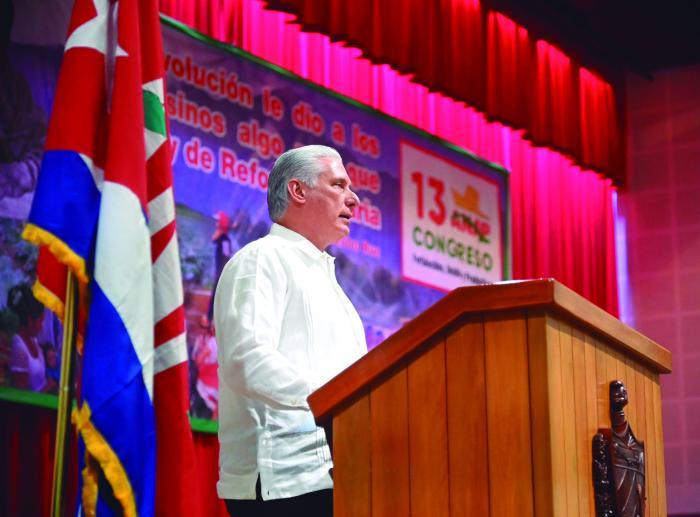
(Shorthand Versions-Presidency of the Republic)
Dear comrades who leave their sweat as seeds of labor in the fields of Cuba;
Peasants, worthy representatives of our Revolution;
Dear friends:
First of all, our congratulations for the National Day of the Peasant and for the excellent and contributing debate carried out in this ANAP Congress.
We congratulate the comrades elected as members of the National Committee of ANAP, its National Bureau, and comrade Felix as national president of the organization. We also congratulate the outstanding provinces and the winning province in the emulation.
I am not here to tell a story of which all of you have been a fundamental part and continue to be; but it is not possible to face the present without looking deeply into the past.
The images we saw at the beginning of this working session reveal to us that there is a lot of history to defend, an enormous legacy of Fidel's thought that we must creatively interpret and that we still have a lot to do.
This Congress will not be historic because of the richness of its debate, but because from it we will definitely succeed in producing the food that our heroic people demand and we will move away from that food importing mentality that has stopped our productive development in these years.
Before the Revolution, the Cuban peasant lived chained to exploitation and poverty. Eighty-five percent paid abusive rents, the vast majority were subjected to sharecropping and semi-feudal exploitation, because the foreign large estates devoured the land, and misery was the destiny of those who fed the country. Land, which should have been a source of life, was inaccessible to the majority.
And the Revolution arrived like a hurricane of justice and hope. In the Sierra Maestra's mountains the peasant was not a passive spectator, but a central protagonist of the fighting. As their ancestors did with the Mambises, they provided shelter, food, information, and many joined the ranks of the Rebel Army. As Che Guevara pointed out: “The peasants of the mountains not only gave us food, but taught us how to win.”
In that spirit of struggle and justice, Fidel, with his clear vision and deep love for the people, signed the Agrarian Reform Law in 1959 and gave the land to those who worked it, returning to more than 100,000 peasant families the dignity that had been outraged for centuries.
In the historic Peasant Congress in Arms, held in the Second Eastern Front in September 1958, the then Commander Raúl Castro Ruz warned that without agrarian reform there would be no Revolution, and called for the union in an indestructible alliance between peasants and revolutionaries.
It will always be necessary to proudly review the road traveled, because the Revolution came to break those chains, and it did it, in the first place, with the Agrarian Reform Law signed by Fidel in the Sierra Maestra, to give the land to those who worked it, which made the nation the owner of its destiny for the first time in its history.
Army General Raúl Castro Ruz has said more than once that with that sovereign act the Revolution crossed the Rubicon, that is to say, it reached a point of no return in its desire for justice. The transcendence and radicality of that process of profound social justice, which settled a historical debt, changed forever the panorama of the Cuban countryside. And it aroused the wrath of the unjust. The economic war against Cuba, which has not ceased since then, is due, among many other reasons, to the declaration of the Agrarian Reform.
The law also consolidated the alliance between peasants and agricultural workers, a fundamental social base for the Revolution, and by directly confronting the imperialist interests that opposed the agrarian transformation, it provoked reactions such as the Bay of Pigs mercenary invasion and the economic blockade of the United States, which has been intensified today.
But the Agrarian Reform did not stop, but rather deepened, dignified the Cuban peasant, transformed property relations in the countryside, promoted social justice and laid the foundations for the economic development and agricultural sovereignty of the country.
ANAP, founded on May 17, 1961 under the First Agrarian Reform Law of 1959, was also born as an act of social justice and food sovereignty. By proclaiming that “the land is for those who work it,” the foundations were laid for a cooperative model that dignified the peasant and redistributed economic power. Today, this legacy translates into more than 404,806 members and 3,198 grassroots organizations, figures that reflect the strength of a movement that has resisted blockades and adversities of all kinds.
As the voice of the Cuban peasantry, ANAP is more than an organization: it is the family that unites, the space where dreams, struggles and hopes are shared. And its members are responsible for 70% of the food that reaches the table of Cubans.
Comrades, we cannot ignore the extreme complexity of the times we live in. The world economy that is hitting us, the imperialist blockade that is trying to suffocate us and the internal difficulties are demanding us to be more creative, organized and disciplined than ever.
In the face of these challenges, the Cuban peasantry, who are born fighters, men and women who know that with hard work, unity and commitment everything is possible, are giving us lessons in dedication every day in the fields of Cuba.
The urgent task today is to produce more, to be more efficient, to take care of each hectare as a treasure.
We live in complex times, with economic difficulties and external pressures that have escalated to frankly unbearable levels, but also with great opportunities to test the resilience and creativity that distinguishes us as a people.
In this more than difficult context, ANAP has the historical responsibility to represent and guide the peasantry, to be a light on the road to efficiency, organization and social justice. We must redouble our efforts so that each plot of land produces, so that each cooperative is an example of work and commitment.
During these days, the topics that define the present and the future of the organization and its membership, which undoubtedly also means the present and the future of our nation, have been addressed with depth and passion.
Due to their transcendence, I will comment on some that I consider fundamental and that constitute priorities for ANAP's work in order to strengthen the productive systems demanded by the Local and Territorial Development Strategy in each municipality and province of the country:
• The improvement of the internal functioning of the organization, which includes: the defense of unity from the participation of the peasantry in the Government Program to correct distortions and re-drive the economy; the role of the leadership structures; the fulfillment of functions; the policy of cadres; the work system; the growth of associates; the political-ideological work, and the work with women and young people, among other issues.
This is the fundamental premise for advancing the strategy and work objectives approved here.
• Efficiency in the use of land: land is a sacred resource, a legacy that is only truly cared for when it is used to the maximum.
Optimize the use of land and ensure that each plot produces the maximum without squandering resources, without waste or negligence, generalizing the best experiences.
Unproductive or misused land is against the interests of the whole nation. Productivity is an act of love for the homeland and a revolutionary duty.
We must reduce dependence on food and input imports and increase national production with endogenous resources; strengthen urban, suburban and family agriculture, which has proven to be a pillar for local self-sufficiency and crop diversification.
• Production, contracting and commercialization of what is produced: it is necessary to strengthen the integration of the actors involved, raise the demands and control, reach all partners with opportunity, honesty and transparency, to commit and fulfill; develop a strong local government management, with commissions and organized actors that integrally manage the production, transformation, commercialization and consumption of food; reduce losses and food waste, and promote food and nutritional education to guarantee healthy and adequate food to the entire population.
• The defense and protection of the productive bases: it has been reaffirmed here that security in the countryside is the security of the Revolution. Fighting theft, corruption and indiscipline is everyone's task, but those responsible for all this have names and surnames, and it is essential to control them. Collective vigilance and revolutionary discipline are the most effective weapons to protect what demands so much work and sacrifice from the peasantry. There cannot and must not be impunity, and in the conditions of severe shortages that the country faces today we are obliged to toughen the application of the laws and to apply them with the greatest rigor. Protecting the productive bases by combating theft, corruption and any act that weakens the collective strength is a fundamental mission.
• It is necessary to strengthen cooperatives and peasant autonomy: always respecting the free will of each peasant, we must be clear that collective organization is fundamental to improve production, share experiences and face together the enormous challenges that reality imposes on us.
• On the incorporation of peasant youth: generational replacement is a central issue.
We have discussed strategies to motivate young people to stay in the countryside, to be trained, to innovate and to assume responsibilities, because the future of Cuban agriculture depends on them. And in recent years we have noticed a positive trend towards rejuvenation in several territories, which must be nurtured by promoting initiatives and creating conditions that are attractive to young people interested in working the land. Promote the active participation of peasant youth, so that they inherit not only the land, but also the revolutionary commitment.
• About sustainability and care for the environment: agroecology, From Peasant to Peasant method and sustainable practices have been recognized as essential tools to produce healthy food and care for our land, guaranteeing a development that preserves resources for future generations. These practices need to be extended and deepened.
Strengthen agroecology by retaking the From Farmer to Farmer method, where knowledge is shared as equals, because no one knows better than you what the Cuban countryside needs; share experiences, learning and advancing together; innovate with accessible technologies, without depending on expensive inputs and prioritizing native seeds; incorporate accessible and sustainable technologies that respect the land and allow us to produce more with less expensive inputs, and strengthen relations and agreements with research centers and universities.
We are all facing historic challenges in which the peasantry is a determining factor. We are talking about reducing imports, increasing yields and production, and combating crime.
Today the call is to produce more with less, to break the import mentality, to be efficient and to keep alive the revolutionary ethic in every furrow, in the face of unilateral coercive measures and the shortage of inputs that hits everyone in all areas of the economy.
In addition to these tasks, there are others, derived from some criticisms that the Congress did not avoid, such as:
• Soil degradation, aggravated by the lack of fertilizers and fuels, and a direct consequence of climate change.
• The increase in robberies, assaults and crimes of illegal slaughter of livestock, which discourage agricultural production.
• Chronic non-payments by state-owned companies, which seriously compromise crop yields and discourage producers.
• The need for modernization, with efficient irrigation systems and the adoption of agroecology to sustain food security.
In the face of these problems that burden the producers, the importance of activating the peasant vigilance detachments and community cooperation was ratified, as well as the demand for transparency in payments and integrated work with the peasants of all state institutions.
The proposals made by you in this Congress emphasized the need to strengthen cooperatives, ensuring their autonomy and linkage with state enterprises, and the management of science and innovation in production processes; promote agroecology with more than 250 innovative initiatives already systematized in Cuba, and some supported by FAO and the European Union; increase the role of peasant women, not only in productive tasks, but also in decision-making, and recognize their contribution in movements such as Mujeres Creadoras (Creative Women); the work of cooperatives oriented to peasant communities, supporting the Rurality Program, to improve living conditions, the environment and habitat; and expand social protection, extending the Social Security system to cover more agricultural workers.
The implementation of these proposals should be socially oriented and designed to improve the working and living conditions of the Cuban peasantry. Fidel, in his integrating vision, affirmed that without the peasants there is no Revolution. This Congress honored that maxim by reaffirming that ANAP is a pillar of the economy and of the national identity.
What is missing then for all cooperatives to function well? The answer lies, as you have given it, in unity, innovation and attachment to a legacy that, like the land, nourishes Cuba's roots.
It will correspond to the organization to assume with courage and clarity the tasks oriented to solve the indicated problems.
For our part, as we close this Congress, we take away clear commitments on the part of the Party and the Government:
• To strengthen cooperation between producers and state institutions; to implement with greater efficiency policies that guarantee access to inputs and technology;
- To prioritize training and knowledge sharing to increase productivity; to continue promoting the active participation of youth and women in the agricultural sector
- To strengthen agricultural production with responsibility, to optimize resources and ensure that each hectare yields what is necessary to feed the nation;
- To guarantee the fair distribution of inputs and that our farmers have what they need to work efficiently; promote cooperation and knowledge, to transmit best practices from generation to generation;
- To mobilize our young people and women, because in their hands is the future of the countryside and the Revolution, and
- To defend our principles firmly and face any obstacle without fear, with the pride of knowing that our work is an act of resistance and victory.
As we close this Congress we reaffirm the oath taken in the Sierra Maestra: The land belongs to those who work it! ANAP is not just an association; it is the raised fist of those who defend the Revolution.
This Congress was not only a balance, but a collective oath: To continue cultivating hope in the midst of storms! As José Martí wrote: “Agriculture is the only constant, certain and entirely pure source of wealth”, and in every furrow the Cuban farmer also sows his homeland.
To achieve food sovereignty in Cuba, it is key to implement a comprehensive approach that combines public policies, technological innovation and strengthening of local food systems, for all of which the peasantry is irreplaceable. According to the Food Sovereignty and Food and Nutritional Security Law approved in our country, a legal framework is established to guarantee sustainable food production, the mobilization of local resources and the organization of actors in sovereign and sustainable food systems.
In addition, Cuba's National Plan for Food Sovereignty and Nutritional Education articulates these actions with an intersectoral, participatory and sustainable approach, aligned with the objectives of the National Economic and Social Development Plan until 2030.
Food sovereignty in Cuba is achieved by combining law and public policies with innovation; actively participating yourselves and in communities, to achieve productive diversification and integrated local management of food systems, all under the principle of producing sufficient, nutritious and culturally appropriate food with respect for the environment and national sovereignty.
Today we conclude a congress that has not only been a space for debate, but also a reaffirmation of the commitment and will of our small farmers in the development of our nation. Throughout these days we have exchanged ideas, discussed solutions and strengthened the path towards a more efficient, sustainable and beneficial agricultural production for the Cuban people.
The interventions have shown the daily efforts of rural women and men, their resilience in the face of challenges and, above all, their unwavering vocation to contribute to the welfare of the country. We can proudly say that ANAP continues to be a fundamental pillar in the construction of a solid economy, capable of supplying the population with healthy food, grown with effort and love for the land.
This Congress has shown that together we must be invincible. That the strength of the Cuban peasantry lies in its unity, in its love for the land and in its commitment to the Revolution.
Today more than ever the Revolution trusts and counts on all of you! You are the hope that germinates in every furrow, the force that sustains food sovereignty, the living example that another better world is possible!
There is no nobler task than feeding our people. There is no fairer sacrifice than that of the peasant who, with sweat and effort, harvests the hope of the homeland. We are heirs to a history of struggle, and we have the responsibility to honor it every day.
The task ahead of us is immense, but we know that the Cuban peasantry has always demonstrated its capacity to overcome any adversity. With unity, work and discipline we can advance on the path to food sovereignty and sustainable development that our people deserve.
Today is not the end of a day's work, but the beginning of a new stage of commitments and concrete actions. Let us make of our fields the inexhaustible source of prosperity and dignity!
Today we are not closing a congress. Today we open a path.
May every word we have shared here be translated into action! May every commitment be fulfilled with honor! May every peasant feel the pride of knowing that his work is the basis of the independence of the Cuban people!
Sisters and brothers of the land, let us raise our hands and hearts in a solemn commitment: to defend the Revolution, to produce with love and discipline, and to honor the memory of those who gave us land and freedom.
May this Congress be the starting point to redouble our efforts, to sow not only food, but also dreams, justice and future.
May each of you return to your land with the conviction that you are indispensable, that your work is sacred and that the homeland needs you stronger than ever.
May the spirit of those peasants who fought in the Sierra Maestra, who gave everything for a just and sovereign country inspire us to go forward, with our heads held high and our hands on the land that our fathers won for us standing up.
Long live the Cuban peasants! (Exclamations of: “Long live!”)
Long live the ANAP, strength and soul of the countryside! (Exclamations of: “Viva!”)
Long live Fidel and Raúl (Exclamations of “Long live!”)!
Long Live the Cuban Revolution (Exclamations of: “Long Live!”)!
Ever onward to victory! (Exclamations of: “Ever!”)
Fatherland or Death!
We shall overcome!
(Applause.)


