ESMERALDA, Camagüey. - As part of a work style that seeks direct exchange with people and learning from good experiences, First Secretary of the Central Committee of the Party and President of the Republic Miguel Díaz-Canel Bermúdez began his agenda this Wednesday in the municipality of Esmeralda, one of the largest in the province of Camagüey, and where sugar and livestock production, in addition to tourism, mark life.
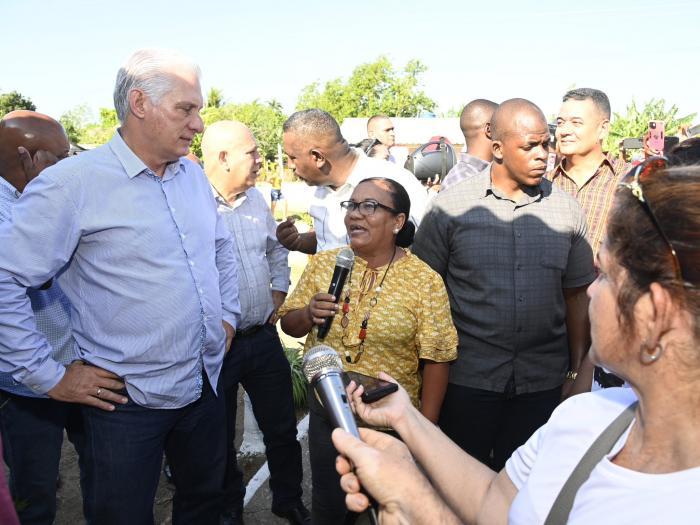
Accompanied by member of the Political Bureau and Secretary of Organization of the Central Committee of the Party Roberto Morales Ojeda, as well as the authorities of the territory, the Head of State arrived at the community of Aguacate, where there is a deep-rooted Haitian tradition.
In the village, the main activities are agriculture, beekeeping and cattle raising. Aguacate was a locality seriously affected in 2017 by Hurricane Irma. The event left behind 64 homes completely destroyed; and the recovery was possible thanks to the efforts and resources of the community.
The president listened to a detailed explanation by Yoania Álvarez Garcés, teacher and President of the Municipal Assembly of People's Power. She gave a brief description of the town, which is inhabited by almost 500 people.
To the residents of Aguacate, who attended the meeting with President Díaz-Canel, the dignitary explained that the tours “allow us to see the problems that exist in each place, the support that must be given from the country, and also the way in which the municipalities and provinces are working.
“Above all, we have learned from the things that are being done in the midst of the complex situation we are facing”. The head of state recalled that “there are prolonged blackouts, there are the problems of the food basket, medicines and transportation; and we are not going to find immediate solutions to all that, because it has to do a lot with the issues of the blockade; but working we will get ahead, and we will overcome these problems”.
Díaz-Canel emphasized that the roads to solutions will be possible with the effort of everyone “united, in harmony”, as has been done “in this community, which is an orderly, beautiful community”, he acknowledged.
The president spoke to the people about the importance of exercising popular control as a community. “That everything you propose and everything you do should be controlled by yourselves, so that resources are not diverted, so that resources are not wasted, so that resources are really used for what was given, so that things are done well, without bungling.
“There are many things that we still have to do and that are limited precisely by the perversity of that blockade which is overbearing, inhuman, but also sustained, with a tremendous rage and with a tremendous contempt for our people”.
The First Secretary of the Central Committee of the Communist Party of Cuba denounced that the blockade is characterized by tremendous desires to “rewrite history, to invent history”, and brought up how that hostile policy seeks to deny the work of the Revolution.
“Even yesterday, May 20 -added the Head of State-, which is an obscure date in our history -because what it meant was the birth of a pseudo-republic, of a mediatized republic, of a republic sold to the United States- they have presented that day as the day of Cuba's independence.”
“That -he emphasized- is not Cuba's independence day. Cuba's declaration of independence is the uprising of October 10, in La Demajagua; and the true independence was achieved on January 1, 1959, with the triumph of the Revolution.
“When the celebrations for the victory of the Great Patriotic War over fascism took place, they wanted to deny the contribution of the Soviet Union, of the Soviet people to whom (the deed) cost more than 27 million dead; and now they are presenting themselves as the ones who solved the problem of fascism in humanity, when they themselves are encouraging the emergence of new fascist, neo-fascist and ultra-conservative currents in the world today”.
Faced with such a situation, the president reflected, “we have to work together; we have to work encouraging each other; we have to work with harmony and resistance; and we will win”.
Díaz-Canel affirmed that, through this style of work that goes to the multiple scenarios of the country, “we see things that work badly, but we also see many things that are being done with tremendous heroism, and that are responding to the problems we have”.
OTHER TRIPS INSIDE ESMERALDA
“With shame”, read large letters on the place where the drying mill of the May 17 base business unit, which belongs to the Ruta Invasora agroindustrial grain company, is located. The President arrived there and was given details about the center, whose objective is to process and benefit the cereal grown as part of the whole rice program in the northern part of the province.
The facility, which was commissioned in September 2010, underwent an investment in 2022, which made possible a significant expansion of the drying capacity.
Michel Bayate Camejo, Director of Ruta Invasora enterprise, told the Head of State that Esmeralda has the potential to become a very important grain producing area for the country.
IN SIERRA DE CUBITAS
In that locality, also located in the northern part of the province, Díaz-Canel first visited the areas of the 35th Anniversary Cooperative basic production unit, belonging to the Sola Agricultural and Citrus enterprise.
While talking with Raúl Alejandro Bárcenas, Director of the company, the president was interested in the actions being carried out to recover unproductive lands. During the meeting, it was learned that managers and workers intend to reach 2,500 cultivated hectares.
The Head of State inquired about the workers' salaries and the possible delivery of profits. In view of the lack of fuel and other resources, he called for the search for alternatives to continue gaining land and producing the foodstuffs demanded by the population.
In the municipal capital, the president spoke to the residents of the 2nd district. During the exchange, he learned about the main problems of the town, especially those related to the water supply.
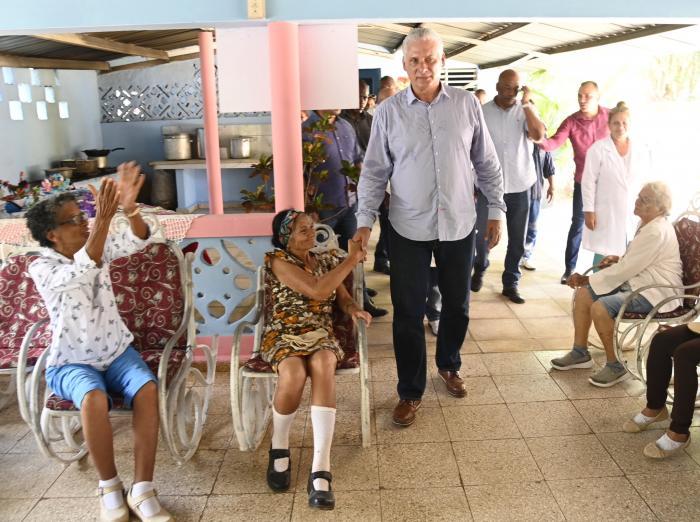
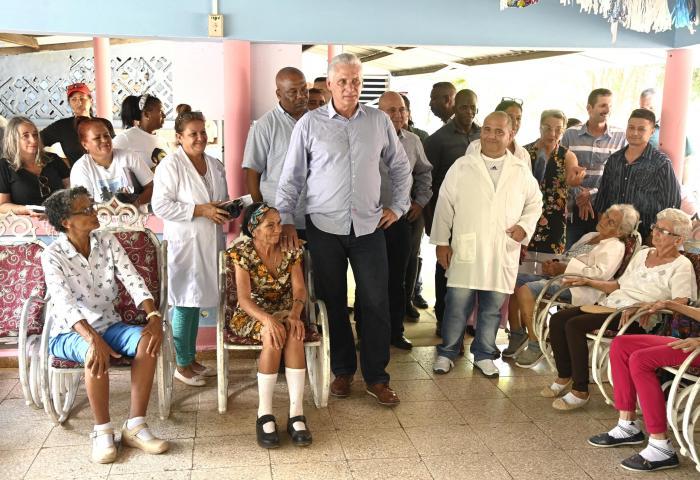
Díaz-Canel arrived at the cozy and very clean September 1st grandparents' home, where 34 elderly people are cared for. While the gray-haired women and men took their places to be photographed with the Head of State, ideas emerged from the group such as: “This does not happen every day”; “we feel privileged that you are here”.
“WE ARE GOING OUT”.
Minas was the third and last municipality of the day. There, the President visited the La Loma farm, owned by producer Omar Fernández Adán, which belongs to the Municipal Agroindustrial Company.
That farm is the area selected by the company for the cultivation of agroecological potato, an activity that began in 2022 on 14 hectares, and in which the yields are among the best in the country.
“Tremendous experience yours. You are one of those who inspire and make us think that we can get ahead,” said the president to Omar. And he also reflected with him that, some time ago, there were many who did not believe in agroecology, but that, for example, during the recent 13th Congress of the National Association of Small Farmers, it became evident that not a few are believing more in this option.
The next stop was the Arturo Puig Ruiz de Villa community polyclinic, which covers more than 31,700 inhabitants. The president was able to learn that the health center has a zero infant and maternal mortality rate.
After touring some of the polyclinic's facilities, the Head of State had an exchange of views with workers of the institution and with residents of the community. He thanked them for waiting for the meeting under such a strong sun; and in another moment of his speech he referred to the importance of working together to “face all the battle of hatred that exists in social networks, trying to discredit the Revolution, to divide us, to fracture us and humiliate us”.
Towards the end of his speech, he said: “I am convinced -and I am not saying this because of a slogan or a problem of convocation-, I am convinced, from what we have seen in these tours, from how people respond, from the way in which a group of collectives are responding to the moments we are living, that we are going to get out” of this difficult moment.
Díaz-Canel commented that Cubans will do it “by fighting; and we are going to come out with courage, with bravery, and united for Cuba”.