

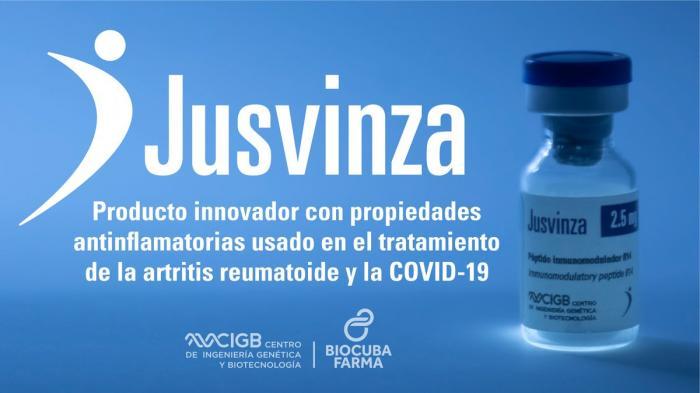
After receiving, in September 2023, the conditional medical registration for the treatment of rheumatoid arthritis (RA), the Cuban drug Jusvinza is currently undergoing a Phase III clinical trial, which should be completed soon, and on whose results will depend its definitive approval for the therapy of that disease.
Doctor in Biological Sciences María del Carmen Domínguez Horta, leader of this research project at the Center for Genetic Engineering and Biotechnology (CIGB) for almost four decades, told Granma that the main site of this study is the Rheumatology Service of the 10 de Octubre Clinical and Surgical Hospital, in Havana.
She explained that the trial is placebo-controlled and double-blind, and includes patients with moderate RA, referred there after being evaluated by rheumatology specialists from the western provinces. Its main objective is to corroborate the drug's efficacy, and the lead clinical investigator is Dinorah Prada, MD.
According to the initial results, Jusvinza maintains a good safety profile, and only mild and reversible adverse events have been described, said Dr. María del Carmen.
“Just with the granting of the conditional registration, we carried out a study in the five eastern provinces and in Camagüey, which we called Mariana, and which involved 534 patients suffering from moderate and high RA, under the leadership of Dr. Osvaldo Calisté Manzano.
“The effects observed consisted of a significant improvement of the clinical picture, while the excellent safety of the drug was ratified”.
She emphasized that, based on the experience gained during its use against COVID-19, in which it was demonstrated that Jusvinza was effective in controlling hyperinflammation in severe and critical patients, two clinical trials in severe community-acquired pneumonia and acute respiratory distress syndrome have been ongoing in recent months.
“We are currently continuing to deepen the study of Jusvinza's mechanism of action and its pharmacological properties, taking into account the potential broad spectrum of use that the drug has, to treat acute and chronic inflammatory diseases.”
The results have been published in high-impact scientific journals, and they highlight the prestige achieved by Cuban biotechnology, said Dr. Domínguez Horta.
A DISABLING DISEASE
Rheumatoid arthritis is a chronic, autoimmune, systemic and irreversible inflammatory disease that affects about 135,000 people in Cuba and damages joints throughout the body.
According to the World Health Organization (WHO), in 2019 there were around 18 million people with the disease worldwide, of which approximately 70% are women, and 55% of them are over 55 years old.
It usually appears between the ages of 40 and 60 and most often affects the joints of the hands, wrists, feet, ankles, knees, shoulders and elbows.
If not treated in time, RA in advanced stages can severely damage these structures and the surrounding tissues, accentuating the loss of the body's physical capacity to face daily tasks.
For Dr. María del Carmen Domínguez, the availability of the drug Jusvinza puts the country in a position to benefit, in the not too distant future, when it has the definitive registration and is produced in sufficient quantities, tens of thousands of patients who will be able to live with this chronic disease, without being forced to abandon their work and maintaining a full quality of life.


