

Immortalized by the shutter of a Japanese photojournalist and known to all as the girl with "the smile of victory," Vo Thi Thang is a metaphor for Vietnamese resistance, for the indomitable spirit of women in the face of aggressors and executioners.
Born in 1945, this heroine's life was one of dedication to the liberation of Vietnam. When she was taken prisoner, it is said that after hearing the verdict of the military tribunal that answered to the pro-American regime in Saigon, she smiled at the judges and said that her 20-year prison sentence would not be served, as victory would come first.
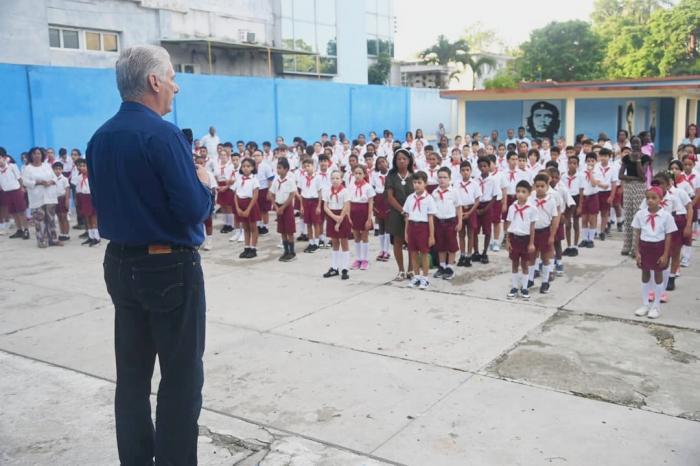
In 1975, when the liberation of South Vietnam and national reunification were achieved, the young woman was released. The name of this legendary woman is borne in Cuba by the primary school located on the corner of Quinta Avenida and 62nd Street in the capital's Playa municipality, where the President of the Republic of Cuba, Miguel Díaz-Canel Bermúdez, arrived on Monday morning to deliver a special gift to the students and teachers.
In a kind of invitation to delve deeper into history—a history that has beautiful passages such as that of Vo Thi Thang—the dignitary arrived moments before the school's morning assembly began. There, where the Minister of Education, Naima Ariatne Trujillo Barreto, was also present, the Head of State said to the students at the start of the day, when the flag is raised and the National Anthem is sung:
"Good morning to all the teachers at the little school and also to the students. We had explained to the Minister of Education that we wanted to visit the school in particular."
The president recalled that he had recently led a Cuban delegation that participated in the 80th anniversary of Vietnam's declaration of independence—made by Ho Chi Minh—and the constitution of the Democratic Republic of Vietnam, which later became the Socialist Republic of Vietnam.
"During that visit, which was very interesting for us because we were able to delve deeper into the history of that sister nation and brotherly people, we visited a number of places, and at those places we were given gifts that are replicas of those places. And it seemed to me that the best place for them to be was precisely in this school, to be added to the collection of gifts and objects that you have in the school, because they can also help you to better understand the events that are linked to these places."
After explaining why he was at the center, which has an enrollment of 604 students from preschool to sixth grade, Díaz-Canel Bermúdez offered a detailed explanation of the objects he had brought with him: "This first one," he said, "is a model of the Vietnam Military History Museum, which we visited on the first day. We visited it when we were almost in Vietnam."
"It is important because it tells the whole story of the Vietnamese people's wars against French colonialism and also against Yankee imperialism. But the fact is that in that museum, in its outdoor areas, there is a monument that pays tribute to the Cubans who died for Vietnam's independence. We had Cuban collaborators; we had Cuban doctors who were involved in the Vietnamese war of liberation, and in that museum there is a tribute to those Cubans who gave their lives."
The Head of State showed the students a replica of Independence Square: "This is the place," he explained, "where Ho Chi Minh declared Vietnam's independence 80 years ago and established the Republic, which was first the Democratic Republic of Vietnam and later the Socialist Republic."
"In this place, where the staircase is now, is where Ho Chi Minh's remains rest; that is, it is Ho Chi Minh's Mausoleum," explained the president, pointing to one of the replicas.
He then showed the students another "very interesting" object and shared a historical passage with them: "When Ho Chi Minh was declared President of Vietnam, after they achieved independence, the government moved into what had been the home of the French colonial governor in Vietnam." It was in Hanoi, and Ho Chi Minh, "who was a very modest and simple person," did not want to "live or do his office work in what was a very colonial French mansion."
The Vietnamese leader, said the First Secretary of the Central Committee of the Communist Party of Cuba, pointing to one of the models brought from the Asian nation, had asked that "this little house in the gardens of that residence, which was the house of one of the gardeners who worked for the governor, be made ready for him."
"It is a two-story house—you can see it in more detail later. The Political Bureau meetings were held down here." The president pointed to two rooms: one where Ho Chi Minh slept, and another with "some items for working: his desk, places where he wrote and also where he ate."
It's a very beautiful story, delve into it, the Head of State suggested to the students, whom he thanked for their attention and for the welcome that included singing and dancing, and in which the children did not overlook the fact that it was October 6, like that day in 1976 when a commercial plane with 73 people on board—including 24 young members of the Cuban Youth Fencing Team, with all their gold medals—fell into the sea due to the sinister hand of terrorism, an evil that still hurts and shocks us.


