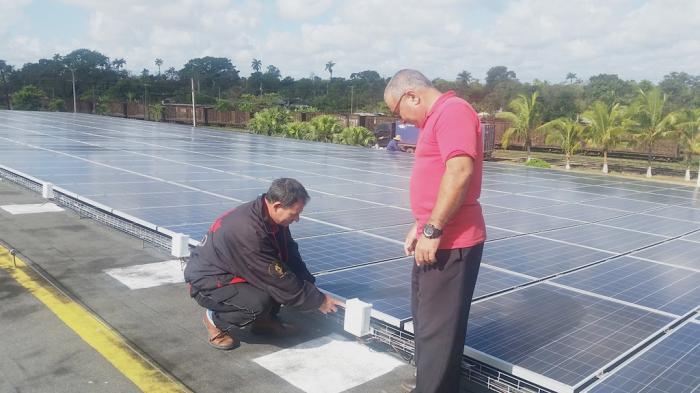
Individuals who carry out economic activities in the country will be able to access tax benefits for investments in renewable energy sources, following the update of the regulatory framework approved by the Ministry of Finance and Prices (MFP), as part of the strategy for the transformation of the national energy matrix.
With the publication of Resolution 41/2026 in the extraordinary Official Gazette No. 30, individuals who carry out economic activities, such as self-employed workers, agricultural producers, artists, and intellectuals, who are taxpayers subject to personal income tax, are exempt from paying this tax when they invest in renewable energy sources.
The Deputy Minister of Finance and Prices, Yenisley Ortiz Mantecón, explained that this benefit applies both to projects intended for self-consumption and to those that can contribute electricity to the National Electric Energy System.
She added that the measure updates and ratifies previous provisions aimed at supporting the policy of development and use of renewable sources, initiated with Decree-Law 345 of 2017.
Ortiz Mantecón recalled that Resolution 41 ratifies everything established in 169/2025, which recognizes the benefits of exemption from income tax during the investment recovery period and adjustments in rates and prices for projects linked to renewable energy sources.
However, that regulation was limited to the exemption of certain tariff items applicable to those individuals, hence the need for an update for individuals who carry out an economic activity.
She pointed out that, in order to access the benefit of Resolution 41, it is essential to have the technical opinion of the National Office for the Rational Use of Energy (Onure, in Spanish), which certifies that the investment is intended for renewable sources, with which the taxpayer must submit the documentation to the National Tax Administration Office (ONAT) of their tax domicile.
She specified that the incentive can be extended for up to eight years, according to the investment recovery time certified by Onure.
From the issuance of the first resolution in 2023 until December 2025, Onure received 168 energy license applications: 95 from non-state management entities and 73 from the state sector.
The Deputy Minister highlighted that, of these projects, 56 are already installed and operational, with an energy ruling and tax benefit granted, distributed in provinces such as Villa Clara, Camagüey, and Havana, and currently 112 projects remain under evaluation, including applications from individuals who will now be eligible for the incentives.
The Deputy Minister stressed that the measure, although it implies a reduction in tax revenues, responds to the State's priority of promoting the transition to clean energy sources, ensuring the participation of all economic actors, and strengthening the country's energy matrix.
She also clarified that the tax benefit may be canceled in the event of non-compliance with the established requirements. Among these, Onure conducts periodic audits of those who receive energy rulings, and if it is detected that the investment is not being used effectively in renewable sources, ONAT may revoke the exemption.
Cancellation also applies when it is verified that the imported equipment or resources do not correspond to the approved project or the documents supporting the investment are not presented, ensuring that the incentives fulfill their objective of effectively promoting the energy transition.