

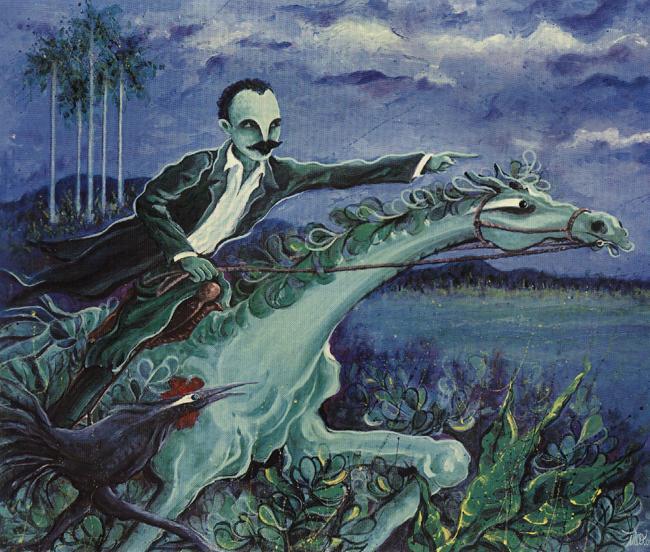
With the outbreak of the War of Independence on February 24, 1895, the emancipatory struggle organized by José Martí continued the fight begun by Carlos Manuel de Céspedes on October 10, 1868, at the La Demajagua sugar mill.
After ten years, divisions, contradictions, and indiscipline within the insurgent ranks led to the failure of the Ten Years' War (1868-1868) with the signing of the Pact of Zanjón, which implied a peace without independence. Faced with such an affront, the resolute and uncompromising figure of the Bronze Titan, Antonio Maceo, emerged, protagonist of one of the most glorious chapters in our history: the Protest of Baraguá.
Martí, who meticulously studied the errors of the past epic, summoned both the new and the old guard through words and actions. To achieve unity, on April 10th, 1892, he founded the Cuban Revolutionary Party, with the objective of achieving Cuban independence and supporting and assisting Puerto Rico in that process.
He conceived the war he prepared during the period of "fruitful truce" as brief, generous, and necessary, as an event of great human significance in the search for the already faltering equilibrium of the world at the end of the 19th century. Their aim was to achieve a Republic for all and for the good of all, and to prevent, in time, with Cuba's independence, the devastating blow of the seven-league giant upon the lands of Our America.
The dreams for which Cubans took to the jungle on that February 24th, 131 years ago today, were thwarted from the moment the United States entered the war and established a neocolonial Republic subservient to Yankee interests, with the Platt Amendment to the 1901 Constitution as an affront to the sovereignty and integrity of the Cuban nation.
The fighting spirit of several generations was not quelled; it always found its foundation in the ideas of Martí and in the mambí ideals of February 24th. That day, in 1899, was chosen by General Máximo Gómez for his victorious entry into the capital, where he received the embrace of the people.
Mella, Villena, Guiteras, José Antonio, and other valiant heroes revived the legacy of the 1895 uprising. And the Centennial Generation, led by Fidel, raised its banners and kept the memory of the Apostle alive, the man who in 1953 became the mastermind behind the attack on the Moncada Barracks.
After the January sun of 1959, with the triumph of the bearded rebels in the Sierra Maestra mountains—from whose ranks Radio Rebelde also emerged, on this very day—the dream of a homeland without a master became a reality.
The victorious Revolution thus embodied the aspirations of all those who fought for a free and sovereign Cuba. And the date of February 24th was adopted in 1976, marking the first socialist Constitution, following Martí's maxim that the first law of the Republic should be the Cuban people's devotion to the full dignity of humankind. More recently, on that same day in 2019, the new Constitution was ratified with broad popular support.
On February 24th, 1960, Commander-in-Chief Fidel Castro Ruz, at the commemoration of the beginning of the Necessary War, declared:
"A revolution is not a simple event in the history of a people. A revolution is a complex and difficult undertaking, and it also has the virtue of being a great teacher, because it teaches us as we go, and as we go, it strengthens the people's consciousness, and as we go, it teaches us what a revolution truly is."
In difficult times for the nation, the Cuban Revolution remains firm in its principles, supported by a people with deep roots in José Martí and Fidel Castro, who cherish unity above all else. Based on this essence, the nation rises each day with the cry of independence or death, just as it did on that February 24, 1895.
Photo: Artwork by Antonio Mariño Souto


