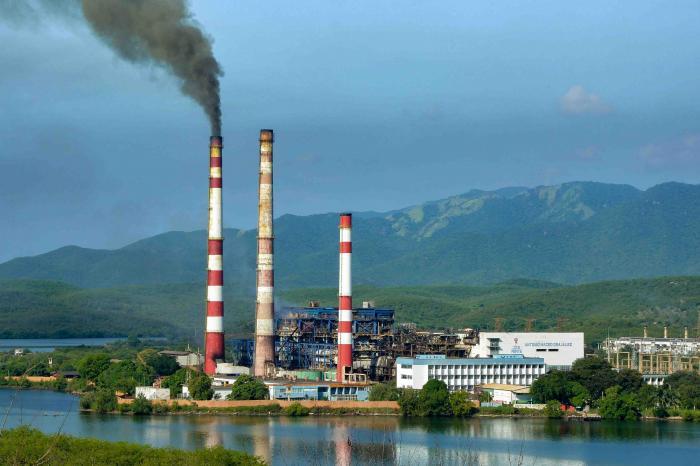
SANTIAGO DE CUBA—Since the 1990s, the Antonio Maceo Grajales Thermoelectric Power Plant (CTE) has been operating using domestic crude oil.
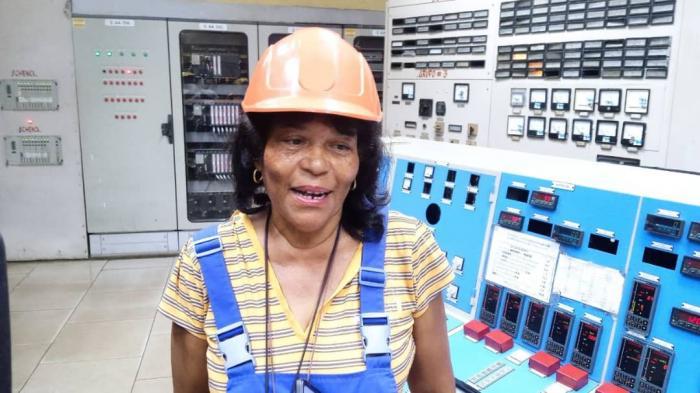
"It was at the behest of the Commander-in-Chief, who, in those years when we were left to operate independently, invited us to modernize the 100-megawatt (MW) generating units, with French assistance and Cuban expertise," recalled engineer Mayra McCalle Irsula, who has worked at the plant for over 35 years.
"It was at the behest of the Commander-in-Chief that, during those years when we were left to operate on our own, he invited us to modernize the 100-megawatt (MW) generating units, with French assistance and Cuban ingenuity," recalled engineer Mayra McCalle Irsula, who has worked at the plant for more than 35 years.
For this group of more than a thousand workers, contingency situations are nothing new, and this one - imposed by the U.S. government - "we face with even greater commitment, not waiting for anything from outside when we can also generate solutions here," Jesús Aguilar Hernández, general director of this CTE, vital for the eastern region of the country, told Granma. Last February, the CTE celebrated "60 years since its first synchronization with the National Electric System (SEN) created by the Revolution, because before 1959 the country did not have large thermoelectric plants and was barely electrified."
In this regard, McCalle Irsula, an Industrial Maintenance specialist, explained the main actions taken to guarantee uninterrupted power generation: "We consolidated the operators, kitchen staff, security personnel, and technicians into a single vehicle; the maintenance team is available 24 hours a day to respond quickly to any incident." At the plant, also popularly known as "Renté," remote work and teleworking are also implemented, when possible, to maintain the rest of the services.
POWER GENERATION CANNOT STOP
The Antonio Maceo hydroelectric plant faces the challenge of generating power in a context of fuel scarcity. Its workforce has opted for a strategy of creative resilience, with its warehouses stocked with few spare parts and imports frozen. "The motto is not just to operate, but to create as much as possible because the main fuel is ingenuity," stated Aguilar Hernández.
Although the passage of time has made it impossible to contribute the full 500 MW of installed capacity to the National Electric System (SEN), with units 3, 5, and 6—operating at maximum capacity—285 MW can be supplied. "We repaired the circulation pumps on unit 5 and, at the same time, carried out a more extensive intervention on unit 6, specifically on the turbine and boilers, to bring them online in March," assured the general manager.
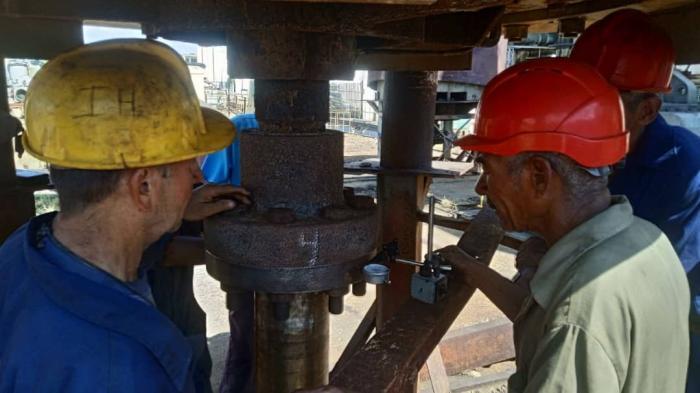
If the management outlines the strategy, the workshops are where ingenuity becomes tangible. Eduardo Morales García, head of Machining and soon to receive the medal for 40 years of service, recounts the day-to-day struggle against shortages: "We are manufacturing some shafts for the seawater pumps of unit 5, a part that used to come from Russia, but we were given the task of making it here."
His testimony paints a picture of the industry's current reality. "When a job comes in, we have to make almost everything ourselves: the blade, the bar, the material, even the hacksaw for cutting the pipes," a system sustained by the powerful movement of innovators and efficiency experts.
While respecting the original designs, he modified the water supply system for the boiler, first in Unit 6 and then in the others, reducing unexpected downtime due to failures and ensuring efficient control of parameters such as regulation and dome level. A demineralized water system was also developed for the 100 MW units.
For Morales García, Renté is more than just a workplace. "I’ve dedicated my life to this place. All the workshop workers are always willing to come in and do their jobs, no matter the day or time. We don’t have all the resources, but we always have an idea, a solution."
The fuel shortage doesn’t just shut down the machines; it paralyzes transportation, disrupts shifts, and jeopardizes operations. At Units 5 and 6, the work takes on a monumental scale. There, Ángel Fabars Borlot, the electromechanical supervisor for the Power Plant Maintenance Company (EMCE), oversees the work in an environment where any mistake could be catastrophic.
"Unit 6 is scheduled for extensive repairs, and at Unit 5, we had to deal with a failure in the generator’s hydrogen seals. These are extremely complex tasks because these are enormous machines. The smallest part weighs tons, and the clearances are measured in millimeters," the specialist explained.
The lack of personnel, due to transportation problems, slows down the processes. "We select the best, the most dedicated and knowledgeable. The response is slower because we don't have the necessary number of people, but those who are here do an excellent job," he assured.
A DAILY JOB
Next to the circulation pumps, Maximiliano Guisande Agüero, head of Dynamic Equipment, with 56 years of experience at Renté, led the final stretch to bring Unit 5 online.
"We know the country's energy difficulties, what we're going through, so we dedicate all the effort and time necessary to put the equipment into service as quickly as possible. Even one unit out of service makes the machine less efficient. Hence the importance of our work," he asserted.
Its staff promotes the recruitment and retention of young people through work agreements with the Pre-University Vocational Institute of Exact Sciences, polytechnic schools, and the University of Oriente, involving students in production through their work placements and training, as well as their professional development.
The General Manager added that "it is a privilege that our plant has reached its 60th year of operation. It represents a challenge left to us by previous generations and that we must pass on to future ones. It requires a lot of work and commitment. More than the equipment, what sustains it is the quality of its workforce."