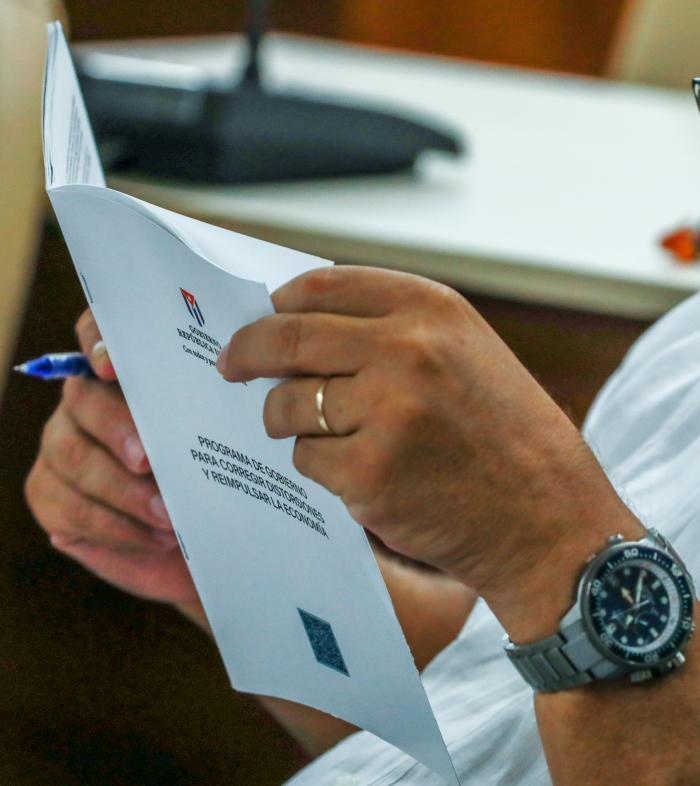
The updated 2026 Government Economic and Social Program, the result of c
onsultations with more than two million people, introduces substantial changes in five key areas for the population: the macroeconomic environment, external income, food production, the business system, and energy sovereignty, with a more realistic and integrated approach.
WHAT IS THE GOVERNMENT PROGRAM?
With the goal of guiding its work toward growth, the country has undergone a continuous process of economic planning:
• In 2024, the Government presented its Projections to correct distortions and boosts the economy. At that time, it had eight fundamental objectives and was originally conceived as an action plan for the country's economic recovery.
• In 2025, it was conceptualized as a Government Program with ten general objectives, 106 specific objectives, 342 actions, and 264 indicators, published in October of that year.
• Recently, the Government's 2026 Economic and Social Program was published, representing the most up-to-date version following the public consultation process. It is structured with ten general objectives, 111 specific objectives, 505 actions, and 309 indicators and targets.
GENERAL OBJECTIVES
1. To foster a macroeconomic environment that promotes productive activity and increases foreign exchange earnings.
2. To increase and diversify the country's foreign exchange earnings.
3. To increase national production, with an emphasis on food.
4. To transform, modernize, and develop the Cuban business system, strengthening the role of socialist state-owned enterprises, with an emphasis on integration among all economic actors.
5. To advance the improvement of strategic management for territorial development.
6. Advance the improvement of government management, defense, and national security.
7. To consolidate and develop social policies, guaranteeing the protection of vulnerable individuals, families, households, and communities.
8. To advance the implementation of general directives aimed at preventing and reducing crime, corruption, illegal activities, and social indiscipline.
9. To advance the recovery of the National Electrical Power System, promoting energy sovereignty.
10. To manage science and innovation, natural resources, social communication, and digital transformation to promote sustainable development.
THOSE THAT MOST IMPACT THE LIVES OF THE POPULATION
Among the ten general objectives, five directly affect the daily lives of Cuban families: macroeconomic stabilization, external income, food production, the business system, and energy.
In this new version of the Program, regarding the macroeconomic environment, the conceptualization shifts from "implementing a program" to "fostering conditions." This means that, while in 2025 the emphasis was on executing a plan, in 2026 it is recognized that stabilization is not decreed, but rather built by creating the appropriate systemic conditions.
For citizens—in the project—this means less rigidity and more space for productive activity—state, cooperative, or private—to find a favorable environment. The priority is for trade, investment, and employment to respond to real incentives, not just directives.
Regarding external income, both versions agree on the statement: "Increase and diversify the country's external income." However, while the wording remains the same, the implementation context has changed, given the measures announced in previous months.
The new version reinforces concrete actions, many of them aimed at eliminating barriers to exports and boosting tourism, remittances, and foreign investment. For the population, more external income would mean a greater capacity to import food, fuel, raw materials, and medicines, which would alleviate the restrictions that currently affect daily consumption.
Regarding domestic food production, the objective remains unchanged, as it was already a priority, but the associated actions are growing exponentially. The 2026 program implements new measures for granting land in usufruct, reducing input prices, contracting directly with producers, and eliminating bureaucratic obstacles. Furthermore, for the first time, this objective is explicitly linked to the integration of all economic actors, allowing cooperatives and small farmers to participate on equal footing with state-owned enterprises.
The projection of the business system could be said to shift from "complementarity" to true "integration." In 2025, non-state actors were seen as complementary to state-owned enterprises; in 2026, the focus is on integration—a term that implies horizontal relationships, shared production chains, and equitable access to inputs, financing, and markets. The state-owned enterprise remains the core, but it is transforming and modernizing to compete and cooperate on equal terms with cooperatives, micro, small and medium-sized enterprises (MSMEs) and self-employed workers.
Objective 9 also redefines concepts: the focus is no longer on recovering the National Electrical System, but on advancing and promoting energy sovereignty. This shift is strategic and affects all households. In 2025, the approach was tactical: implementing a program to overcome the current difficulties. In 2026, the focus shifts to a long-term vision: energy sovereignty, meaning the national capacity to generate, distribute, and manage energy without critical dependence on foreign sources. This implies accelerating investments in renewable energy sources, reducing fossil fuel imports, and stabilizing the electricity service.
The updated Government Program is the result of a process of listening, evaluation, and adjustment. The changes to these five key objectives reflect a clear commitment: to move from theory to practice, from decrees to real-world conditions, and from complementarity to productive integration.
For the Cuban people, who face daily challenges, the most important thing is that the measures translate into results; and the new program seeks precisely that: to measure, execute and transform.
As the First Secretary of the Central Committee of the Party, and President of the Republic, Miguel Díaz-Canel Bermúdez, stated: “The Program is the compass, the roadmap, the guiding thread of all government management.”