

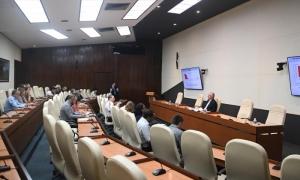
The National Center for Scientific Research (CNIC, in Spanish) announced the progress made in the clinical evaluation of new and traditional natural products aimed at post-stroke treatment and dermatological diseases, among others.
The presentation took place this week during the regular exchanges between the First Secretary of the Party’s Central Committee and President of the Republic, Miguel Díaz-Canel Bermúdez, and scientists and experts on health issues.
Dr. Sarahí Mendoza Castaño, Director of Research, Development, and Innovation at the renowned scientific institution, reported on the development of products that have demonstrated their efficacy and safety and will expand the center’s drug portfolio for the benefit of the Cuban population, as well as offering potential in the international market.
The specialist presented, among other things, the results of the clinical trial to evaluate the efficacy of using Policosanol—the active ingredient in the iconic PPG, developed by the CNIC in the late 1980s—combined with 81 milligrams of aspirin (ASA) in the treatment of cognitive impairment in patients who have suffered an ischemic stroke.
The 12-month study involved 100 patients of both sexes, with an average age of 69, affected by the condition, divided into two treatment groups.
During the experiment, it was demonstrated that, after 45 days of treatment, a significant improvement began to be observed in patients in both treatment groups.
"With this study, we demonstrate for the first time that long-term therapy with 20 milligrams of policosanol and a daily dose of 81 milligrams of ASA improves both functional recovery and post-stroke cognitive impairment in patients who have suffered an ischemic stroke," stated Javier Sánchez López, Ph.D., of the Center for Neurology and Neurosurgery.
"This is a promising result," said the renowned neurologist, "and we are preparing to use this therapy in the future for vascular parkinsonism, because," he explained, "policosanol clearly protects the vascular tree; therefore, in any condition involving this type of damage, its effect will be beneficial. That is our hypothesis, and the results have been encouraging in this initial study."
Given the incidence of ischemic stroke in the progression of dementia, Sánchez López argued that "people today are living longer and longer, but we can be caught up in cognitive decline. That is why any product, any trial that points to an improvement is welcomed as a relief, knowing that we want to live longer, but also with a better quality of life, and even more so by using natural products, which are highly reliable and safe for medical use."
The presentation of the CNIC’s new scientific findings also included a study on the efficacy of combination therapy using ozonized sunflower oil (OSO) cream and AGO soaps, sulfur soaps, or sulfur and OSO soaps, respectively, in patients with certain dermatological conditions.
Particular attention was drawn to the studies on the efficacy and safety of dermatological soap and OSO cream in patients with acne, in which 75 participants of both sexes were divided into three groups: one group received treatment with OSO dermatological soap, another with OSO cream, and the third with the combination therapy.
Dr. Sarahí Mendoza Castaño, Ph.D., explained that, among participants with an average age of 24 and a predominance of females, all groups showed clinical cure and improvement in assessment scores and quality of life, with the effects of the combination therapy being better than those of monotherapies with soap or cream. Studies with these products will continue to confirm the results with a larger sample size and longer treatment duration.
At this week’s meeting between the First Secretary of the Party’s Central Committee and President of the Republic, Miguel Díaz-Canel Bermúdez, and scientists and health experts, CNIC specialists also presented an evaluation of the efficacy and safety of using OSO dermatological soap and an alcohol-based anti-inflammatory cream in patients with chronic dermatitis.
The study, currently under review, lasted eight weeks and included 90 patients. Its results appear promising, as do those regarding the effects, safety, and tolerability of rectal ozone therapy in patients with joint symptoms following the acute phase of chikungunya.
The President praised the results that the National Center for Scientific Research continues to accumulate. Founded in 1965 by Commander-in-Chief Fidel Castro Ruz, the institution has earned the distinction of being the founding nucleus of the scientific institutions created by the Revolution, first as the Scientific Pole and today as Biocubafarma.
The center’s latest achievements confirm that, 61 years after its creation, the CNIC remains fully committed to rigorously and effectively addressing biomedical and technological challenges of economic and social importance to the country, as well as to developing cutting-edge products that are competitive on the global market.


