

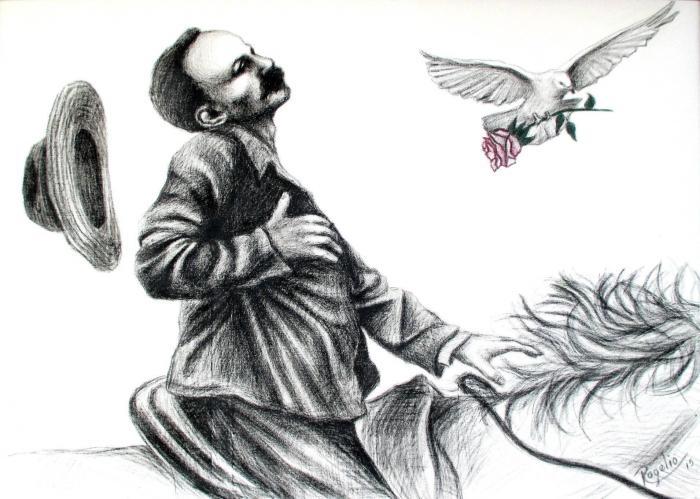
Dos Ríos, May 19th, 1895. 1:30 PM. The sun beats down. The Contramaestre River is swollen. On the savanna, gunpowder foretells a destiny from which there is no turning back.
Máximo Gómez had ordered, "Get back, Martí." But the man in the black suit and beaver hat hadn't come to Cuba to be in the rearguard. Hours earlier, he had told the soldiers, "For Cuba, I am ready to be crucified." The crowd shouted, "Long live the President!"
Ángel de la Guardia felt his horse become restless. José Martí looked at him, and the two riders galloped toward the smell of gunpowder, toward a clearing where the tall grass concealed the Spanish soldiers.
Three bullets struck the Apostle: one in the chest, fracturing his sternum; another in the neck, shattering his upper lip as it exited; the third in his right thigh. Gómez was unable to recover the body. "I have never been in such danger," he would later write.
Martí's body remained in the hands of the Spanish. Colonel José Ximénez de Sandoval, who led this battle, declined the title of Marquis of Dos Ríos, arguing that it was not a victory. "There died the greatest genius that America ever produced," he declared.
In August 1896, Gómez brought 300 mambises to the site. They took stones from the Contramaestre River and placed them one by one, each soldier his own, until they had built a rustic pyramid.
"Every Cuban who passes by here must leave a stone." And the stones continued to arrive during the war, during the republic, throughout the entire century.
It is true that the mother-of-pearl revolver, a gift from Panchito Gómez Toro, was found with all its cartridges intact, that the Delegate did not manage to fire it, but his word caught fire throughout America in a way that lead could never have achieved.
The unfinished letter to Manuel Mercado, begun the day before, announced: "Prevent the United States from expanding throughout the Antilles." That warning has not expired. It continues to resonate every time a small nation says no to an empire, every time dignity refuses to kneel.
We see it in the hummingbird's morning and in the somber majesty of the pitahaya, as Lezama wrote. We see it every time a Cuban recites The Golden Age, every time someone rejects insignificance and banality.
On May 19th, 1895, the sun shone on the brow of that body that collapsed in Dos Ríos; but the other Martí —the one of Simple Verses— did not dismount, but rather chose to ride with his fiery words to the far reaches of America.
He has not died, he who remains, 131 years later, a cornerstone of the Cuban nation; Martí lives every time someone rises up against injustice and in favor of the poor of this land. And as long as there is a Cuban who refuses servitude, and holds the Homeland as an altar and not a pedestal, Martí will not have died. He will be, as always, galloping on.


