

The planks had lost their rustic roughness and retained the damp coolness of the mountains. That's what he thought when he rested his head on the table for a few minutes, seemingly endless.
His thoughts came and went like a distant torrent in the sea of memory, ebbed and flowed like unruly tides in a dream: he smelled the orange blossoms from the grove at the back of the house in Birán; he heard again the tap of the old man's cane on the floorboards, an omen of his authority's imminent presence; he perceived the din on the way to school one morning under a cloudy, lightning-filled sky: the train whistles as they entered Santiago, the rustling of cassocks as they passed through the corridors of the religious schools, the thunderous footsteps of the crowd rushing down the steps of La Colina, the dry crackle of the Springfields, the shots from the Winchester 44s in front of the Moncada Barracks; the crash, the heavy crash of water against the planks and the creaking wood above the dark and unfathomable depths, then the shrapnel and the whistling of the airplanes... But was it the harassment following the battle of Alegría de Pío or the air raids that accompanied his column as it moved away from the Pinares de Mayarí to enter the territory of the Second Front? He couldn't discern it in the stupor in which his senses foundered. His eyes were closing from fatigue and tension, and he finally allowed himself only a fleeting pause to regain his lucidity. He awoke suddenly, looked up, and resumed writing.
During the last few hours, he had done so tirelessly, his forearms resting on the ground, amidst the urgent demands of war, after enduring long days of marching, ambushes, reconnaissance, combat, and bombings. In a brief summary, he asserted in his letter that after the defeats inflicted by Fidel on the Batista army's offensive in the Sierra Maestra, with the tremendous impact of the arrest of American citizens in the Second Front, and with the ever-increasing desertions and growing demoralization of the dictatorship's troops, they were forced to do something to raise the morale of their soldiers and cling to power a little longer. They would probably attempt an offensive in pursuit of a "victory," even if only partial. The Second Front was the least well-armed and, given the concentration of enemy forces, appeared to be the chosen target.
He couldn't afford to rest. He was preparing everything for the defense of that beloved territory where the peasants had joined the rebellion as gunmen, and the women, the elderly, and the children supported the guerrillas with a silent, poignant complicity and nightly activities. Everything that had been done in that area was a prelude to the Revolution. He would never abandon the fight for the dreamed-of ideal of a better, happier homeland. From the mountains, he had persisted in his search for books and primers to educate those whose suffering he felt most deeply: many combatants couldn't even read a clock, and that was just one of the many bitter realities that had to be banished from the island. He wouldn't allow himself a moment's rest, he wouldn't be defeated, he wouldn't go to rest in the shade of the copal trees or the seedling plants, he couldn't afford to waste time resisting, and he wrote: "If they would send us the 159 Springfields and the M-2s that are over there, we could do many things, at least prevent them from penetrating our lines; they must send them here urgently. I had to sleep for a while, lying on the same table where I'm writing to you, so I could finish this. Vilma is writing next to me in the same condition, so please forgive me that this isn't as long as I'd like; in any case, it's better this way for you, since all we do is ask for weapons!!"
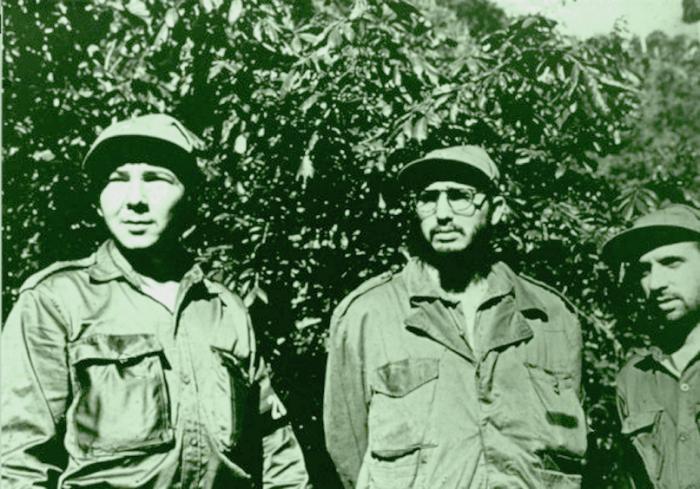
The letter ended with a warm embrace for his comrades in the 26th of July Movement and his signature at the bottom. On July 5th, 1958, the forces of the Second Eastern Front Frank País had repelled an initial enemy offensive and were preparing to wage new and decisive battles, crucial for the victory that followed on January 1, 1959. By then, the story of the young man with long hair tied in a ponytail, Commander Raúl Castro, was widely known to the people, but in his case, the reasons and life events that motivated popular affection were very special.
He was barely 27 years old when he came down from the hills. Born on June 3rd, 1931, at one in the afternoon, with the stifling and ominous midday heat as the threshold of life, he was the fourth child of the Castro Ruz couple, the third and youngest of the boys in the house, whom Don Ángel, the father, would recognize as "My little calf." A cheerful, mischievous, witty, and family-oriented boy—that's how they saw him in the Birán village and at the big house.
After leaving Belén School, unable to endure the strict discipline, the obligatory prayers, and confessions, Raúl spent most of his time at his father's farm. It was around this time that Fidel managed to inspire him with the idea of university studies, hoping to earn a degree in Law or Public Administration. Raúl formally submitted his application on April 1, 1950. In reality, by moving to the capital, he embarked on a definitive journey into history. Fidel placed Marxist books in his hands, and reading them was a revelation. Raúl followed these ideas without ever losing his way, with the precision of a compass and the vehemence of a passionate and just young man, carrying out daring actions such as the one at the Palace of Justice during the Moncada Barracks attack when, detained by the guards, he suddenly disarmed them, saved the lives of the small group of combatants, and effectively led them.
From that day forward, Raúl's presence would always be the certainty that the impossible is possible. It was surely this event that Fidel recalled a few years later, after the Granma landing and the dispersal of the entire revolutionary contingent in the battle of Alegría de Pío, after experiencing the loss of beloved comrades as adversity and death surrounded them. Upon realizing that Raúl was alive, upon seeing him again, Fidel expressed all his confidence and optimism with a resounding phrase: "Now we will win the war!"
It was all part of the astonishing account the people gave when speaking of Commander Raúl. They mentioned his rebellious temperament, his wonderful wit, his approachable simplicity, his severity and rectitude, his austere vocation, and his jovial demeanor, but above all, he was identified with unwavering loyalty and the singular courage of being the second leader of the Revolution by his own merit. Having earned Fidel's trust, being, along with Che and Celia, his right-hand man, deeply rooted and steadfast, was the most compelling confirmation of his virtues and qualities, a prelude to his tenacious commitment to the revolutionary work, developing the armed forces and participating in the political and social life of the country. Always accompanied by the guerrilla fighter Vilma Espín, he also starred in a beautiful story of revolutionary love that revealed his sensitivity and tenderness to the masses.
And now, in this rainy and warm June, almost fifty years after the January Revolution, we confirm that Raúl remains the same. He accompanies us with his audacity and simplicity, his unwavering faith in youth, his complete selflessness, and his restless, questioning, eloquent, joyful, and profound spirit. He affirmed that it could be done and gave life a deadline, and life proved him right beyond measure. Firmer than ever in his convictions and his ideal, he fosters the constant and wonderful loyalty that has earned him the respect and affection of all. The people sensed his maturity in the epic events they had lived through and foresaw his enduring stature as an eternal brother fighter. Fidel turns to him to confer, entrust strategies, and realize dreams, something that, with the winds and time, united them in the generous, foundational, and invincible legend of the Cuban Revolution.
* Article published by Granma on January 3, 2006


