

(Shorthand Versions - Presidency of the Republic)

Dear Alicia, dear children and grandchildren of Ramiro;
Family members;
Comrades in battles and revolutionary tasks;
Fellow citizens:
Ramiro is back in Santa Clara, the beloved city he helped liberate as part of the rebel vanguard under Che Guevara's command; the same city he visited so many times over the years on strategic missions for the homeland.
Ramiro rests in Ernesto Che Guevara Plaza, whose construction, including its impressive memorial, he oversaw down to the last detail. It was there, on a day of unforgettable significance, that he, alongside Commander-in-Chief Fidel Castro and Army General Raúl Castro, laid to rest the sacred remains of his guerrilla leader and his reinforcement detachment.
Ramiro will also rest in the Mausoleum dedicated to the brave combatants of the Las Villas Guerrilla Front, a mausoleum he visited every time he came to Santa Clara to pay heartfelt tribute to his comrades in arms.
Amid the profound sadness caused by his passing—for despite his long life and all he gave, he is still deeply missed—it is worthwhile to express our gratitude for the outpouring of support from all of Cuba and for all that has been revealed about his exemplary life in his own words and those of his comrades.
Ramiro was a man of silences, who every day of his life upheld José Martí's precept that "the best way to say is to do," and he did; but when he did speak, his words were a lesson in life. A lesson in life and history, because he was passionate about Cuban history and admired and respected our heroes so deeply that he became one of them, not by saying, but by doing. By doing everything that earned him the prominent place he now occupies in our history; by making the fight for social justice the meaning of his life, with total and absolute dedication to the revolutionary cause for more than 70 years, in direct combat against the enemy on all fronts and in tireless work for the development of the country; so much so that just a few months ago, when he wasn't seen at the inauguration of photovoltaic parks or visits to thermoelectric plants, the whole town asked: "Where is Ramiro?"
His industriousness was impressive, active and full of life as he approached the 94th birthday on which we bid him farewell.
Fellow Cubans:
Today we not only lay Ramiro's ashes to rest in a place steeped in symbolism. We pay homage to a man whose life is intertwined, from its very roots, with the history of the Cuban Revolution. A man who, from his humble beginnings in the La Matilde neighborhood of Artemisa, forged an indomitable spirit and unwavering loyalty that would make him one of the fundamental pillars of the nation and the Revolution.
Ramiro Valdés was not born into privilege; he was born into a very poor family, in a house with a dirt floor and a cardboard roof, where, as he himself recalled, when it rained, it rained more inside than out. His mother, Ofelia Menéndez, an upright woman, a follower of José Martí and a supporter of Carlos Manuel de Céspedes, instilled in him the values that would guide his entire life: dignity, honesty, and the pride of being poor, but honest and upright.
It was in this context of hardship and injustice that his rebellion germinated with astonishing clarity for his youth. When Batista seized power on March 10th, 1952, Ramiro immediately understood that the path forward lay not with traditional politicians, but with the youth and with a man he listened to on the radio: Fidel Castro Ruz.
He participated in the preparations for the attack on the Moncada Barracks and was the one who removed the chain and entered first through Post 3. There he was wounded by a bullet that would haunt him for years, and which he himself, with his field knife, would later remove in the Sierra Maestra.
Imprisonment on the Isle of Pines, exile in Mexico, the Granma voyage, the defeat at Alegría de Pío, and the reunion with Fidel at Cinco Palmas are other episodes that inscribed his name in recent history. In none of those moments did Ramiro doubt. His faith in Fidel and in the cause was absolute, a certainty that would become his personal hallmark.
In the Sierra, his courage and ability led to his promotion to Commander and to sharing the most complex missions. He was second in command of Column 8, under the command of Che Guevara, in the glorious Invasion of the West, a feat that he, a dreamer since childhood, had imagined repeating when reading about the exploits of the Mambises.
It was in the Sierra Maestra mountains that he forged two of the deepest bonds of his revolutionary life, with two equally beloved figures in our history: Ciro Redondo and Ernesto "Che" Guevara.
Ciro Redondo, besides being his comrade-in-arms, was his brother from the La Matilde neighborhood, his childhood friend, his accomplice in dreams of rebellion. They grew up together, conspired together, and dreamed together of a free Cuba. Ciro's death in the battle of Mar Verde was a profound blow to Ramiro, a wound that never fully healed.
With Ernesto "Che" Guevara, Ramiro found not only a leader, but a brother in ideas and dreams. He met him in Mexico, and from then on, their friendship was unbreakable. They traversed the mountains together during nighttime training exercises, learning from Che Guevara how to navigate by the stars. Ramiro witnessed his stoicism, how asthma did not prevent him from walking, how he demanded more of himself than he demanded of others.
Fidel entrusted Ramiro with a mission that speaks volumes about the absolute trust he placed in him: to watch over Che Guevara's life. An impossible mission with a man as audacious as Che Guevara, but one that Ramiro undertook with the responsibility of someone who understands the weight of that trust.
When Che Guevara fell in Bolivia, Ramiro was tasked by the country's leadership with searching for, exhuming, and transferring to Cuba his remains and those of the comrades who had fallen in the guerrilla war. At that time, he reflected: "…if I had been there (…), I wouldn't be looking for him, but rather they would be looking for him and me, for both of us." That brotherhood with Che Guevara transcended death.
The triumph of the Revolution was a new beginning. Ramiro, along with a handful of men, took on the titanic task of organizing the State Security Organs. He started from an office in Ciudad Libertad, with just three people, to build the defense of the Revolution against its most powerful enemies. "It had to be done in silence" became his motto, a maxim that distinguished his quiet, effective and deeply patriotic work.
As Minister of the Interior, he confronted CIA conspiracies, assassination plots against Fidel Castro, banditry in the Escambray Mountains, and imperialist aggression in all its forms.
As Vice President of the Councils of State and Ministers, he assumed responsibility for leading strategic sectors such as telecommunications, energy, construction, and mining, among others. A man without an engineering degree surrounded himself with the best mentors, studying and learning, demonstrating that revolutionary commitment is the best driving force for overcoming any challenge.
Beyond his positions and responsibilities, Ramiro Valdés is, above all, an example of discipline and dedication. His famous midday exercise routine was not a whim, but rather preparation. He understood that to serve the Revolution, to be ready for the tasks and for whatever might come, one had to be in peak physical and mental condition.
His aversion to the limelight was another of his great qualities. His sole objective was to fulfill, naturally and humbly, the duty that life and the Revolution placed before him. This modesty, this lack of vanity, is perhaps one of the traits that most distinguished him and that simultaneously made him one of the most beloved and respected leaders of the Cuban people.
The exemplary life of Ramiro Valdés teaches us that the Revolution is made with humility, with discipline, and with unwavering faith in victory. He embodies the finest values of our history: the rebelliousness of Carlos Manuel de Céspedes, the lucidity of José Martí, the courage of Antonio Maceo, and the dedication of the fighters of the Sierra and the plains.
There is a bond that runs through Ramiro Valdés's entire life like a central axis: his loyalty to Fidel and Raúl. Not exactly to two men, but to the ideal they symbolize, an ideal that unites an entire generation and, with it, an entire people in the fight for the sovereignty of the homeland, for social justice, and for development. A loyalty born of years of shared struggle, mutual trust, and a common vision for the future of Cuba.
His relationship with Fidel began even before they met in person. Ramiro listened attentively to Fidel on the radio and knew, with the certainty that only revolutionary instincts can provide, that he was listening to the leader the country needed. When he finally met him at Prado 109, his impression was undeniable: Fidel was the leader, the politician, the revolutionary who was going to solve Cuba's problems.
His relationship with Raúl was equally deep and fraternal. From the Army General, he received not only guidance but also a trust and respect that remained unwavering throughout the years. They shared the same vision of discipline, the same rigor in their work, and the same modesty in their dealings with others. As Ramiro himself acknowledged, Raúl was always very clear and very demanding, and that demanding nature became a guiding principle for his own work.
When Raúl promoted the advancement of new generations, Ramiro was there, offering his full support, accompanying us in the task of continuing the work. I am one of the privileged students of his revolutionary school and of his firm but affectionate way of exchanging opinions and experiences, because Ramiro Valdés was a man of deep feelings, although his apparent reticence might suggest otherwise.
Those who knew him know that behind his stern face and demanding gaze beat a heart of immense tenderness. He demonstrated this in the way he spoke of his mother, Ofelia, to whom he attributed everything he was, and recalled how she instilled in him the dignity and honesty that guided his life. This veneration for his mother speaks of a man who never forgot his roots or the sacrifice of those who raised him. It is also evident in his relationship with the families of his fallen comrades and with his own.
Ramiro was a devoted father, an attentive and loving husband. His beloved Alicia, the matriarch of the house, as he affectionately called her, was his companion for more than five decades. His children and grandchildren witnessed a man who, despite immense responsibilities, always found time to be present, to educate by example, to transmit the values he had received from his mother and from the Revolution, and I quote him: "History shows, at least Cuban history, that to be a revolutionary you have to be romantic, idealistic and in love, first and foremost with the Revolution, that's how it is, there is no other way."
Farewell, dear Commander of the Cuban Revolution, Ramiro Valdés Menéndez!
I do not ask that you rest in peace, for what was already said in this very Plaza in 1997 upon receiving the remains of Che Guevara and his comrades in arms.
As the unforgettable Enrique Núñez Rodríguez from Villa Clara wrote then about the Memorial, the Mausoleum where we now lay your ashes "must also be a place for combat / for the cause of the people, / a trench, / rather a camp, / a battle site / where there will be no rest nor peace / for the guerrilla fighter."
Thank you for your dedication, your commitment, and your example, dear Ramiro!
Always onward to victory! (Applause.)
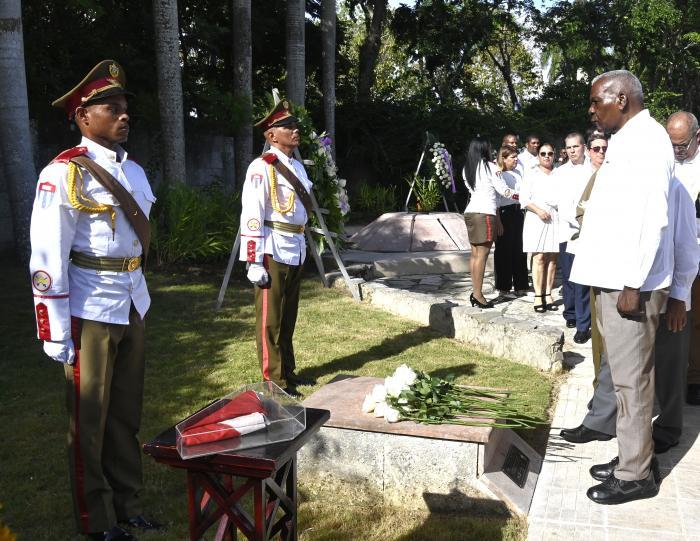
Foto: Estudios Revolución

Foto: Estudios Revolución

Foto: Estudios Revolución
Foto: Estudios Revolución
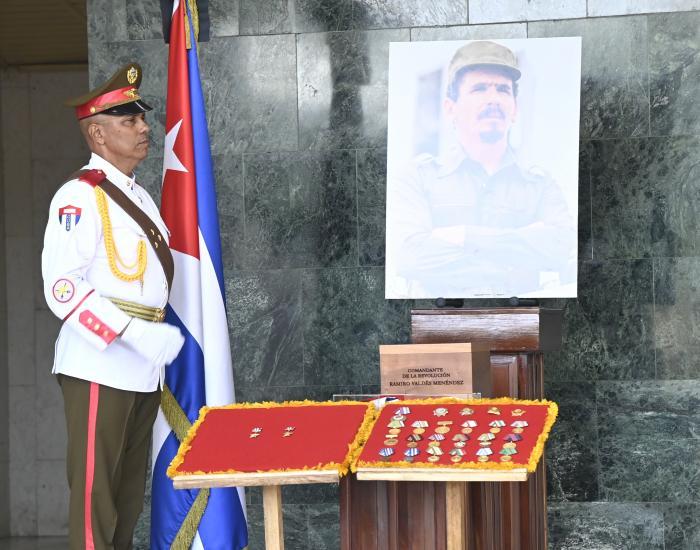
Foto: Estudios Revolución
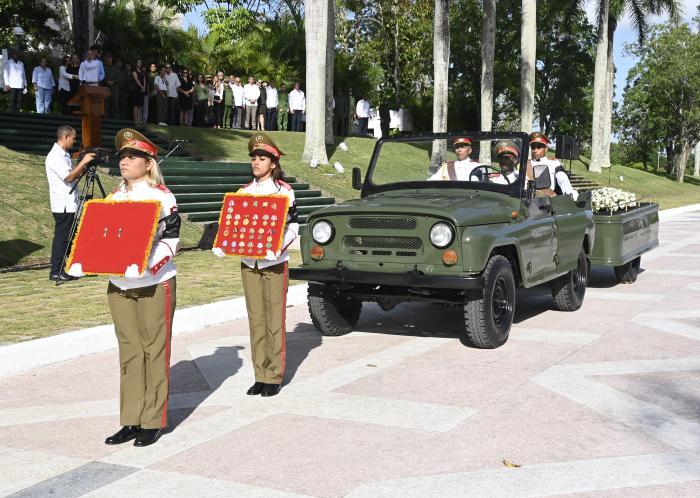
Foto: Estudios Revolución

Foto: Estudios Revolución

Foto: Estudios Revolución

Foto: Estudios Revolución

Foto: Estudios Revolución

Foto: Estudios Revolución

Foto: Estudios Revolución

Foto: Estudios Revolución

Foto: Estudios Revolución

Foto: Estudios Revolución


