

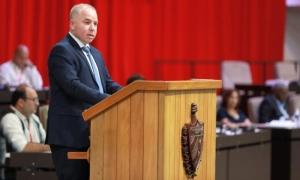
The Minister of Finance and Prices, Vladimir Regueiro Ale, reported to the Seventh Ordinary Session of the National Assembly of People's Power, in its Tenth Legislature, that the implementation of Law 181/2026, the State Budget Law for 2026, shows, at the close of the first semester, results exceeding projections in several indicators, although challenges remain related to tax collection, tax evasion, and the execution of certain expenditures.
In presenting the budget execution report, he explained that several provinces are maintaining favorable budget results, including Pinar del Río, Artemisa, Havana, Mayabeque, Matanzas, Villa Clara, and Camaguey, while other territories are also approaching closing the year with positive balances.
Regarding revenue, he noted that compliance continues to be supported primarily by tax collection; however, he emphasized the need to more effectively mobilize the resources that should remain in the territories to finance local development projects and support the implementation of economic and social transformations.
The Minister also highlighted the strengthening of fiscal control measures and warned that tax evasion and non-compliance continue to be one of the main sources of revenue for the State Budget and require more coordinated and effective action from all the institutions involved.
SOCIAL SPENDING REMAINS A PRIORITY
Regarding budget execution, Regueiro Ale reported that it has reached 93% of the amount projected for the period. He explained that the main shortfalls are due to difficulties in supplying goods for budgeted activities and the failure to meet the targets of some economic plans that receive financial support from the Budget, including those related to the procurement of agricultural production.
He added that a significant portion of the budget resources was concentrated on financing economic activities and subsidizing electricity rates for the residential sector, as well as on investments aimed at restoring electricity generation capacity and other strategic sectors.
ESTIMATES INCORPORATE IMPACT OF TRANSFORMATIONS
Regueiro Ale explained that the Ministry prepared a year-end estimate taking into account the implementation of the recently approved economic and social transformations, which should contribute to boosting the marketing of goods and services, recovering agricultural production, and fostering improved performance of budget revenues.
However, he indicated that the projections also consider the financial impact of the partial salary increase in the state-funded sector and the increase in the minimum wage, factors that will affect the fiscal deficit at year-end.
The Minister reaffirmed that any required adjustments will be submitted to the National Assembly in due course, in accordance with the provisions of Law 181/2026, the State Budget Law for 2026.
2025 BUDGET SETTLEMENT REAFFIRMS PRIORITY OF SOCIAL SPENDING AND FISCAL DISCIPLINE
Regueiro Ale emphasized that the budget policy maintained as an essential principle the protection of the Revolution's social programs and the fulfillment of the macroeconomic stabilization objectives outlined in the Government Program.
He reported that the fiscal deficit at the close of 2025 amounted to 67,642 million pesos, a result made possible by exceeding total revenues by 2% and by spending being 2% lower than planned, demonstrating more rigorous management of public finances.
Regarding revenues, the Minister noted that gross revenues reached 463,461 million pesos, while tax revenues represented 68.6% of total revenue collected.
According to the report, this behavior was favored by the updated taxes applied to fuels, cigarettes, and tobacco, as well as by the increased contributions from non-state sector actors, especially from sales and profits.
However, the report warned that tax evasion and underreporting persist, affecting the State's ability to increase resources allocated to social programs.
In this regard, it was reported that the National Tax Administration Office's audits identified debts of 12.056 billion pesos and recovered 7.14 billion, although 6.669 billion remain outstanding.
The report also drew attention to the insufficient use of tax bank accounts by some taxpayers, despite the fact that 98% of them have already activated them as part of the banking process.
HEALTH, EDUCATION, AND SOCIAL SECURITY RECEIVED THE LARGEST VOLUME OF RESOURCES
The Minister of Finance and Prices reported that expenditures totaled 518.543 billion pesos, equivalent to 97.9% of the budgeted amount. Of this, 64% was allocated to the Public Health, Education, Social Assistance, and Social Security sectors, demonstrating the social nature of the budget.
- Public Health: More than 75 billion pesos were allocated, resources that supported over 103 million primary care consultations, nine million specialist consultations, 23 million dental consultations, and more than 825,000 hospital admissions. These funds also ensured, to the extent possible, the acquisition of essential medicines.
- In Education, 69.133 billion pesos were allocated to support a total enrollment of 1,368,000 students across all levels of education and 266,198 university students, along with investments in school infrastructure and projects to improve learning conditions.
- Culture required expenditures totaling 11.845 billion pesos, corresponding to programs aimed at raising the cultural level of the population and promoting healthy recreation.
- In Sports, 7.656 billion pesos were allocated for the development of sports and physical culture.
Regarding social protection, Regueiro Ale specified that by 2025, the focus of Social Assistance would be on addressing the needs of vulnerable groups, including the elderly, people with disabilities, and low-income families, as a tool to promote social equity.
STRENGTHENING FISCAL CONTROL REMAINS A PRIORITY
While acknowledging the progress made, the Minister pointed out that shortcomings persist related to budgetary control, tax evasion, the availability of specialized personnel in the economic and financial areas, as well as distortions in the relationship between the state and non-state sectors.
"Overcoming these limitations is imperative to enhance the intrinsic fiscal capacity of the Budget as a development tool," he stated.
In this context, he reaffirmed the need to strengthen fiscal discipline, improve control mechanisms, and increase the efficiency of public spending as part of implementing the economic and social transformations approved by the country.
Finally, he emphasized that the State Budget will continue to be an essential tool to support economic development, guarantee the sustainability of social policies, and contribute to building a more just and equitable socialist model.


