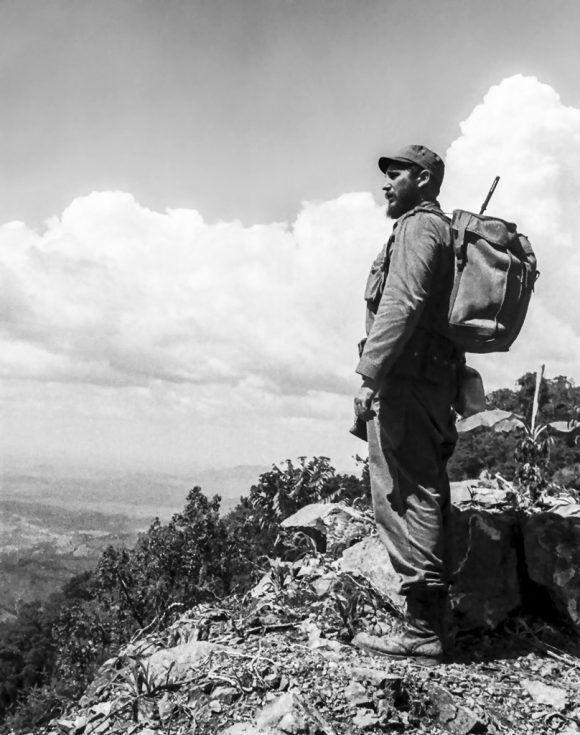
Writing these lines brought back to my memory, as if no time had passed, every moment lived alongside the man who began as the brother I always saw as a role model, and who, through his example, by marching at the front in every battle, deserved to be recognized by our people as their undisputed leader.
I consider writing this prologue the highest honor, while at the same time feeling the need to highlight observations and conclusions related to the thought, life, and work of Fidel, as his compatriots and many others around the world call him, for whom his name alone is enough to identify him.
He was my closest mentor. I will never forget when he gave me my first book on political topics: The Origin of the Family, Private Property and the State, by Friedrich Engels. After that, he recommended others that clarified what I hadn't been able to understand until then.
As children, we spent time together at La Salle School in Santiago de Cuba. Years later, when he graduated with a law degree, he suggested to our parents that I move with him to Havana to continue my studies and attend university.
In the early 1950s, Fidel attempted to run for representative of the Havana neighborhood of Cayo Hueso, hoping to transform the nation's dire situation through constitutional means. Shortly afterward, the coup d'état of March 10th, 1952, convinced him that only one path remained to achieve this goal: armed struggle.
In response to this shameful event, he filed a motion of unconstitutionality with the Havana Emergency Court and denounced in the press, particularly in his article "Revolution Not, a Coup," the criminal nature of the coup that would violently exacerbate the situation of the Cuban nation.
Months later, on January 28th, 1953, the centennial year of José Martí's birth, an imposing demonstration of workers, employees, students, and the general public marched from the university steps to the Fragua Martiana (Martí's Forge). Thus began the March of the Torches, and Fidel Castro was at the forefront of more than a thousand disciplined and impassioned young people.
Almost a year had passed since he began his work of uniting the best of the Orthodox youth into a single movement, with the goal of organizing a military action. At that time, he maintained: "We need to start a small engine to help start the big one." The small engine would be the assault on the Moncada Barracks, and the big one, the people fighting with the weapons captured there.
As I once said, if Karl Marx had stated that the protagonists of the Paris Commune were "ready to storm heaven," then the attack on Moncada by several dozen young men armed with bird-killing shotguns could be said to have "tried to take heaven by surprise."
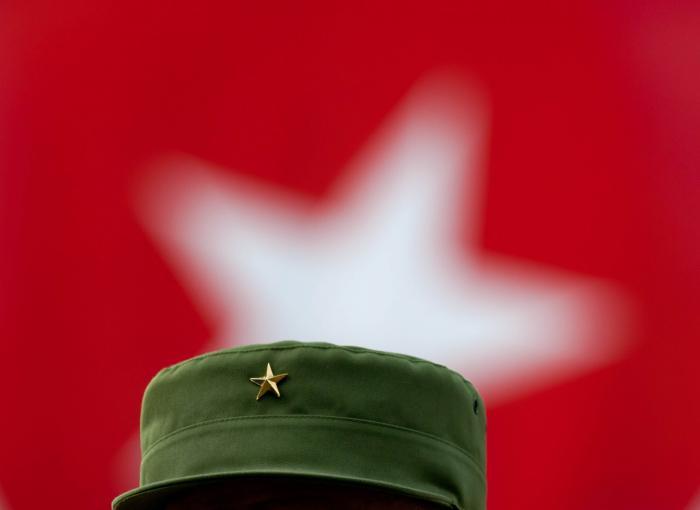
The Batista dictatorship unleashed its fury against those who had participated in the July 26th Movement. We survivors were condemned in a trial devoid of constitutional guarantees. Meanwhile, Fidel was tried alone in a small room at the Saturnino Lora Hospital in Santiago de Cuba. There, he defended himself and became a relentless accuser of the regime.
His plea, "History Will Absolve Me," became the political program of the Revolution. How far those judges and soldiers could have imagined that the words of a prisoner tried in secret, as if to ensure no one would know what he said, would become laws of the nation for the good of the people!
Twenty-two months later, an amnesty was announced due to popular pressure, and the dictator hinted at including us if we renounced armed struggle. Fidel declared from prison: "We do not want amnesty at the price of dishonor."
When the unconditional pardon was granted in May 1955, Fidel focused his efforts on demonstrating to the masses that revolutionary war was inevitable and laid the groundwork for organizing the clandestine movement.
Mexico then became our refuge. We lived in makeshift camps, under strict regulations, where, in addition to military training, we studied Cuban reality and works of world culture.
With Fidel's promise in 1956 to "be free or martyrs," we arrived on the Cuban coast aboard the Granma yacht on December 2nd. A few days later, after enduring harassment, persecution, and the setback at Alegría de Pío, we met again with the Leader of the Revolution in a place in the foothills of the Sierra Maestra known as Cinco Palmas. We were eight combatants with only seven rifles, but Fidel, with the unwavering confidence in victory that he never abandoned, declared: "Now we will win the war!" His genius as a revolutionary leader was decisive in transforming that exhausted detachment, which would later face very difficult situations, into the victorious Rebel Army.
I admired his fearlessness and ability to foresee the enemy's plans, his audacious idea of creating new guerrilla fronts and invading the central and western parts of the island, which he shared with me in December 1957 at a place known as Balcón de La Habanita, upon the return of the troops under my command who had fought between Pilón and Manzanillo. He seemed to possess the gift of prophecy; his intelligence and analytical skills allowed him to anticipate events.
Likewise, his sensitivity and humanism were examples for me and the rest of the combatants. Nothing affected him more than a life cut short by the savagery of the people's murderers. Each fallen comrade was a heavy blow to him; upon learning of the vile assassination of Frank País García, he exclaimed, "What monsters! They don't know the intelligence, the character, the integrity they have murdered!"
In Fidel converged the traits and virtues of the military leader and the political leader, who left a deep mark on all of us: absolute identification with the interests of the people; profound military knowledge; high culture, given not only by a vast professional preparation, but by its political, military and ideological dimension; modesty and simplicity in the treatment, ability to formulate his ideas with precision and skill to transmit them with such passion that all who listened to him made them their own.
It is impossible to explain the victorious campaign of the Rebel Army without highlighting the role of its Commander-in-Chief. The military feat against the tyranny's Summer Offensive is unprecedented in Cuban and perhaps even world military history.
A small, non-professional army, with scarce and inferior weaponry, poorly equipped, and with virtually no chance of survival, defeated forces 30 to 50 times superior in number, weapons, and other resources. The essential factor in that decisive victory was Fidel's wise leadership and his conviction that the ideas of men are the determining moral force.
It was not that July morning in 1953, but five years, five months, and five days later, on January 1st, 1959, that we began the conquest of heaven, which for a revolutionary means the progress, well-being, and happiness of the people. From his defense at the Moncada trial, Fidel made it clear that the Revolution was born committed solely to the people.
As noted in the second volume of this collection, the revolutionary government resolutely and definitively reclaimed national sovereignty, which had been denied since 1898 by U.S. intervention. It immediately implemented radical measures to benefit the people, including reductions in rents and telephone and electricity rates, a housing and savings plan, and, above all, the Agrarian Reform Law, which eliminated large landholdings and distributed land to those who worked it. These measures, along with the nationalization of foreign companies, allowed the Revolution to advance its socialist project in a decisive historical process led by Fidel Castro.
Immersed in fulfilling the Moncada Program, the objectives of the revolutionary process were outlined in the First Declaration of Havana. The exploitation of man by man was banished from our land, a society based on labor and collective contribution was founded, and the path of anti-imperialist struggle was charted. The Revolution of the humble, with the humble, and for the humble had begun to bear fruit. When, in April 1961, the Commander-in-Chief proclaimed its socialist character, he was simply giving a name to an already existing reality.
In the following days, under his personal leadership at Bay of Pigs, the people, the combatants of the Rebel Army, the National Revolutionary Police, and the nascent Militias inflicted upon Yankee imperialism the first major military defeat in Latin America; that same year, Cuba was declared a Territory Free of Illiteracy, a feat achieved by our youth in response to the call of the Commander-in-Chief.
The following year we faced the Missile Crisis, in which Fidel amply demonstrated his statesmanship in defense of the principles of the Revolution.
Shortly afterward, in 1965, on the path to consolidating revolutionary unity, the first Central Committee of the Communist Party of Cuba was formed. The leader of the Revolution, elected First Secretary for his merits, affirmed that we now had a Party with a single, true, and scientific ideology, heir to the Party of Independence of José Martí. That night he read us the unforgettable farewell letter of Che Guevara, the heroic guerrilla fighter who, for Fidel and all of us, was a symbol of the highest human values, an extraordinary example, and a paradigm of a revolutionary.
The Commander-in-Chief dedicated his life to solidarity and internationalism, to the anti-colonial, anti-apartheid, and anti-imperialist struggle, for the emancipation and dignity of peoples. Following his example, our fidelity to Marxism-Leninism and proletarian internationalism will remain unwavering.
There is perhaps no other instance in history where the leadership of a revolution has enjoyed such overwhelming support, trust, and conscious enthusiasm from the masses as that offered by our people to their Revolution, their leaders, and especially to Fidel, their beloved and undisputed leader.
In 1989, he presciently warned us about the possibility of the collapse of the USSR and the Socialist Bloc, and assured the world that if such circumstances arose, Cuba and the Cuban Revolution would continue to defend the banners of socialism. When many in the world were betting on its end after the collapse, his leadership and close relationship with the people were decisive in ensuring that the country, in the difficult circumstances of the Special Period, preserved the fundamental gains achieved. A decade later, faced with the enemy's ruthless offensive, he launched a strategic counteroffensive.
He possessed two great virtues: his excellent tactical thinking and his dual role as a military and political strategist. Following Martí's precept that trenches of ideas are worth more than trenches of stones, he perfected our strategic concept of the People's War, essential in preparing the country for defense, and in doing so, he deepened and contributed to Cuban military art like never before. Likewise, the battles he called us to wage for the return of the child Elián and the Cuban Five, with the certainty that they would return to the Homeland and the assurance that we could achieve it through unity, exemplify his excellence as a political strategist.
Fidel taught us that progress was indeed possible in education, health, culture, and in the crucial fields of genetic engineering and biotechnology; that we could achieve it despite the genocidal economic, commercial, and financial blockade imposed by the U.S. government for more than six decades.
Both in Cuba and in the fulfillment of glorious internationalist missions, he instilled in us his unwavering confidence in triumph and his faith in victory. He was an expert in the use of limited resources, knew how to place each person in the right place at the right time, and taught us to combat the great with the small, the strong with the weak, and technological superiority with intelligence.
In the pages of this edition, one can observe the development of bilateral relations with the United States and the other capitalist countries, his capacity for dialogue and cooperation based on respect and principles. Being a staunch anti-imperialist did not prevent him from recognizing the merits of the American people and expressing solidarity with them in difficult times.
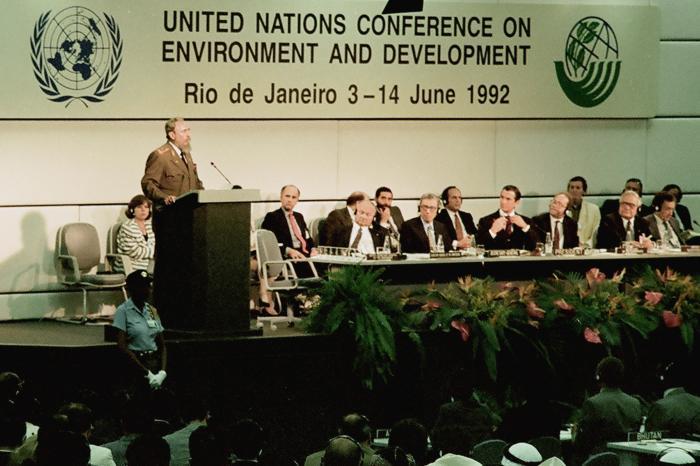
In international forums, his voice rose on behalf of the peoples of the Third World, defending peace and their right to development, denouncing imperialism and the arms race, and warning of the economic, political, and moral impossibility of paying the external debt. He joined forces to strengthen the Non-Aligned Movement and transformed it into an effective mediator in conflicts facing the dangers of war. In similar settings, he warned of the cost that postponing environmental protection would have on the survival of the human species.
Through his example as a revolutionary humanist, detached from material possessions, he addressed both global and everyday problems. He did not hesitate to offer his own blood, to provide aid and medical assistance to those affected by flooding, hurricanes, earthquakes, or other catastrophes. He taught us the true meaning of solidarity: sharing what little we have, not what we have in excess.
He promoted Latin American and Caribbean unity and the principle of equality among all people. In this endeavor, Chávez was his comrade in arms. From an early age, he saw in him a leader and foresaw his political future, even when many didn't yet know him. Together, they tirelessly worked to turn their dreams into reality.
Even during the most delicate moments of his health, he continued to share his wisdom and experience with us in the face of every problem and crucial decision. Until his final days, we saw him transformed into a "soldier of ideas," a researcher, and a promoter of sustainable sources for animal and human food.
Fidel is Fidel. Faithful to Martí's ethic that "all the glory of the world fits in a grain of corn," he strongly insisted that his memory should in no way be interpreted as a cult of personality. The best monument to his ideals and work is to continue working to make his vision a reality, united as one under the leadership of the Party.
He expressed his confidence in young people and his conviction that the ideas of Cuban communists would endure. He bequeathed to future generations a legacy based on personal example and his unwavering will to achieve the impossible. His legacy makes us strong, unites us, and is an impregnable bastion in the defense against attempts to destroy the Revolution.
I once said that Fidel's enduring lesson is that it can be done, that humankind is capable of overcoming the harshest conditions if its will to win does not falter, if it correctly assesses each situation, and if it does not renounce its just and noble principles.
Before the members of the National Assembly, I repeated and made my own Che Guevara's accurate statement: "And if we are here today and the Cuban Revolution is here, it is simply because Fidel was the first to enter the Moncada Barracks, because he was the first to disembark from the Granma, because he was the first in the Sierra Maestra mountains, because he went to Bay of Pigs in a tank, because when there was a flood he went there and there was even a fight because they wouldn't let him in. That is why our people have such immense confidence in their Commander-in-Chief, because he has, like no one else in Cuba, the quality of possessing all the moral authority possible to ask for any sacrifice in the name of the Revolution."
Being Fidel's brother is, for me, not only an honor but also a privilege. I am a communist because he taught me. From a very young age, I decided to join him in building this beautiful work that is the Cuban Revolution.
Immersed in these reflections, events that reveal Fidel's multifaceted personality flooded my mind. Because of their value to future generations, I will try to summarize them in a few lines, even knowing that it would wound his proverbial modesty should he still be physically among us.
He was Martí's best disciple: enveloped in his ideas and convictions of struggle, he was able to complete the Master's unfinished work.
He founded the first socialist state in the Western Hemisphere and, in doing so, created a Marxist-Leninist party, the Communist Party of Cuba, whose indigenous principles have been tested by more than six decades of socialist construction. His conceptual contributions regarding the Party guarantee its functioning and its leading role in Cuban society.
I reaffirm what I stated on June 14th, 2006: "There is only one Commander-in-Chief of the Cuban Revolution, and only the Communist Party, as the institution that unites the revolutionary vanguard and is the sure guarantee of the unity of Cubans throughout all time, can be the worthy heir to the trust placed by the people in their leader. That is what we are working for, and so it will be; anything else is pure speculation, to put it mildly."
Wherever it was necessary to raise one's voice against an injustice that needed to be redressed, a just cause that needed defending, Fidel was there. Through courage, sacrifice, and example, his authority emerged and grew. In 1959, I stated: "Fidel is wherever work is being done (…), wherever a Cuban is working honestly, wherever a Cuban, whoever they may be, is doing good. Wherever a Cuban, whoever they may be, is defending the Revolution."
True to his principles, Fidel spared no effort or sacrifice in pursuit of his goals, even to the extreme. With absolute candor, he confessed: "I belong to the camp of the impatient. I belong to the camp of the hurried, those who always push to get things done, and those who often try to do more than is possible."
He was a mentor to generations who admired and followed him. To be like him is the call to Cuban revolutionaries: to strive to emulate his qualities and example, and to become worthy builders of the society we are forging.
For cadres, Fidel is the supreme example of a leader, thanks to his virtues, his style, and his working methods, which made the connection with the masses a primary source for learning, research, study, and leadership. When in doubt or seeking advice, let us turn to him with the certainty of finding a wise answer.
The concept of Revolution that he bequeathed to us, and to which we swore an oath, enriches the classic definition and becomes a valuable contribution in complex times, a weapon against dogmatism, and a compass for every battle we wage. Our greatest commitment is to make his principles a reality!
Throughout his life, Fidel embodied the virtues that converge in a military genius: the study of history and the experiences of the wars of independence, through the struggle and the war of national liberation, the doctrine of national defense, and the victorious leadership of Cuban internationalist troops 14,000 kilometers from our island. His contributions to the art of war in different contexts of struggle are well worth studying and applying whenever the situation demands it.
A maker of dreams and feats, he fought against the most diverse "windmills" with the renewing force and nobility of a Don Quixote, the celebrated character he so admired. History recognizes him and will continue to recognize him for the significance of his work.
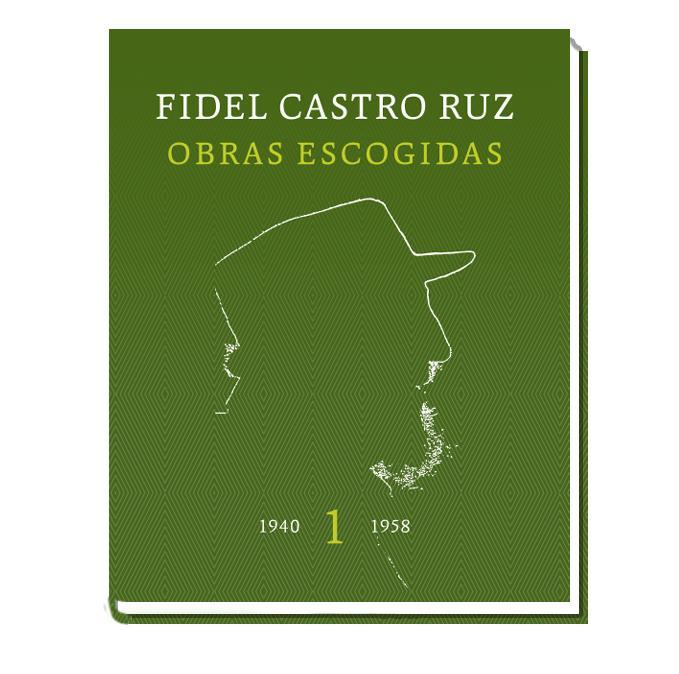
A research project made possible these Selected Works of Fidel Castro Ruz, compiled in 23 volumes. They are a selection of 690 works of different types: speeches, interviews, articles, reflections, prologues, and other materials, some previously unpublished or little known. The final volume aptly includes a testament to the deep friendship he shared with Hugo Chávez, whom he described as "the best friend the Cuban people ever had."
The collection confirms what we all know: Fidel possessed the gifts of an extraordinary communicator, a profound and vibrant orator who captivated multitudes. It is a transcendent part of the nation's historical memory; there is no essential event that is not included in these pages, although it would be presumptuous to claim that it contains everything he ever said. At the same time, it reveals how much remains to be researched and written about the epic of the Cuban Revolution and its impact on history and the future. It will be an essential reference for delving deeper into the thought, life, work and example of our eternal leader.
For those who worked on these magnificent and timely Selected Works, with Martí's and Fidel's dedication, it became a school and a source of masterclasses. The colossal challenge remains for the Fidel Castro Ruz Center to publish the Complete Works, an urgent necessity for the nation's historical memory.
Current and future generations will find in them an inexhaustible source for understanding the times we live in and a formidable weapon to continue defending the Homeland with the strength of Baraguá and the spirit of Antonio Maceo's immortal words: "Whoever tries to seize Cuba will reap the dust of its soil soaked in blood, if they do not perish in the struggle."
Infinite thanks, Fidel, for your teachings and example. With you, we reaffirm the commitment you instilled in us:
Homeland or Death!
We shall overcome!
Always onward to victory!