

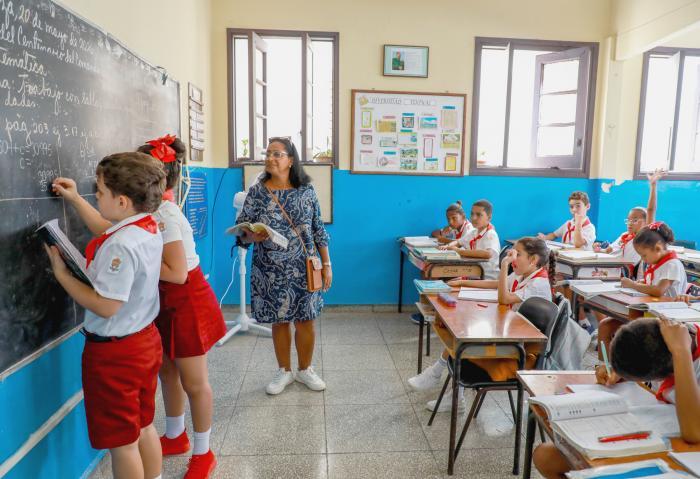
The 2026-2027 school year will begin in Cuba on September 1st at all levels of general education, while universities and higher education institutions will also resume their academic activities. This comes amidst a national context marked by energy shortages and other limitations that affect the daily lives of families.
The Minister of Education, Naima Trujillo Barreto, stated during a tour of the country to review preparations for the school year that, despite the complex circumstances, efforts are underway to guarantee a "dignified and sustainable" school year, addressing the main educational needs of children and adolescents, in accordance with the resources of each institution and community.
According to reports from the Cuban News Agency (ACN), the minister emphasized the need to innovate, make flexible, and tailor solutions to each school, neighborhood, municipality, and province, so that existing conditions do not hinder the efficient and high-quality development of the educational process.
The challenge involves adapting school organization to a reality that extends beyond the classroom and directly affects families: difficulties in securing fuel and transportation, power outages, supply problems, and material limitations necessitate seeking alternatives that allow for the continuation of teaching activities while acknowledging the specific conditions of each region.
Regarding Higher Education, the 2026-2027 academic year will also begin on September 1st at universities and training institutions throughout the country. The system has established an organization based on decentralization and a territorial approach, drawing on the experience implemented during the previous semester.
Thus, the registration processes for new students, readmission, and renewal of enrollment for continuing students will be organized from their places of residence. These procedures can be carried out in person or online, depending on the resources of each university, Municipal University Centers (CUM), and Municipal University Branches (FUM).
University education will combine blended and distance learning modalities, with periods of in-person instruction when conditions permit, primarily for daytime students. Activities may take place not only at main campuses but also at CUMs, FUMs, and local production or service entities.
For the blended learning course, in-person sessions are expected to resume at least once a month, while the distance learning course will maintain its usual format.
The measures adopted by both educational systems share a common goal: to preserve the continuity of education through greater flexibility and better use of available resources, without applying uniform solutions where conditions differ.
The start of the school year will therefore be accompanied by additional efforts from teachers, students, families, and local authorities. The goal, according to the responsible agencies, is to ensure that the challenges of the current situation do not lead to an interruption of the educational process, but rather to a reorganization capable of responding to the circumstances of each community.


