

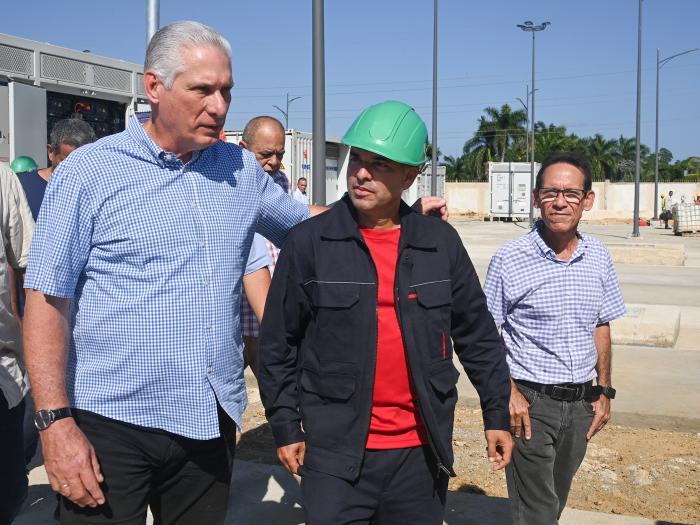
The Paso Seco water supply source, a strategic point for supplying water, primarily to the south and center of the Cuban capital, is undergoing extensive maintenance and restoration work, following President Miguel Díaz-Canel Bermúdez's directive to maintain water pumping amidst the country's energy crisis, a consequence of the U.S. government's blockade and the oil embargo, which has now lasted more than eight months.
On Thursday, the President visited the site in the Boyeros municipality as part of his tour of the country's territories to personally assess the strategy being implemented to ensure that the capital's residents receive water, even amidst prolonged power outages. This is one of the most critical issues facing a city of nearly two million people.
Specialists from the National Institute of Hydraulic Resources, the National Electric Union, the Revolutionary Armed Forces, and other national entities have been involved in the project to repair deteriorated infrastructure (equipment, transmission lines, motors) and improve the backup power supply to the water source, as explained to the press by Rubén Campos Olmo, Director General of the National Electric Union.
"We really started from a critical situation," he considered, "and there's a strategy to recover the facility in terms of ensuring the electrical supply, water resources, and the local culture, following a directive from the President at the National Defense Council to seek permanent protection for the capital's water supply."
He explained that motors will be deployed there, and also to other sources in the city, to keep the wells running in the event of failures in the National Electrical System. This would ensure that the pipeline remains full and that better water pumping levels can be achieved for the city.
Naturally, this solution involves fuel costs, which is why the future in Paso Seco, and in the other pumping and repumping stations in Havana, lies in the installation of solar panels.
Campos Olmo clarified that most of the energy reaching these sources will continue to come from the National Electrical System, now supplemented by motors to compensate for outages.
"These motors are scheduled to be brought in within the next 72 hours and connected, so that in the event of a system failure, prolonged disruption, or breakdown, they can be put into operation," he said.
In a meeting with officials involved in this strategic task, Díaz-Canel addressed the critical situation currently being experienced by a large part of Havana's population, affected by power outages and, consequently, water shortages. He called for resolving this problem as quickly as possible, not only in Paso Seco, but throughout all of Havana's water supply systems.
BESS HAVANA 220 ALMOST READY
The Cuban President also visited the Havana 220 Battery Energy Storage System (BESS) this Thursday, one of four 50 MW systems that, together, will contribute 200 MW of storage capacity to the country. The other three are located in Cotorro (Havana), Cueto (Holguín), and Bayamo (Granma).
The Head of State toured the facility, which is currently under construction and assembly, near the Technological University of Havana (Cujae).
According to engineer Manuel Alejandro Soler Sánchez, head of the electrical aspects of the site, "it's an energy storage project using lithium batteries, whose primary function is to regulate the frequency of the National Electrical System."
This system, he added, "is a grid-forming system, which would help us, in the event of SEN (National Electrical System) disruptions, to provide power to a generating plant or to bring the system online."
The young specialist, who was also involved in the installation of the Cueto BESS (Battery Energy Storage System), emphasized in his statements to the press that "it's about regulating the primary frequency and mitigating what we know as Automatic Frequency Trips (AFTs)," which is understood as the automatic protection mechanism against a dangerous drop in frequency in the SEN, which also causes blackouts.
This site, along with the other two we have in line—Cotorro and Cueto—would also help us increase the overall power output of the photovoltaic parks, Soler Sánchez explained. In cloudy conditions, it can compensate for that deficit, he explained.
According to what they told the Head of State, the electrical work and technical assembly are scheduled to be completed by September 30th; technical support will follow, and it should be online by October 30th. They agreed that this is a technological milestone for the country.
SUCCESSFUL EXPERIENCE TO REPLICATE
Servivip is a state MSME, belonging to the Higher Business Management Organization for Water and Sanitation, whose mission since 2021 has been to solve the problems of hydraulic networks inside homes, buildings, citadels and communities, where the National Institute of Hydraulic Resources did not reach.
Then it grew with other services such as the supply of water in pipes (it fulfills more than 80% of this activity in Havana), unclogging, wastewater evacuation, garbage collection, drinking water treatment, among others, which have led it to be a benchmark in its sector, with the status, in addition, of National Vanguard for three consecutive years.
President Díaz-Canel arrived at one of the facilities of this company, located in the municipality of Cotorro, this Thursday morning to learn about the experience of one of the first state MSMEs founded in the country, currently with 88 workers and an average salary that exceeds 48,000 pesos.
In dialogue with the president, its director, Víctor Janier Jara Jorge, explained the main economic indicators of the company, his experiences in these five years of work, the benefits of the new economic and social transformations recently approved, as well as the disadvantages that still persist with respect to other forms of management. Regarding this, the president took note, to respond and solve the obstacles.
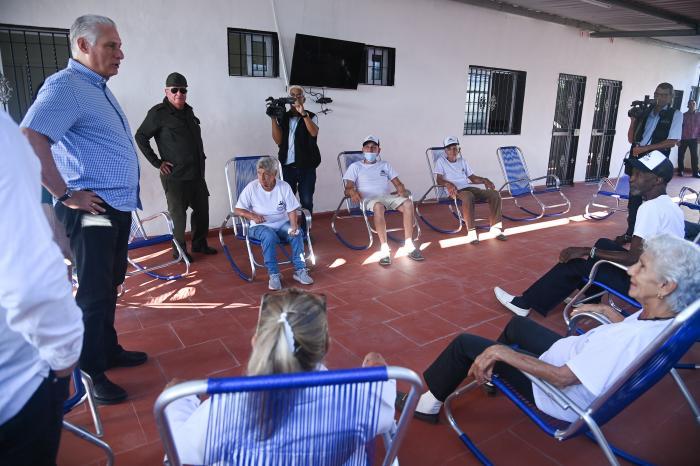
Likewise, he was made aware of the company's social responsibility in exalting projects, such as a Grandparents' House for elderly people who live alone – also visited by Díaz-Canel –, in which they are cared for throughout the day and provided with food; and attention to the school and the Maternal Home of the community.
The President highlighted this successful experience in a state MSME and indicated extending it to other companies of the National Institute of Hydraulic Resources, which could solve so many problems with the talent and creativity of their workers and managers.
During the President's tour of various entities in the Cuban capital, he was accompanied by Political Bureau member and Minister of the Revolutionary Armed Forces, Army Corps General Álvaro López Miera; Deputy Prime Minister Inés María Chapman Waugh; and several members of the Council of Ministers.


