

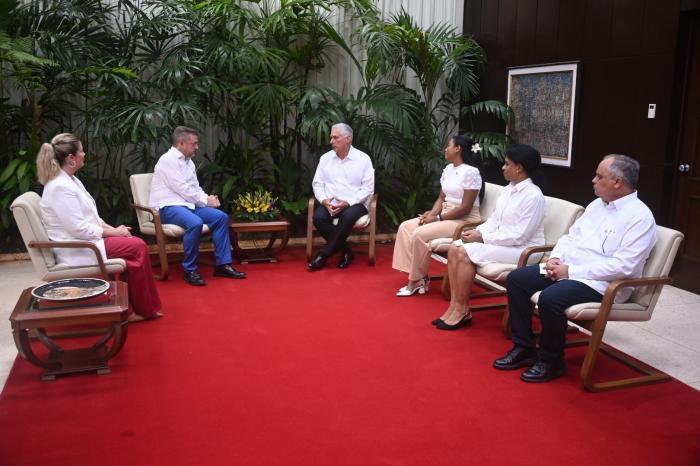
Miguel Díaz-Canel Bermúdez, First Secretary of the Central Committee of the Communist Party of Cuba and President of the Republic, described the arrival in the Caribbean nation of International Paralympic Committee President Andrew Parsons and the organization's Director of Development for the Americas, Michele Melissa Formonte, as a gesture deserving of gratitude "and also as support for the Cuban sports movement."
The leader shared these remarks at the Palace of the Revolution while welcoming the visitors, noting that the visit was taking place at a complex time due to "the situation our country is experiencing—one that greatly affects sports, and Paralympic sport in particular."
Díaz-Canel expressed to the officials the commitment of the "Largest of the Antilles" to continue providing support. He addressed them as "representatives of the International Paralympic Committee and the Americas Paralympic Committee," reaffirming that "there is political will and government commitment."
The Head of State cited another reason for offering support: "We do this based on a fundamental concept of social justice—a principle of the Cuban Revolution that is inclusive and offers opportunities for all. We stand with you in this fight to ensure Paralympic sport gains greater recognition and inclusion, and to champion the cause."
The President affirmed that Cuban Paralympic athletes are a source of national pride, noting that "they have achieved outstanding results on the international stage, and we will continue to support that entire movement."
In the same vein, he reaffirmed Cuba's willingness to place itself at the service of the Paralympic movement and to contribute "the modest experience we have"—specifically through "the Sports University that you will visit tomorrow."
Díaz-Canel also offered their expertise—"all the scientific knowledge from sports-related research centers, and regarding Paralympic sport in particular."
The President explicitly stated a desire "to work on joint projects that would also allow us to develop training bases for our athletes, as well as development projects for them."
For his part, Andrew Parsons remarked, "It is an honor to be in Cuba." He reminded the Head of State that both visitors were Brazilian, speaking of a "brotherly friendship."
The First Secretary of the Party's Central Committee emphasized, "We are brothers, indeed." He continued to listen attentively to the International Paralympic Committee President, who also described the visit as a gesture of support—both for the Caribbean nation and for Paralympic sport.
Omara Durand Elías—a multiple Paralympic and world champion and president of the Cuban Paralympic Committee (CPC)—was present at the exchange session.
Omara "has achieved so much in Paralympic sport and is an example for so many athletes, especially women," noted Andrew Parsons.
The International Paralympic Committee President recounted that when Omara invited them to Cuba, "the first thing was to say yes."
Among other emotions, he spoke of being moved by the visit on Monday to the Solidaridad con Panamá school, a place where—he noted—education, art, sport, and inclusion come together.
Another particularly significant moment for the visitors was standing on the track where Omara has trained to achieve her admirable results as an athlete.
Andrew Parsons told the leader that, on Monday, he and the Cuban Paralympic Committee president had discussed "events, programs, and how the International Paralympic Committee and the Americas Paralympic Committee can support the Cuban Paralympic movement."
Also present at the meeting on the Cuban side were Deputy Prime Minister Inés María Chapman Waugh and the head of the National Institute of Sports, Physical Education, and Recreation (INDER), Osvaldo Vento Montiller.


