

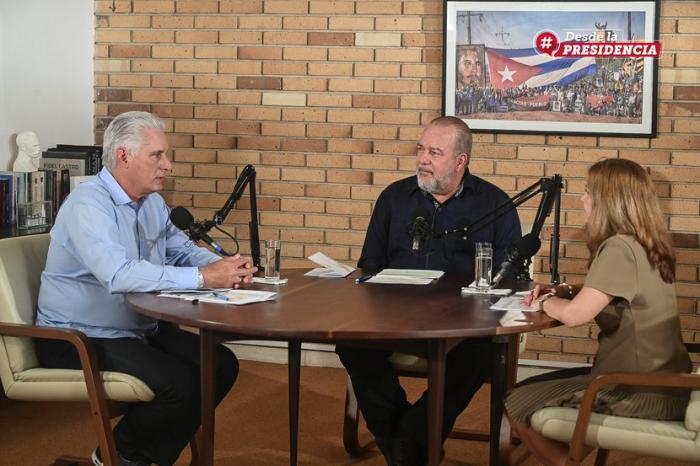
The space "From the Presidency" - podcast hosted by the First Secretary of the Central Committee of the Communist Party of Cuba, Miguel Díaz-Canel Bermúdez - is back; and this time, with a very topical and especially important topic: the 176 Economic and Social Transformations in which the nation is immersed to unleash economic potential, without leaving behind the social projection of all the changes.
In the company of the member of the Political Bureau and Prime Minister of the Republic of Cuba, Manuel Marrero Cruz, as well as the Minister of Justice, Rosabel Gamón Verde, the Head of State expressed that the last few months have been very intense, because "we were all working based on the design of the economic and social transformations", and on other very important tasks such as the activities for the centenary of Fidel's birth, and other political events of relevance to the country.
A cycle of diagnoses, proposals and discussions guided by the Communist Party in its last Congresses, together with subsequent analyses, closes - the president reflected. The changes that the Island is facing, he said, form "a necessary process to creatively confront the main obstacle to the economic, social and human development of our country."
Díaz-Canel stressed that "we are in a moment of urgency, under conditions of war against Cuba." The dignitary denounced that "a multidimensional war is developing, a war that is economic, that is ideological, that is cultural, and that is also communicational."
It is not, he said, just any war but rather the so-called Fourth Generation wars, with coercive measures that "escalate with the purpose of suffocating the economy, and a total media war."
The dignitary explained that, as the state of the Transformations was analyzed in the most recent Council of Ministers, he wanted to invite to the podcast space - in this first episode of the second season of "From the Presidency" - the Prime Minister of the Republic, and the head of Justice, to share with the people "the fundamental elements of the analyzes that took place in the main Executive Body of the nation."
What has been done, how much progress has been made, and where do we stand now? How can we respond to those who say this will amount to nothing more than paperwork? The leader put these questions to the Prime Minister, who, among other points, highlighted the three months that have passed since the Economic and Social Transformations were designed and approved.
These transformations—Marrero Cruz stated—represent "the What," a "political decision that we must transform our economy." He then asked: "What have we been doing during these three months?" He answered that they had been "writing and designing the How"—the methods for implementing the Transformations.
It was a time, he said, "to draft those policies and the legal regulations underpinning them, so we could then move to the next stage—actual implementation—and begin to see results."
It has been arduous work, not without frustrations given that the desired results are not yet visible, noted Marrero Cruz, who later referred to the challenge of striking a balance between the economic and the social spheres. The Head of Government did not overlook attacks from adversaries or doubts raised by friends—many people concerned that these changes might signal a "shift toward capitalism."
Regarding what has been designed and approved, the Prime Minister affirmed that it is a "fully sovereign decision" made without external pressure. The Political Bureau member recalled the need for a much deeper process of change; this gave rise to the Transformations, which—he emphasized—are intended to strengthen Cuban socialism without neglecting "social balance."
The Transformations—which are robust and far-reaching in the economic realm—must, the Head of Government argued, reinforce the "necessary social transformations."
Addressing the speculation and legitimate doubts regarding whether these plans would remain merely on paper, Marrero Cruz emphasized that "we have full confidence and certainty" in the work being done. He detailed that, over the past three months, "160 implementation proposals have been meticulously designed—meaning proposals that implement 160 Transformations—and to provide the necessary legal backing, 197 legal regulations have been drafted and approved."
The Head of Government stated that the groundwork for the "how"—a process he had previously explained—is already in place. He highlighted that, in essence, limitations, obstacles, and unnecessary bureaucratic hurdles are being removed: "The path forward is now open; indeed, progress is being made and results are already visible, even if the impact on the population's quality of life is not yet fully perceived. Nevertheless, we are advancing step by step in this process."
This process, he explained, creates the conditions for the final stage: the actual implementation of the Transformations. At this point in his remarks, Marrero Cruz reviewed the decisions taken so far, starting with the transformation of economic actors—beginning with the Socialist State Enterprise, for which 17 transformations have been devised.
Regarding the economic landscape, the Head of Government noted that all actors—both state and non-state—must be taken into account, pointing out that over 3,600 new MSMEs have been approved in the last three months. Currently, he stated, there are 16,100 MSMEs, 448 Non-State Cooperatives (CNEs), and more than 385,000 self-employed workers (TCPs) in Cuba.
"All of that," he remarked, "adds to the state business sector; these are economic actors for whom all obstacles and impediments have been removed so they can increase production."
Marrero Cruz stated that "social impacts" were carefully considered in every aspect of the design. In this regard, he highlighted decisions such as wage increases in the state-funded sector and the identification—with expert assistance—of individuals in the most vulnerable situations. Regarding the latter, he clarified that there is room to include people who belong to this group but have not yet been registered as such. The goal, he noted, is to guarantee social protection for those who need it most.
The Head of State also spoke about increasing incentives for farming and seamlessly integrating the non-state sector into the economic fabric, as these goals are part of the necessary transformations. He also acknowledged the population's understandable dissatisfaction regarding difficulties with the National Electric Power System (SEN), as well as the solutions on the horizon through the shift in the energy matrix.
He addressed topics such as transport transformations, foreign investment, municipal autonomy—described as a "profound transformation"—and the banking and financial system, as these are key aspects of national life where these transformations must and will take effect.
"We are convinced that this is the right path," stated the Prime Minister of the Republic of Cuba.
HOW LONG UNTIL RESULTS APPEAR?
President Díaz-Canel raised further questions: How long will it take for results to become visible in the daily lives of Cubans? When will the benefits be seen? Marrero Cruz noted that these are questions many people are asking.
The transformations, he said, should not be viewed in quantitative terms, but rather in qualitative ones. He made this point because everything that has been done—he emphasized—creates the conditions necessary to realize the expected results.
The Head of Government acknowledged that people will notice the impact when there are fewer blackouts, fewer water shortages, a wider range of products available, and better prices. He noted that the context is highly complex, yet "the conditions are in place" to see progress.
"We will not allow," he stressed, "the transformations to remain merely on paper."
THE LEGAL FRAMEWORK
To address the aspect of legal certainty within the context of the transformations, President Díaz-Canel invited Minister Rosabel to share her insights on the work done so far regarding the regulatory framework.
The owner then recalled that from the first moments a legal group was created to guarantee the quality and agility of the regulatory creation process. And he referred to a legislative schedule, which preliminarily identified 138 legal provisions that supported the implementation of the Transformations.
"We can tell you that in those three months - July, August and September - of those 138 legal provisions identified at the beginning, 105 have already been prepared, reviewed, and approved," the owner explained.
"We have 197 legal provisions ready to implement the Transformations," stated Rosabel, who also spoke about how the regulatory creation times were reduced, and about how the publication, in the Official Gazette of the Republic of Cuba, of all the regulations has been arranged, so that the protagonists master each content.
The minister reiterated that rigorous work is being done to guarantee the effectiveness and significance of the regulatory support process; and did not overlook the important role that jurists must play in conducting a process that must be carried out in accordance with the Law.
"How do we prevent an institution from wanting to modify some of the regulations?" the Head of State asked. Rosabel affirmed that the process as designed leaves no room for that to happen, nor does it allow for contradictions between lower-level and higher-level regulations.
"The most important thing here is the follow-up and monitoring process," the official emphasized, noting the importance of ensuring that the Transformations are carried out in strict adherence to legal regulations.
A PEOPLE'S RESISTANCE
Towards the end of the podcast, President Díaz-Canel stated that "work has been done with great responsibility, tenacity, and a strong commitment to ensuring this process moves forward successfully." He further highlighted that feedback gathered from the public regarding the Transformations reveals a sense of national resilience and "creative resistance" centered on sovereignty and the resolve to defend the Revolution and socialism.
The leader also addressed the doubts, concerns, and dissatisfaction felt by those questioning the direction of the Transformations. Díaz-Canel Bermúdez also referred to various suggestions that have emerged from the people. "I believe," he said, "that this is part of the popular debate—the collective discussion that we all must engage in."
The opinion study mentioned by the Head of State paves the way, he noted, for "addressing these issues with complete transparency" in future programs.
The president wanted to highlight that the construction of consensus for the implementation of the Transformations is a dialectical process, to which ideas can be added constantly.
"I believe that the permanence of the Revolution is the best proof that we are on the right track, because we have been subjected to a ruthless attack, to a ruthless aggression, to a genocidal and criminal practice by the administration of the United States."
"The challenge is strong, but we are not going to stop," said the president, who stressed that "the commitment is that we are not going to stop and that we are going to continue being consistent and coherent with the implementation of the Transformations."


