

There are pains that do not fade; they become eternal, staying with those who suffer them until their very last breath. José María Uranga knew this. When asked about his daughter Nancy Uranga Romagoza—the Cuban foil fencer returning in triumph from Caracas—he could barely manage to say, his voice breaking: "Today, just like the first day, I am always remembering her. Her mother and I... But what can we do? Twenty-odd or thirty years of laying flowers..." Then he slowly leaned back against the chair, as if seeking refuge within the very hollow of his grief. For there are voids that never end, and there are parents who must learn to live with an absence sown in blood and fire.
Haymel Espinosa was barely a few months old when her father, Miguel Espinosa Cabrera—the co-pilot of a Cubana de Aviación flight—died in the terrorist bombing off the coast of Barbados. Now an adult, she confides in the documentary *Explosión a bordo* (Explosion on Board): "So many times I needed him by my side; so many times I wanted him close. I wanted him with me on my wedding day. I feel that the photo is incomplete: I am there with my mother, but my father is missing." She adds: "When someone is taken from you like that—so suddenly—you are left with the hope that they might return. For me, it is a dream; it is what I always dream regarding my dad. Sometimes I think I’m going to run into him, that perhaps he survived as a castaway."
On that day—October 6th, 1976—two bombs exploded aboard a Cubana de Aviación plane in mid-flight. There were 73 people on board, including 24 teenagers from the youth fencing team. Most of the victims were reduced to fragments scattered over the sea. The remains of only eight Cubans could be recovered, and they became a symbol for all those who perished.
News of the attack spread like wildfire, shattering the hearts of mothers who—filled with pride—awaited their sons' embraces; of the children forever deprived by terrorism of a father’s hug; of the families suddenly robbed of the scolding, the pat on the back, and the joy of seeing their loved ones marry and their own lineages flourish.
Terrorism did not merely take their lives; it stole their farewells, the bodies to be mourned, the hands to hold, and the words left unspoken. Instead, it left behind an unfinished photograph, an empty chair, a silent phone, and a question that grows old with the passing years.
In a natural death, even though the pain may be an abyss, there are rituals that help give a name to the loss. In a terrorist attack, however, grief turns into an interrogation: How did they experience that final moment? What were they thinking? Why do such a thing? The mind refuses to accept the reality, the heart keeps waiting, and the absence becomes a wound that bleeds anew whenever that date draws near.
Only families who have been victims of terrorism know that insurmountable pain—those stifled sobs that erupt in the dead of night, the rage with no outlet, the irrational guilt of remaining alive, and the stubborn refusal to accept the irreversible.
Many parents could not withstand the blow; sorrow took hold of them, anchoring itself so deeply in their souls that it stole the very breath from their bodies. The families' hope began to fade. How could they find the will to face life head-on? What parent is prepared to bury a child—to outlive them?
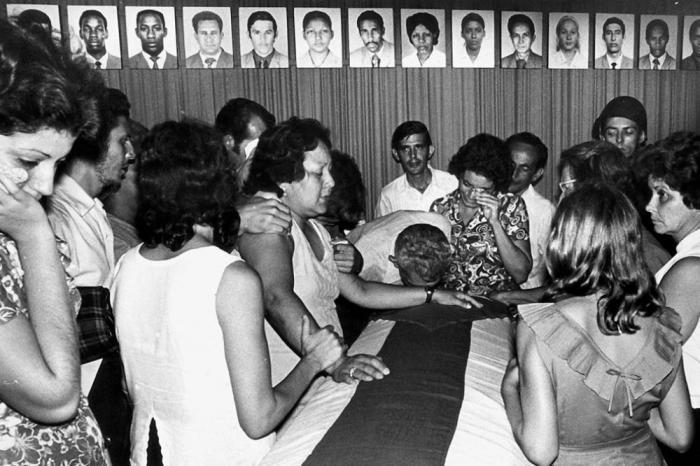
They say that in those days, the pain multiplied and the life of the nation came to a complete standstill. Revolution Square in Havana was a sea of people—mournful, deeply moved, and outraged.
The newspapers of the time immortalized those scenes that still move us deeply: mothers bowed over photographs of their sons, as if trying to breathe life back into them; others clinging to bodies that were no longer there. And the photographs—now eternal—of those young men returning triumphant from Caracas, or of their comrades here, standing the most harrowing honor guard, overcome with emotion.
It was all etched into the collective memory, as was Fidel’s phrase, repeated like an unending echo: "When an energetic and virile people weeps, injustice trembles." That day in the Plaza, the Commander spoke beautiful, heartfelt words: "Their medals will lie at the bottom of the ocean and rise to the Homeland’s Olympus."
Yet the very people who instigated that act ensured that its perpetrators never paid for the crime. Orlando Bosch was pardoned, and Luis Posada Carriles died with impunity, never having to answer to justice. Meanwhile, Cuban families continued to lay flowers, mark the passing years, and endure the pain of absence.
Impunity inflicted a second wound upon the loss: the knowledge that those who sowed terror were able to grow old in peace, walk free, and sleep without guilt, while a mother kept speaking to a photograph and a daughter learned to love a father she knew only through stories.
Every October 6th, Cuba relives the pain of that day: the lump in the throat, the shared embraces, the absence that takes a seat at the table. As long as memory endures and justice remains unserved, the wound of Barbados will continue to ache. It will ache even if impunity masquerades as oblivion, for that injustice weighs heavy, like an eternal d


