

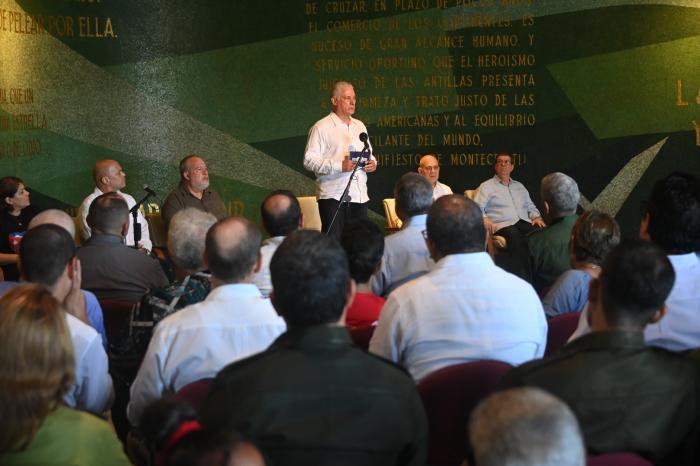
Miguel Díaz-Canel Bermúdez, First Secretary of the Central Committee of the Communist Party and President of the Republic, described the gathering held on the morning of October 6 at the José Martí Memorial in Revolution Square as an act of remembrance, but also of resistance. The event paid tribute to the victims of the Barbados bombing—a terrorist act that claimed the lives of 73 innocent people.
"It is a meeting," he added, "in which we are emphasizing historical memory; a moment to denounce impunity and a time to reflect and reaffirm our convictions within the complex context we are currently living through."
Analyzing the legacy this event left for the Cuban people, he emphasized that it serves as a source of inspiration. It strengthens the resistance and courage needed to continue defending the Revolution amidst adversity, to reject the designs of the empire, to overcome that genocidal and terrorist policy, and to continue consolidating the enduring victory of the Cuban Revolution.
The meeting was attended by family members and colleagues of the victims of the Barbados bombing and other terrorist attacks against Cuba, young members of the national fencing team, combatants from the FAR and Minint, scholars, and prominent figures from various sectors of society.
The members of the Political Bureau participated, Manuel Marrero Cruz, Prime Minister, and Roberto Morales Ojeda, Secretary of Organization of the Central Committee of the Party; Yuniaski Crespo Baquero, head of the Ideological Department of the Central Committee; and the Hero of the Republic of Cuba Gerardo Hernández Nordelo, national coordinator of the CDR, who moderated the exchange, in addition to other leaders of the Party, the State and the Government.
Cristina Valenzuela Corcho, daughter of Adriana Corcho, who lost her life on April 22nd, 1976 along with Efrén Monteagudo, victims of the terrorist attack against the Cuban embassy in Portugal, stated that she was aware that the relatives of all the victims of terrorism are in the hearts of the people, an accompaniment that she has felt during these 50 years.
And this shows us - he said - that the history of which they are part can not only remain in books so that future generations know it, but that it is something that we are living every day.
Ileana Alfonso, daughter of Demetrio Alfonso, one of the victims of the Barbados crime, said she was proud to have fulfilled her father's dream, who wanted her to graduate in Physical Culture and start her working life from the bottom. However, although she has satisfied what he wanted, that has not alleviated the permanent suffering of her family and her, who was not able to grow up under her father's guidance.
A veteran INDER employee, Ileana urged young athletes to draw inspiration from the 24 fencers who returned home in 1976, rejoicing in having won every gold medal contested in their sport at the Central American and Caribbean Games. However, she told them, this requires dedication and discipline—qualities that would enable them to represent their homeland and the heroic people of Cuba in any athletic competition.
Seily Mendoza, a fencer and Central American champion, recalled the dreams of the young people whose lives were cut short by such hatred during the mid-flight sabotage of the Cubana airliner. It was a sacrifice, she said, that inspires new generations to commit themselves to their country and strive to bring the best results home to the people.
Antonio Guerrero—one of the "Cuban Five"—recalled that they were very young when the Barbados atrocity occurred, yet they resolved to defend the Revolution at any cost. It was events like that, he noted, that turned them into anti-terrorism fighters; for we Cubans—he said, echoing Fidel’s words from that time—"are an energetic and virile people who resist, and injustice will continue to tremble; challenges will persist, but a whole people stands ready to defend the Revolution."
CONDEMNING TERRORISM IN ALL ITS FORMS
This was a gathering where the President wished to speak, above all, as a member of the generation born in the early years of the Revolution—a generation whose lives have been largely defined by the blockade and the abominable crime of Barbados. It is a matter, he noted, that has always been deeply felt by revolutionaries and one we must bear in mind when looking back at our history to find answers for the present day.
Recalling the somber yet epic days experienced by the people following the mid-air bombing of the Cubana de Aviación aircraft on October 6th, 1976—events marked by Commander-in-Chief Fidel Castro Ruz’s historic funeral oration—Díaz-Canel emphasized the heart-wrenching nature of the experiences endured by the victims' families in the wake of that heinous act.
"Those testimonies, those experiences, and those life stories—which you have carried in your hearts and minds all these years—are truly heart-wrenching," the President stressed. For him, this exchange at the José Martí Memorial was a gathering for all of Cuba—and especially, he noted, for our youth—"because our truths must be shared; they must be repeated. We must bring them into the present moment we are living through, so that we may find answers."
In the tribute to the victims of the horrendous terrorist act in Barbados, sponsored, organized and financed by the CIA, the Head of State highlighted the presence of a representation of young Cuban fencers. The one in Barbados, he told them, was "a flight of hope". "There were no terrorists there, there was no one who had done anything against the United States."
"Therefore, this terrorist act was also an act of revenge, senseless revenge, revenge without any argument that could justify it. It was an act of resentment, of arrogance. "And they acted against the innocence of those who were on that flight."
And among them, he added, were the members of the youth fencing team, who had a successful performance, with their gold medals. How much joy would there be on that flight, how many desires to meet that they could never achieve? —Díaz-Canel asked himself when he then remembered Fidel's words, when he said that they, with their medals, were elevated to the Olympus of the martyrs of the country.
At another point in the analysis of the attacks that our country has been the victim of to date, the President pointed out that between Cuba and the United States there is an asymmetric relationship in which the aggressors are them, and the attacked are us.
"But the fact is," he remarked, "that those who were attacked could not be defeated, because they neither surrendered nor will they surrender. They have fought, are fighting, and will continue to fight."
"And therein lies the importance," he added, "of keeping that historical memory and those truths intact in our minds, hearts, and feelings—and of continuing to pass them on, share them, and nurture them with our children, our grandchildren, and the generations yet to come."
Addressing participants at a gathering to honor the victims of terrorism against Cuba—terrorism fostered and supported by the United States government—Díaz-Canel reiterated his condemnation of the impunity and double standards applied by hegemonic powers, such as placing a country that has itself been a victim of terrorism on a list of nations that allegedly support terrorism. And this is done by the very country that has supported terrorism more than any other in the world, he asserted.
"Furthermore," he added, "the perpetrators of the crime—the attack on the Cubana de Aviación flight—Orlando Bosch and Luis Posada Carriles, faced no punishment whatsoever; they remained unpunished."
"And it is clear," he later clarified, "that this impunity was the result of a political decision by the United States government; it was neither an oversight nor a case of forgetting—it was simply a political decision made by the United States."
In the face of the U.S. government's despicable, genocidal attitude, Díaz-Canel upheld the true ethical spirit of Cuba and the Cuban people. "We do not overcome hatred by generating more hatred," he said. "We overcome hatred in this way: by prevailing, resisting, creating, and striving to remain true to that history and that legacy."
For all these reasons—the leader asserted—"fifty years after the Barbados crime, we have every right as a nation and a people to demand the declassification of CIA files regarding the attack. We have every right as a nation and a people to demand that the United States stop shielding terrorists operating from its territory."
Reflecting on the legacy and enduring relevance of those events, Díaz-Canel noted that we cannot forget them, because terrorism has not ceased in the present day; violent actions against our country continue to unfold, and the United States persists in fueling terrorism on a global scale.
After denouncing the acts of aggression Cuba currently faces—including a prolonged blockade that has been intensified and now compounded by an energy embargo—the First Secretary of the Party Central Committee and President of the Republic described the tribute to the victims of the Barbados terrorist attack as "an act of remembrance, a gathering of remembrance, but also a gathering of resistance." He reaffirmed to the families of terrorism victims—as he has throughout the years—that "their pain is our pain; it is the pain of our entire people."
"We know there is no possible solace for such great pain, yet there is an entire people who embrace you, who speak your names every October 6th, and who will never cease demanding justice and the truth. Therefore, every October 6th, as we reflect on these events, we must view it not merely as an anniversary of sorrow, but as an anniversary of reaffirmation—a time to reaffirm our condemnation of terrorism in all its forms."
"Your pain is ours; you are not alone; your memory is ours, and your cause remains the cause of all Cuba," affirmed Díaz-Canel, reiterating that "with the same steadfastness as fifty years ago, Cuba does not surrender, Cuba is not for sale, and Cuba does not forget."


