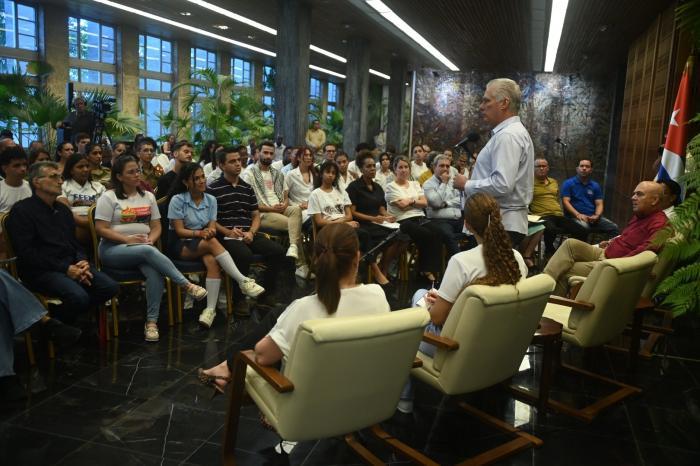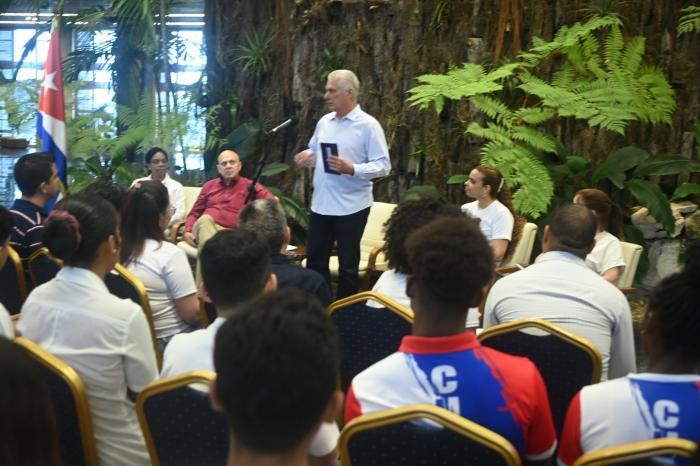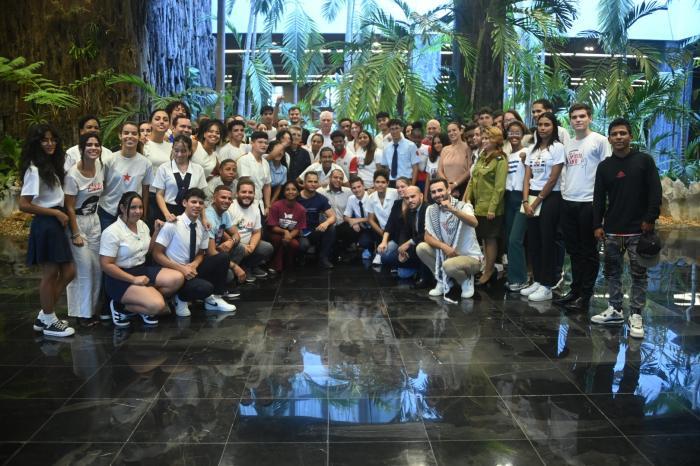
The meeting held this Thursday morning at the Palace of the Revolution between the country's leadership and a group of young people was deeply moving—for a man like Che stirs such emotions when remembered—and at times so stirring that it even brought a tear to the eye. It was October 8, and it was impossible not to recall the legacy of the "Heroic Guerrilla," who had fallen in combat on that day.
"Che Guevara has not died; Che Guevara has multiplied," remarked Miguel Díaz-Canel Bermúdez, First Secretary of the Central Committee of the Communist Party of Cuba and President of the Republic, during the exchange. The sentiment rang true: every young person who spoke that Thursday was proof that new generations are rising up to make history—and know how to do so. It was evidence that, amidst the difficult times facing both the world and the Island, a human network of young people upholds the Guevarist humanism of a Revolution whose core of resistance lies precisely in the sensitivity of its children.
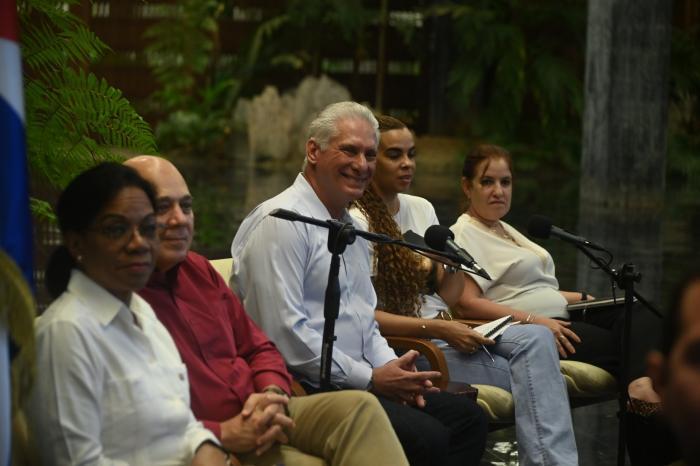
Meyvis Estévez Echevarría, First Secretary of the National Committee of the Young Communist League (UJC), opened the discussion by speaking about reconnecting with his political thought—keeping it as present and alive as his enemies did not want it to be. The event was also attended by Roberto Morales Ojeda, a member of the Political Bureau and Secretary of Organization of the Party's Central Committee; Deputy Prime Minister Inés María Chapman Waugh; and other officials.
The opening remarks invited reflection: Carlos Tablada, a Doctor of Economic Sciences and president of Ruth Casa Editorial, expressed his honor at being among the young people. He shared details of his meticulous research into the economic thought of Ernesto "Che" Guevara—work compiled in a book that, during the 1980s, significantly and positively stirred the thinking of Cuban society, which remains challenged by the book's content to this day.
"Always be rebels; never be content with the status quo," Tablada told the young audience, noting, among other things, that Che Guevara possessed a broad cultural background. Tablada recalled the "Heroic Guerrilla's" ethics—"the day we lose our ethics," he said, "we lose everything." Touching on the importance of study and independent analysis, the economist recalled how Che Guevara had predicted the collapse of the Soviet bloc twenty-five years before it happened.
Next, Daily Sánchez Lemus, a Doctor of Historical Sciences, shared her perspective. She described October 8th as a "very special day," noting the beautiful moments experienced in Cuban schools as new generations paid tribute to Che Guevara. Speaking about this extraordinary figure, the historian highlighted the responsibility Cubans bear to ensure that his legacy endures.
Children, she reflected, need to know why we want them to be like Che Guevara. The Heroic Guerrilla, she said, "bears the historic responsibility of being present, of being among those who are forever being born." She emphasized his extraordinary enduring relevance, noting that the more difficult the circumstances, the greater the resonance of his anti-imperialist zeal, the lessons of his example, and his commitment to always doing things better—"that 'something more' Raúl has spoken of."
On Thursday, Daily discussed how Che Guevara’s figure is among the most frequently attacked—making it essential to carry his legacy "beyond the statue"—as well as the need to deeply understand who he was and the open, honest friendship he shared with Fidel and Raúl. She also posed a question: "In the highly hostile context we live in, what would Che Guevara do? We must ask ourselves that question and answer it in the best possible way."
GUEVARIST VOICES
As voices rose in the Portocarrero Hall of the Palace of the Revolution, it became evident that new generations are advancing firmly along the arduous path of resistance. The audience was merely a microcosm; within that small space, one could sense the leadership and rich experience born of the Community Youth Network—a force whose impact on the Cuban landscape is already undeniable.
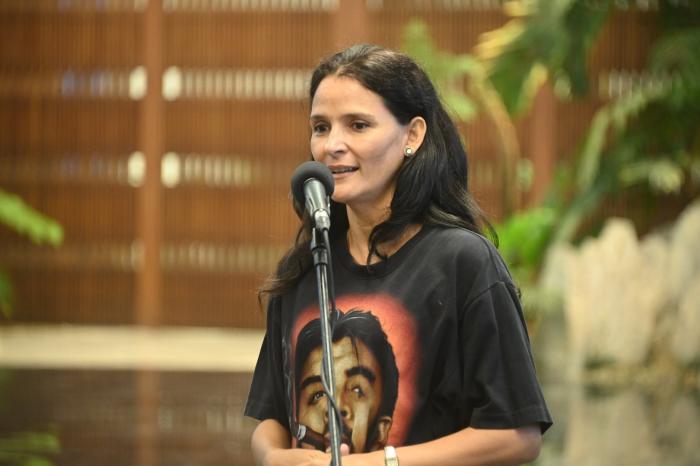
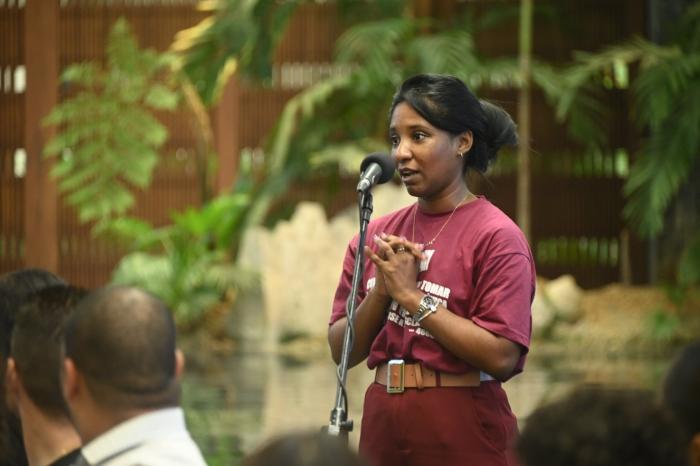
Leanet Proenza del Hoyo, lead coordinator of the *Farma Joven* (Young Pharmacy) project—a solidarity initiative of the UJC (Young Communist League)—recalled how Che Guevara always stepped forward to take action, noting that it is now up to young people to do the same. She described how, within their sphere of activity, new generations are supporting those in need and helping to provide medication.
More than a thousand citizens are already communicating via digital networks, particularly WhatsApp: "We have gone into communities, delivering medication to anyone without the means—to that elderly person who needs it so badly. You have to knock on doors. We have reached nursing homes, children's homes, and maternity homes," said Leanet, who also shared that they receive the medicines from youth organizations around the world.
Regarding *Farma Joven*, President Díaz-Canel Bermúdez remarked that it embodies a "totally Guevarist attitude," reflecting a deep sensitivity to the problems of others: "Che was deeply moved by the plight of anyone at a disadvantage. That is what led him to the highest level of solidarity: proletarian internationalism," the Head of State reflected.
Dr. Alejandra de la Cruz Moreno, a recent graduate and coordinator of the Farma Joven network in East Havana, also spoke. She explained that the network has not focused solely on their own province, as it has expanded beyond those borders. She then shared the story of how some thirty young people contributed their expertise at the Centro Habana Pediatric Teaching Hospital; there, they carried out various missions, stood shifts, and established a contingent ready to step in "whenever needed."
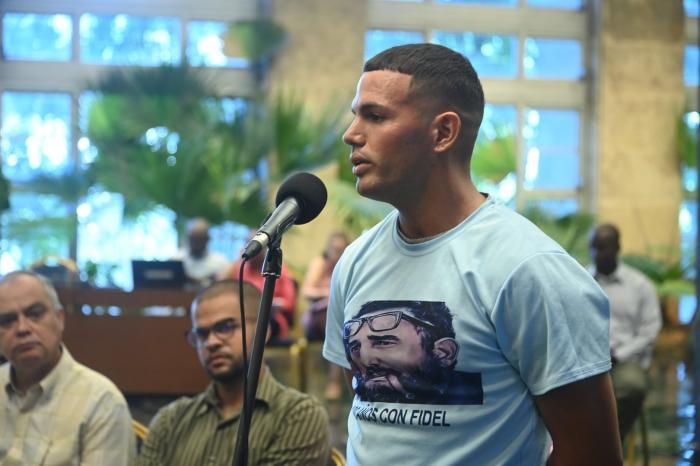
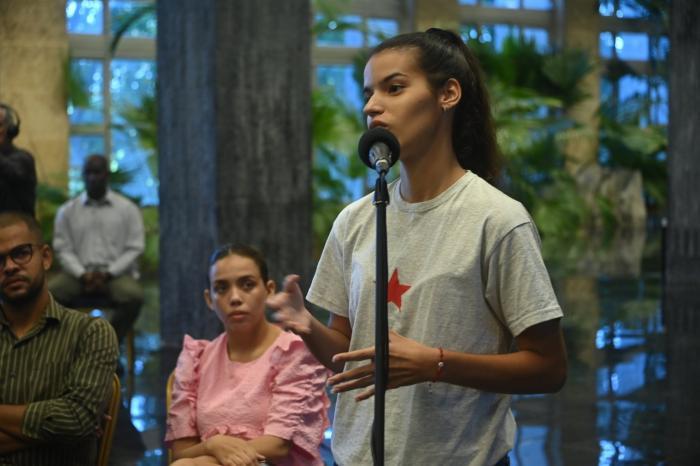
Young people from several Community Youth Networks spoke, sharing accounts of delivering meals to children, organizing mobile cinema screenings, and conducting training courses for social workers. They also spoke of how, despite the intense hatred directed at the Island, Cubans—as heirs to Che Guevara’s legacy—know how to fight without losing their tenderness.
At this point in the proceedings, President Díaz-Canel brought up the concept of the "New Man"—a concept so well-grounded and championed by Che Guevara, and so effectively fostered by Fidel. Addressing the young people, the Head of State said: "You, too, are new men and women, but we must continue to nurture that concept. We cannot build a better world without the New Man."
The young people continued to raise their voices: future engineers, future athletes, and a university professor who spoke of how Che Guevara "compels us to constantly look at ourselves." The series of speeches concluded with a Palestinian student—an orthopedics resident and graduate of the Latin American School of Medicine (ELAM).
His testimony was particularly moving; hailing from the Gaza Strip, he recounted Che Guevara’s visit to his homeland and described how the Guerrilla fighter saw in the eyes of the Palestinian people an unyielding spirit—a people who knew nothing of surrender.
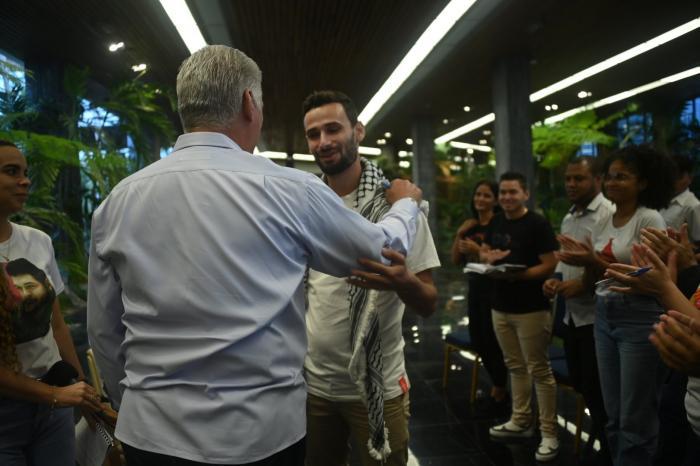
The suffering of both his people and the Cuban people inevitably came to the fore. His words were filled with gratitude for the way the Island had welcomed him and hundreds of his compatriots with open arms. It was deeply moving to hear him speak of how the Palestinian people have donated medicines to Cuban hospitals. The young man asked to embrace the President—and did so—explaining to everyone that, in doing so, he felt he was embracing the people of Cuba.
HONORING CHE GUEVARA EVERY DAY
"We could spend the whole day talking with you," the Head of State remarked toward the end of the exchange. He highlighted that Che Guevara "is present every day in the work being done in the country and in the leading role our youth are playing at this time."
After noting the growing prominence of the Community Youth Network, Díaz-Canel stated that the tribute to the Heroic Guerrilla is significant "because we are holding it during the centenary year of Commander-in-Chief Fidel Castro Ruz."
The friendship between Che Guevara and Fidel—that "tremendous affinity based on principles"—was another topic the leader reflected upon. He affirmed that both men were altruistic, both led by example, both were willing to lay down their lives, and both were rigorous students of Marxism who were critical of poor interpretations of the ideology.
The President recalled historic moments that stand as testaments to the "mutual admiration" binding these two exceptional men: Che Guevara’s farewell letter, in which the Heroic Guerrilla explicitly expressed his profound admiration for his brother Fidel; and the Commander-in-Chief’s own admission: "I still dream of Che Guevara."
The Cuban President highlighted the importance of Daily’s call for the motto "We will be like Che" to be more than just a slogan—to be something deeply felt. "Being like Che is very difficult," the leader remarked, adding that simply aspiring to emulate the "Heroic Guerrilla" brings one much closer to embodying his virtues.
"There are people who cannot fathom how we are managing to resist," the Head of State noted at another point, explicitly stating his view that Che Guevara’s legacy lives on in the refusal to bow down before the empire.
It was inevitable that the President would recall moments in his own life where Che Guevara played a significant role; his native city of Santa Clara was the setting for unforgettable events involving the Heroic Guerrilla. Díaz-Canel recounted the arrival of the remains of the Guerrilla and members of his Reinforcement Detachment in this central Cuban province. He spoke of the men and women deeply moved as they stood before the niches; he recalled, for instance, how the Spanish dancer and communist militant Antonio Gades was visibly overcome with emotion inside the Mausoleum, standing before the stone slab marking the resting place of the Guerrilla’s remains.
The leader shared further reflections and sentiments regarding the legendary figure, speaking of his revolutionary ethics, his austerity, his honesty, and the high standards he set for himself. "Che was always ready to give everything without asking for anything in return," said Díaz-Canel, who also emphasized the value the Guerrilla placed on moral incentives.
After years of study, the development of ideas, and preparation, the Cuban President has deepened his conviction—as he stated this Thursday—that "we must revisit the concepts of the 'New Man'."
For a better world to be possible, he asserted, "we must defend it with the values of the 'New Man'." And, addressing the fierce war waged by the empire against the Island, he concluded his remarks with a Guevarist spirit: "the present is a time of struggle; the future is ours."