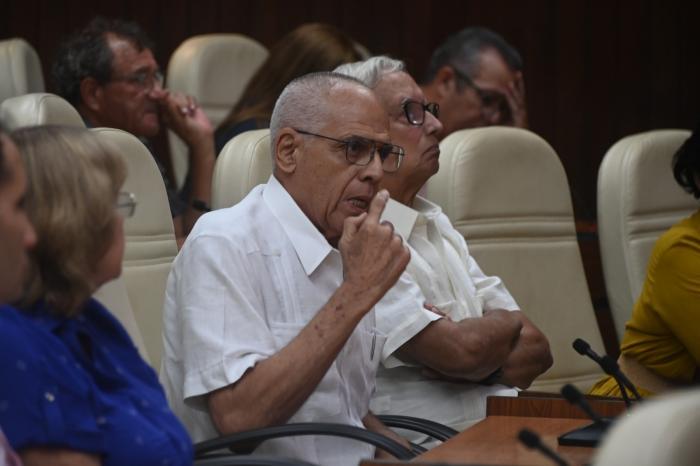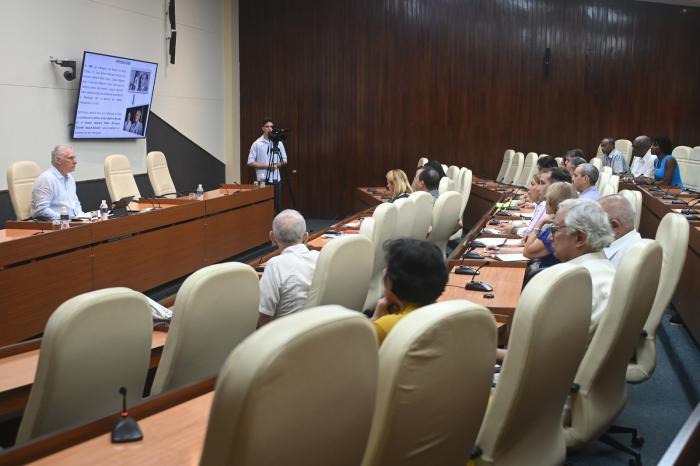
The Cuban Revolution’s political commitment to prioritizing care for patients with chronic kidney disease (CKD)—and to developing the field of nephrology, a specialty championed by Commander-in-Chief Fidel Castro Ruz—was reaffirmed by Miguel Díaz-Canel Bermúdez, First Secretary of the Central Committee of the Party and President of the Republic.
Studies indicate that one in ten people in Cuba faces this disease—a trend mirroring the global situation, where approximately 850 million individuals are affected. This information was shared during the Head of State's regular meeting with health experts and scientists.
On this occasion, the discussion focused on the work of the Institute of Nephrology (INEF), a research center with a tradition of scientific development and a culture of innovation that will celebrate its 60th anniversary on December 1st.
Highlighting the priority the country places on patients suffering from chronic kidney disease, the Cuban President noted that amidst current challenges—specifically the energy blockade imposed by the U.S. government and fuel shortages—one of the National Health System's initial solutions was to allocate electric vehicles to transport patients to hemodialysis services.
The meeting was attended by officials including Deputy Prime Minister Eduardo Martínez Díaz and the Minister of Public Health, José Angel Portal Miranda. The latter led a discussion acknowledging the work of an institution established at the Joaquín Albarrán Hospital by Drs. Abelardo Buch López, Charles Magrans Buch, and Reinaldo Mañalich Comas, acting under the direction of the then-Minister of Public Health and Rebel Army Commander, José Ramón Machado Ventura.
Dr. Yamilé García Villar, Director General of the Dr. Abelardo Buch López Institute of Nephrology—the national reference center for the specialty—noted that Cuba operates a national network comprising 450 polyclinics and medical offices. This network is staffed by 348 active nephrologists, 246 residents, over 1,600 nurses, and more than 600 technicians.
Currently, 3,856 patients suffering from chronic kidney disease are receiving care in the country; of these, 2,876 undergo hemodialysis (including 22 in pediatric units), and 900 are kidney transplant recipients.
Regarding the Institute's primary clinical activities, Dr. García Villar highlighted services such as hemodialysis, peritoneal dialysis, endourological surgery, and kidney transplantation—a procedure that has benefited more than 6,000 Cubans throughout the Institute's history.
The Institute of Nephrology currently has 36 ongoing research projects and is a leader in the sector-wide Dialysis Project; it also runs around ten doctoral and master's degree programs and various educational initiatives, all aligned with the center's research priorities.
Regarding the Dialysis Project—an initiative in an advanced stage of development—the INEF’s Director General explained that its goal is to manufacture a reuse machine, a hemodialysis machine, and dialyzers.
"It is a device that will make a decisive contribution to the dialysis program, which is extremely costly and consumes a significant portion of the national public health budget, despite serving a relatively small number of patients," noted Dr. García Villar.
The Institute of Nephrology is also collaborating with BioCubaFarma scientific centers on several clinical trials—such as one evaluating a vaccine candidate for patients with chronic kidney failure—among other Cuban scientific advancements made over the last five years.
The INEF, considered the *alma mater* of Cuban nephrology, is working to establish a new paradigm focused on the early identification of risks associated with chronic kidney disease. This high-impact condition often goes untreated because patients die from related causes, such as cardiovascular disease.
This was explained by Dr. Raúl Herrera Valdés—a leading national and international scientific authority in the field—who warned that while more than 700,000 people in Cuba likely suffer from chronic kidney disease (CKD), only 25,000 are officially registered in the healthcare system for the condition.
Herrera Valdés emphasized that CKD is a disease with an enormous social, economic, and human impact; it is a lifelong, progressive condition that proves fatal for many. He highlighted the importance of early diagnosis and prevention, noting, for instance, that one-quarter of people with high blood pressure go on to develop CKD.
Regarding early diagnosis and disease progression, renowned nephrologist Dr. Jorge Pérez-Oliva Díaz—president of the Cuban Society of Nephrology—highlighted BioCubaFarma’s contribution to CKD treatment through the development of key products.
"Without BioCubaFarma," he stated, "we would not have been able to scale up hemodialysis and peritoneal dialysis treatments."
The scientist also underscored the role of the recombinant hepatitis B vaccine—produced by the Center for Genetic Engineering and Biotechnology (CIGB)—in preventing chronic kidney disease, as well as the production of recombinant human erythropoietin by the Center of Molecular Immunology (CIM).
Dr. Guillermo Guerra, head of the National Nephrology Group, analyzed the importance of establishing the necessary clinical, epidemiological, and social framework for CKD prevention and treatment—an area requiring continued effort for the benefit of the Cuban people.