In the midst of the difficulties and shortcomings imposed by the most ferocious blockade, Health professionals and workers overcome daily obstacles, in what constitutes part of the heroism of the Cuban people.
This Thursday, the First Secretary of the Central Committee of the Communist Party of Cuba and President of the Republic, Miguel Díaz-Canel Bermúdez, arrived at the William Soler University Pediatric Hospital, one of the most recognized medical institutions in the country.
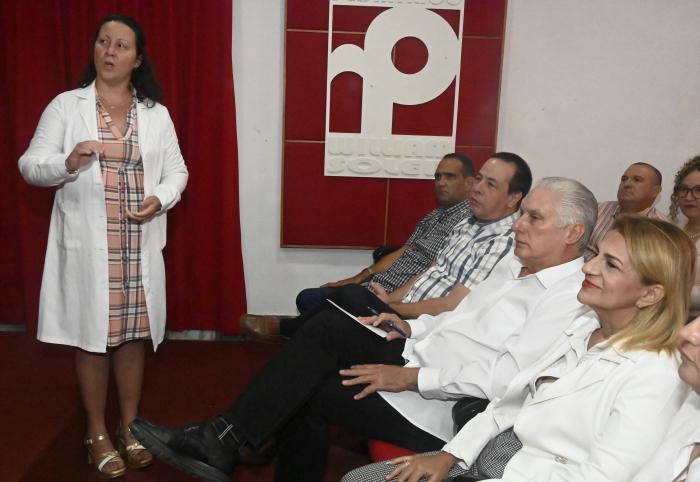
Accompanied by the Minister of Public Health, José Angel Portal Miranda, and the highest authorities of the Party and the Government in Havana, the president exchanged with directors, leaders of the political organizations of the center and specialists. These, in very complex circumstances, have not closed a single service, because for Cuba the most important thing will continue to be the smile of its children.
The Head of State valued that "as part of what we did in these difficult times, and how we overcame them, we will always have to highlight an important space for everything that the Health personnel did, without fuel, without transportation, without medicines, without energy."
In that sense, he reasoned that “having maintained Health services at these levels is impressive; and only a heroic people and a committed staff can achieve things like this.
"You are part of that victory that we obtained at the UN, because that respect for the country has to do with what you have done in Cuba and in the internationalist missions," said Díaz-Canel.
In the meeting with the Cuban President, the director of the hospital, Dr. Alena Fontane Valdés, offered a detailed explanation of how much is done at the renowned William Soler in important programs, including: Regional Center for neonatal surgery, National Reference Center for pediatric liver transplantation, National Reference Center for airway surgery and autologous esophageal transplantation; as well as a National Reference Center for stem cell implantation for Duchenne muscular dystrophy, and for obstetric brachial palsy surgery.
During the dialogue, the directors of the medical institution highlighted that, in a very harsh scenario, where the Health system is strongly hit by the impacts of the blockade imposed by the North American government, improvements are seen in important hospital indicators, such as the increase in the survival of critical and ventilated patients in neonatal therapy, and the survival of critical patients in intensive care.
The Cuban leader took an interest, among other matters, in the implementation of economic and social transformations aimed at advancing various processes underway at this hospital, which serves children and adolescents from different parts of the country. He also emphasized the benefits of digital transformation and the steps the institution is taking along this essential path.
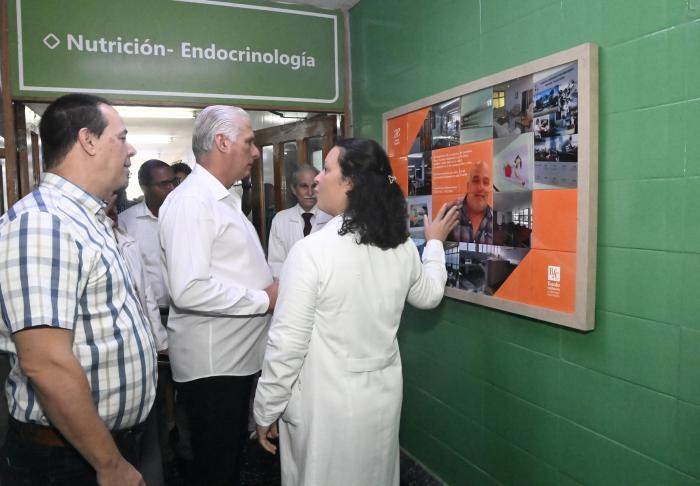
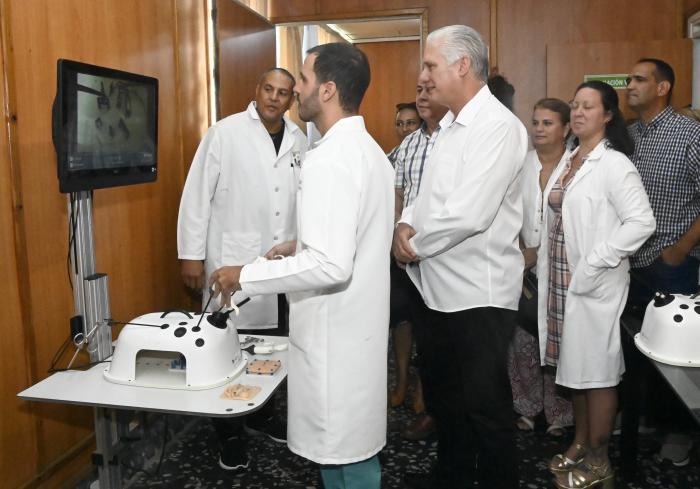
The Cuban President toured several areas of the William Soler Hospital, including the virtual simulation classroom for surgeon training, the telemedicine department, and the surgical ward, where he greeted patients and their families.
A LOOK AT THE CAPITAL’S WATER SUPPLY: THE BENIGNO SOURCE
The Cuban leader’s workday also included a visit to the Benigno water source, as part of his ongoing, systematic review of the Comprehensive Program for Ensuring Water Supply in Havana.
This well field, located south of the Cotorro municipality, serves as a supplement to the capital’s eastern water system and provides water to approximately 58,000 residents in the San Miguel del Padrón municipality.
This was explained to the press by engineer Yosvany Rubí Bazail, General Director of the company Aguas de La Habana, who detailed the measures being taken to increase water volume and improve service to the population.
He noted that the work is primarily focused on infrastructure improvements. Regarding the Benigno well field, all civil infrastructure-related tasks have already been completed, Rubí Bazail confirmed.He further pointed out that a program to eliminate water leaks is currently underway, alongside the installation of additional pumping equipment. During a discussion with the President of the Republic, a comprehensive review was conducted regarding the progress of a strategy—which includes a range of solutions utilizing distributed generation and renewable energy sources—aimed at addressing the energy deficit that is hindering water pumping to the capital.
As explained by the Director General of Aguas de La Habana, regarding the first phase of the program—carried out in coordination with the National Electric Union to provide backup power at water supply sources—"large generator sets are currently being installed to power these pumping stations, and a series of tests are already underway, yielding satisfactory results."
Rubí Bazail confirmed that the objectives set for the first phase are being met, "though service disruptions persist due to the ongoing energy crisis."
The goal, he noted, is to ensure that major water supply sources have reliable power, which will allow for the progressive restoration of water supply systems over a set period.
During a meeting to monitor the implementation of this comprehensive program, Díaz-Canel inquired about the causes behind the service disruptions experienced in the capital over the last few days.
It was explained that the situation was caused by major breakdowns in water transmission mains—such as the Cuenca Sur system—as well as the failure of pumping equipment at several sites (awaiting the import of spare parts) and adjustments made to power lines being installed for the generator sets.
In the exchange, the President of the Republic called for continuing to work in a coordinated manner, with the aim of reducing the effects on the water supply and increasing the volumes of the precious liquid, actions that are aimed at guaranteeing services for the Havana population.
The member of the Political Bureau, Army Corps General Álvaro López Miera, Minister of the Revolutionary Armed Forces, also participated in the visit to the Benigno water supply source; the deputy prime minister, Inés María Chapman Waugh; the head of Energy and Mines, Vicente de la O Levy; the president of the National Institute of Hydraulic Resources, Antonio Rodríguez Rodríguez; as well as Liván Izquierdo Alonso, first secretary of the Provincial Committee of the Party; and Yanet Hernández Pérez, governor of Havana.