


"Healthcare is a core social achievement of the country, and for that very reason, it allows for no neglect; it is the sector where the population is most demanding, and where any failure is immediately felt in the lives of families," stated Miguel Díaz-Canel Bermúdez, First Secretary of the Central Committee of the Communist Party of Cuba and President of the Republic.
The Head of State presided over the concluding session of a multi-day visit carried out by members of the Party’s Central Committee and its auxiliary staff to the Ministry of Public Health (MINSAP), as well as to primary, secondary, and tertiary care institutions and entities within its enterprise system.
These exchanges—which involved conversations with hundreds of Cubans, including administrators, specialists, workers, patients, and the families of those using medical services—are part of the Party leadership’s working system. The goal is to monitor the implementation of economic and social transformations across various sectors, while providing support and methodological guidance to grassroots organizations to improve their functioning, internal operations, and influence within their respective areas of activity.
In discussions with Party members and the management teams of the Ministry of Public Health, various healthcare centers, and enterprise entities, Díaz-Canel emphasized that in Cuba, healthcare is upheld as a universal right. He noted that this visit reaffirms the principle "that healthcare in our country is a fundamental human right—an achievement of the Revolution—and not a commodity or a privilege." The First Secretary acknowledged "the altruism, ethics, and professionalism of healthcare workers, who—while facing the same shortages as the general population—transform challenges into motivation to seek alternative solutions."
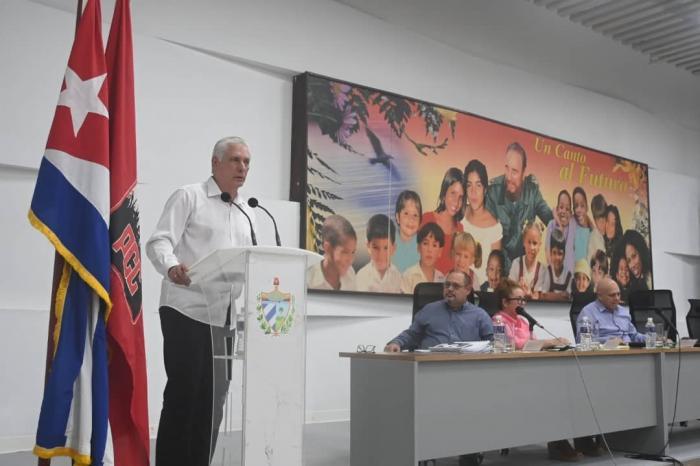
At the beginning of his remarks, the President highlighted that this exchange with healthcare workers—who are widely admired for the work they are carrying out during such difficult times—was taking place just hours after a victory for the nation at the United Nations. For the 34th consecutive time, the majority of the world’s countries and peoples reaffirmed their condemnation of the genocidal blockade imposed on us by the United States for more than 60 years.
After analyzing the significance of this year’s victory for Cuba over U.S. imperialism—and over the policy of blackmail that the U.S. applied to dozens of governments around the world—he emphasized that this also served as "a recognition of the heroism, courage, resilience, and capacity for creative resistance of the Cuban people."
And these values—he noted later—also encompass "the heroism and the contribution of all healthcare personnel to that resistance."
"It is also because of you," he affirmed, "that there is such admiration for Cuba—and commitment to Cuba—among peoples and many governments; therefore, I believe you should consider yourselves key players in the victory we achieved yesterday at the United Nations."
HEALTHCARE: AN INALIENABLE RIGHT
The visit by the Party’s Central Committee and its auxiliary structure to the Ministry of Public Health (MINSAP)—as well as several of its institutions and entities—was marked by a profound, critical, and self-critical analysis of healthcare and operational activities, as well as the work of the Party and its grassroots organizations.
The final working session was led by Political Bureau members Roberto Morales Ojeda—Secretary of Organization of the Party’s Central Committee—and Prime Minister Manuel Marrero Cruz, alongside Yudi Mercedes Rodríguez Hernández, a member of the Central Committee Secretariat and head of the Department for Oversight of Services.
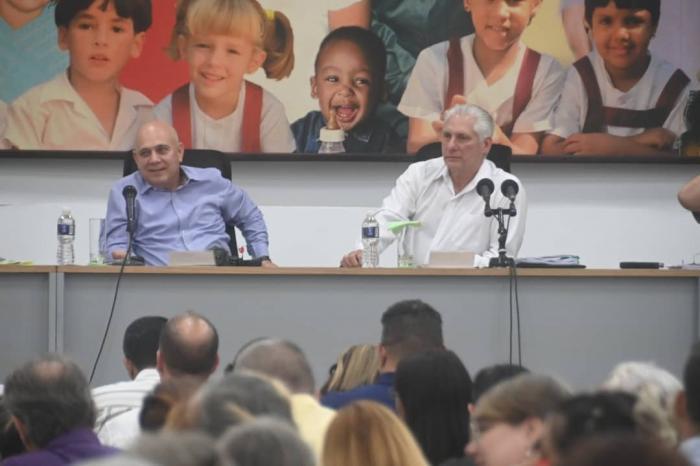
With the participation of Deputy Prime Minister Eduardo Martínez Díaz—among other leaders from the Party, the Government, the Young Communist League (UJC), and the Workers' Central Union of Cuba (CTC)—the session was moderated by Dr. Rolando Ernesto Yero Travieso, a member of the Central Committee and head of the Department for Oversight of the Social Sector.
In a summary of the Ministry of Public Health’s performance—amid the difficult conditions imposed by an economic, commercial, and financial blockade that is intensifying day by day, as well as an energy-related siege—Dr. José Ángel Portal Miranda, the head of the Ministry, pointed out that the sector’s complex situation presents economic, social, demographic, technological, health-related, and organizational challenges. This has led to significant limitations that are affecting the performance of the National Health System and generating "justified dissatisfaction among the population regarding the services we provide." It was noted that, despite existing shortcomings and deficiencies, the implementation of the Economic and Social Transformations recently approved by the Party, the National Assembly, and the Government should be leveraged to begin addressing the objective and subjective challenges facing the healthcare system.
It was highlighted that, notwithstanding the persecution and smear campaign orchestrated by the U.S. government—including sanctions against entities responsible for the export of medical services—Cuba continues its steadfast, solidarity-based collaboration with over fifty countries. However, the drastic decline in revenue, caused by persistent imperialist aggression, has severely impacted financial resources, leading to a shortage of medicines, supplies, and other essentials—a situation that compromises both the quality of services and the health of the population.
Currently, there is a significant shortage of critical medicines, necessitating a daily effort to address not only this scarcity but also the lack of consumables, reagents, and equipment—particularly high-tech medical devices—which are in critically short supply, with serious implications for diagnosis and treatment.
Added to this—he noted—are the acute problems affecting engineering systems, elevators, boilers, power generators, laundry equipment, water supply, cold storage units, medical transport, and a wide range of other equipment. While recovery programs exist for some of these, they are insufficient.
Nevertheless, the Minister of Public Health (MINSAP) expressed confidence that the workforce of the National Health System will overcome these challenges through the successful implementation of the guiding documents issued by the Party, the State, and the Government—including established policies and, in particular, the 176 Economic and Social Transformations currently underway.
Reviewing the initiatives undertaken by MINSAP in recent years to maintain the vitality of its services, the Minister highlighted several key efforts: the updating of the Family Doctor and Nurse Program; the action plan to enhance the problem-solving capacity of primary healthcare; the Cuban healthcare quality strategy; the Maternal and Child Health Program; and the program to improve hospital management. These are among the initiatives developed recently, with others set to be launched in the coming months and years.
He underscored the ongoing commitment to human resource development, noting that there are 62 higher education institutions affiliated with MINSAP. Currently, nearly 99,000 students are enrolled in undergraduate and postgraduate programs—a significant figure that reflects the priority the country places on training and supporting healthcare personnel, as well as on international cooperation.
The National Health System—he added—also maintains a highly active scientific ecosystem, which serves as a foundation for the sector’s development, with 2,098 research and innovation projects currently in progress.
Today, despite existing limitations—Portal Miranda emphasized—not a single institution in the country has been closed. All our hospitals and polyclinics remain operational; while some services have been limited, none have been closed.
At the same time—he added—high levels of medical consultations and surgeries have been maintained. We are deeply concerned for those patients currently awaiting surgery due to resource constraints; however, we have continued to schedule procedures, prioritizing those that are life-critical.
Following an assessment of various indicators and statistics used to gauge the quality of services, Minister José Ángel Portal Miranda reaffirmed the commitment of healthcare workers to the nation’s guiding principle: that every necessary effort must be made to preserve the essence of the Cuban public health system. Health, he stated, is "an essential achievement of the Revolution—an inalienable right of our people."
ADMIRATION AND GRATITUDE FOR HEALTHCARE WORKERS
At the conclusion of a visit by the Party’s Central Committee to the Ministry of Public Health and several of its institutions, the First Secretary of the Central Committee—who also serves as President of the Republic—noted the consequences that the intensified blockade and the energy-sector siege are having on the Cuban people.
He pointed out that, currently, "more than 90,000 people are awaiting surgery; tens of thousands are facing disruptions to their radiotherapy, chemotherapy, or dialysis treatments; and over 34,000 pregnant women are either not receiving the full range of necessary care or are unable to undergo all the required medical follow-ups."
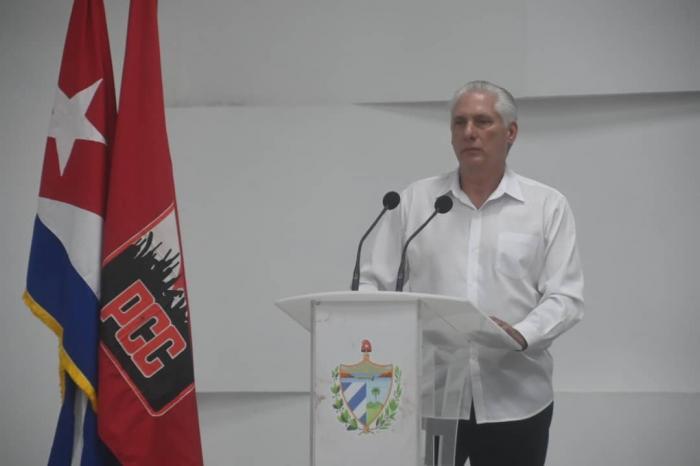
"We, who have always kept our vaccination program up to date—and who possess one of the most admired and robust vaccination systems in the world—are currently at 95 percent implementation of that program," he noted.
The President explained, however, that despite the severe limitations caused by the ongoing aggression, the country has managed to find solutions to many existing problems—such as energy shortages, the transport of patients (with priority given to those undergoing dialysis), ambulance services, and other critical needs—by leveraging the sensitivity and cooperation of all, an interdisciplinary approach, and renewable energy sources like solar panels and electric mobility.
The health sector, he pointed out, is not only one of the areas most affected by the consequences of the blockade and the energy siege; it is also the target of a media-driven campaign—due to its significance for both our people and the world. This includes a narrative they have attempted to construct—which no one actually believes—that claims Cuban medical brigades are a form of human trafficking.
This campaign, he explained, is being used to pressure a number of countries—primarily in the Caribbean and Latin America—to reject the presence of Cuban medical brigades. While some subservient governments have yielded to these U.S.-driven positions, the majority have maintained their support, a testament to the high regard in which these brigades are held.
Elsewhere in his speech, Díaz-Canel highlighted the National Health System’s implementation of 176 economic and social transformations, which aim—as he emphasized—to "correct distortions and revitalize the economy without abandoning our social achievements." With this economic revitalization, the transformations—he reiterated—will allow us to "make further progress in social justice and continue consolidating social programs and social achievements—healthcare among them."
Regarding the priority the Revolution places on this sector as one of our social achievements, he emphasized that, despite the highly complex situation the country is facing, 24 percent of the State Budget—amounting to over 76 billion pesos—continues to be allocated to public health, which underscores the political priority given to the sector.
The First Secretary of the Party’s Central Committee and President of the Republic reiterated the nation’s admiration and gratitude toward healthcare workers—our doctors, nurses, and support staff—who, he noted, manage to reach their workplaces every single day, despite long power outages and a lack of transportation, ensuring that primary care systems and essential health services remain fully operational.


